AQA · A-Level · History
Course version: 7042 · Version from Sept 2017
The role and influence on attitudes to empire of: nationalist leaders,…
Full specification wording
1J The British Empire, c1857–1967 – The winds of change, 1947–1967 (A-level only): The role and influence on attitudes to empire of: nationalist leaders, colonial administration
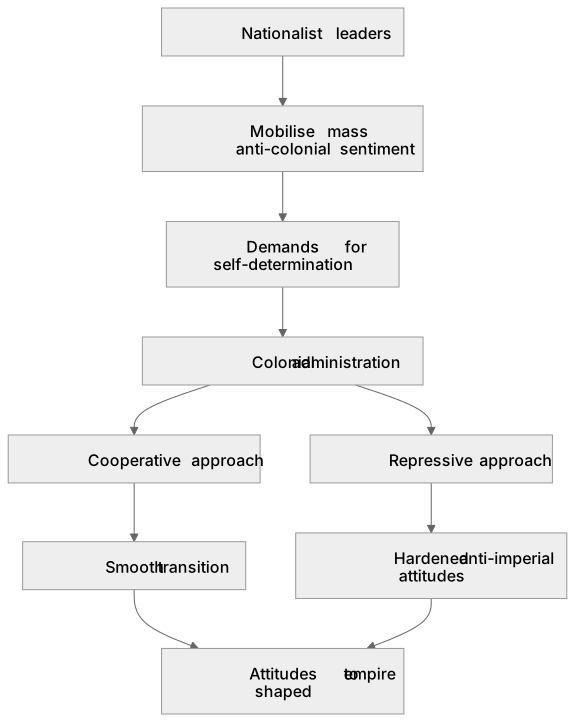
Between 1947 and 1967, attitudes towards the British Empire were profoundly shaped by the dynamic between nationalist leaders and the colonial administration.
Checked against the AQA 7042 specification (opens in a new tab) on .
- Point 4 of 6
- 2 key terms
Study notes
From the checked teaching notes for this specification point.
The idea
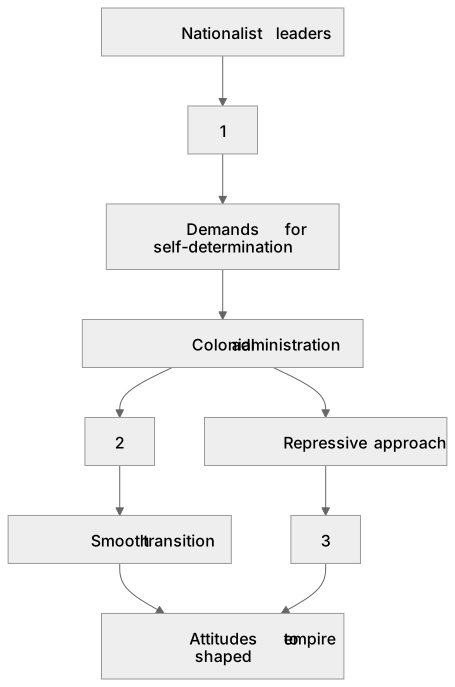
Between 1947 and 1967, attitudes towards the British Empire were profoundly shaped by the dynamic between nationalist leaders and the colonial administration. Charismatic figures like Kwame Nkrumah in the Gold Coast and Jomo Kenyatta in Kenya successfully mobilised mass anti-colonial sentiment, transforming local grievances into powerful demands for self-determination. Conversely, the colonial administration's response dictated the pace and nature of decolonisation. While administrators like Charles Arden-Clarke facilitated a relatively smooth transition by cooperating with nationalists, others, such as Evelyn Baring in Kenya, employed severe repression during the Mau Mau Uprising, which hardened anti-imperial attitudes both locally and in Britain.
What earns the marks
- Analyse the strategies used by nationalist leaders, such as Kwame Nkrumah's Positive Action, to mobilise popular support and challenge imperial rule.
- Evaluate the impact of colonial administrators' decisions on the decolonisation process, contrasting cooperative approaches with repressive measures.
- Assess how the harsh tactics of colonial administrations, such as during the Mau Mau Uprising in Kenya, shifted public and political attitudes against the Empire in Britain.
- Examine the interaction between nationalist agitation and administrative policy in determining whether the transition to independence was peaceful or violent.
Common mistakes and how to put them right
Treating the colonial administration as a monolithic entity.
Put it right: Administrators varied greatly, with some actively preparing colonies for independence while others fiercely resisted it.
Overlooking the role of the British public; failing to note how media reports of administrative brutality, such as the Hola Camp scandal, shifted domestic attitudes against the Empire.
Viewing nationalist leaders solely as agitators.
Put it right: Many were pragmatic politicians who eventually negotiated complex constitutional settlements with colonial governors.
Exam tips
- Contrast the working relationship between Nkrumah and Arden-Clarke in the Gold Coast with the conflict between Kenyatta and Baring in Kenya to demonstrate varying administrative approaches.
- Analyse how the actions of nationalist leaders forced the colonial administration to adapt its timeline for granting independence.
- Ensure you explicitly link the actions of both leaders and administrators to changing attitudes towards the Empire, rather than just narrating events.
Try the lesson
The start of the 1J The British Empire, c1857–1967 – The winds of change, 1947–1967 (A-level only): The role and influence on attitudes to empire of: nationalist leaders, colonial administration lesson, made from checked teaching notes for this specification point.
Have a go first
What was a key method used by nationalist leaders, such as Kwame Nkrumah in the Gold Coast, to change attitudes towards British colonial rule?
Listen
Between 1947 and 1967, attitudes towards the British Empire were profoundly shaped by the dynamic between nationalist leaders and the colonial administration. Charismatic figures like Kwame Nkrumah in the Gold Coast and Jomo Kenyatta in Kenya successfully mobilised mass anti-colonial sentiment, transforming local grievances into powerful demands for self-determination. Conversely, the colonial administration's response dictated the pace and nature of decolonisation. While administrators like Charles Arden-Clarke facilitated a relatively smooth transition by cooperating with nationalists, others, such as Evelyn Baring in Kenya, employed severe repression during the Mau Mau Uprising, which hardened anti-imperial attitudes both locally and in Britain. A strong answer earns marks for these points. Analyse the strategies used by nationalist leaders, such as Kwame Nkrumah's Positive Action, to mobilise popular support and challenge imperial rule. Evaluate the impact of colonial administrators' decisions on the decolonisation process, contrasting cooperative approaches with repressive measures. Assess how the harsh tactics of colonial administrations, such as during the Mau Mau Uprising in Kenya, shifted public and political attitudes against the Empire in Britain. Examine the interaction between nationalist agitation and administrative policy in determining whether the transition to independence was peaceful or violent. Exam tip: Contrast the working relationship between Nkrumah and Arden-Clarke in the Gold Coast with the conflict between Kenyatta and Baring in Kenya to demonstrate varying administrative approaches.
See it
Key words
Say what each word means before you turn the card.
Nationalism
Try answering aloud or in your head before turning the card.
Colonial administration
Try answering aloud or in your head before turning the card.
See every definition
- Nationalism
- Mass anti-colonial sentiment mobilised by charismatic figures, transforming local grievances into powerful demands for self-determination.
- Colonial administration
- The body whose response dictated the pace and nature of decolonisation, varying from cooperation with nationalists to severe repression.
Label the diagram
Some boxes have lost their names. Pick the right name for each number.
1Box 1
2Box 2
3Box 3
There is more to this lesson
The full lesson goes on to check your understanding and help you earn the marks. Create a free account to carry on, with your progress saved.
A week of Premium from your first lesson · Then the free plan continues · No card, no charge
Test your understanding of 1J The British Empire, c1857–1967 – The winds of change, 1947–1967 (A-level only): The role and influence on attitudes to empire of: nationalist leaders, colonial administration
Active recall beats re-reading. Take an instant quiz now to test what you’ve learned and lock it into long-term memory.
A week of Premium from your first lesson · Then the free plan continues · No card, no charge