AQA · A-Level · History
Course version: 7042 · Version from Sept 2017
USA, 1865–1975 – consequence in this period through the following key…
Full specification wording
1K The making of a Superpower: USA, 1865–1975 – consequence in this period through the following key questions:: How did the role of the USA in world affairs change?
Between 1865 and 1975, the United States transformed from a nation focused on internal reconstruction and continental expansion into a dominant global superpower.
Checked against the AQA 7042 specification (opens in a new tab) on .
- Point 3 of 6
- 3 key terms
Study notes
From the checked teaching notes for this specification point.
The idea
Between 1865 and 1975, the United States transformed from a nation focused on internal reconstruction and continental expansion into a dominant global superpower. Initially, foreign policy was characterised by relative isolationism and the Monroe Doctrine, avoiding European entanglements while consolidating power in the Americas. The 1898 Spanish-American War marked a shift towards overseas imperialism, acquiring territories like the Philippines. Despite a brief return to isolationism after the First World War, the Second World War permanently altered America's global role. By 1945, the USA embraced global leadership, driven by the Cold War necessity to contain communism, exemplified by the Truman Doctrine, the Marshall Plan, and military interventions in Korea and Vietnam.
What earns the marks
- Identify the shift from nineteenth-century continental expansionism to late nineteenth-century overseas imperialism, using the Spanish-American War as a turning point.
- Evaluate the tension between isolationism and interventionism, particularly analysing the retreat from global leadership during the interwar period of the 1920s and 1930s.
- Analyse the impact of the Second World War in establishing the USA as an unparalleled military and economic superpower.
- Assess the role of Cold War containment policies, such as the Truman Doctrine and NATO, in cementing America's permanent global engagement and military interventionism.
Common mistakes and how to put them right
Assuming the USA was completely isolated before 1945.
Put it right: Acknowledge active involvement in Latin America and the Pacific, such as the Open Door Policy, long before the Second World War.
Treating the transition to superpower status as a linear progression.
Put it right: Highlight the fluctuations, such as the strong return to isolationist sentiment evidenced by the 1930s Neutrality Acts.
Confusing the Monroe Doctrine with total isolationism.
Put it right: Explain that the Monroe Doctrine actively asserted US hegemony in the Western Hemisphere while avoiding European conflicts.
Exam tips
- Use specific turning points, such as 1898, 1917, 1941, and 1947, to structure arguments about changing foreign policy.
- Link changes in foreign policy to domestic economic growth, showing how rapid industrialisation necessitated new overseas markets.
- When evaluating change, always establish a clear baseline of what US foreign policy looked like in 1865 to accurately measure the extent of transformation by 1975.
Try the lesson
The start of the 1K The making of a Superpower: USA, 1865–1975 – consequence in this period through the following key questions:: How did the role of the USA in world affairs change? lesson, made from checked teaching notes for this specification point.
Have a go first
Which of the following best describes the general shift in the United States' role in world affairs between 1865 and 1975?
Listen
Between 1865 and 1975, the United States transformed from a nation focused on internal reconstruction and continental expansion into a dominant global superpower. Initially, foreign policy was characterised by relative isolationism and the Monroe Doctrine, avoiding European entanglements while consolidating power in the Americas. The 1898 Spanish-American War marked a shift towards overseas imperialism, acquiring territories like the Philippines. Despite a brief return to isolationism after the First World War, the Second World War permanently altered America's global role. By 1945, the USA embraced global leadership, driven by the Cold War necessity to contain communism, exemplified by the Truman Doctrine, the Marshall Plan, and military interventions in Korea and Vietnam. A strong answer earns marks for these points. Identify the shift from nineteenth-century continental expansionism to late nineteenth-century overseas imperialism, using the Spanish-American War as a turning point. Evaluate the tension between isolationism and interventionism, particularly analysing the retreat from global leadership during the interwar period of the 1920s and 1930s. Analyse the impact of the Second World War in establishing the USA as an unparalleled military and economic superpower. Assess the role of Cold War containment policies, such as the Truman Doctrine and NATO, in cementing America's permanent global engagement and military interventionism. A common slip: Assuming the USA was completely isolated before 1945. Instead, acknowledge active involvement in Latin America and the Pacific, such as the Open Door Policy, long before the Second World War. Exam tip: Use specific turning points, such as 1898, 1917, 1941, and 1947, to structure arguments about changing foreign policy.
See it
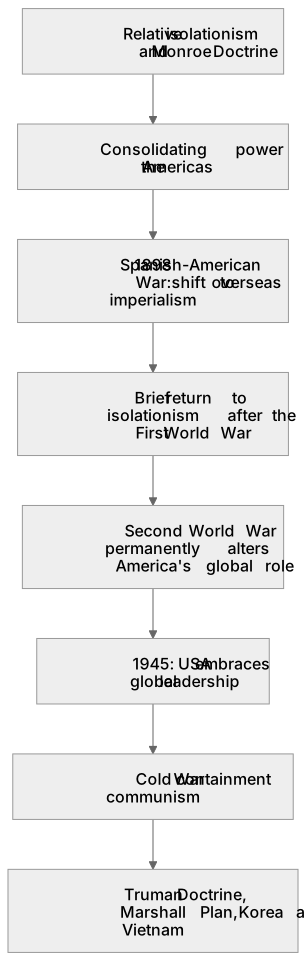
Put it in order
Put these steps in the order they happen.
- 1. Second World War permanently alters America's global role
- 2. Truman Doctrine, Marshall Plan, Korea and Vietnam
- 3. 1945: USA embraces global leadership
- 4. Relative isolationism and Monroe Doctrine
- 5. Consolidating power in the Americas
- 6. Cold War containment of communism
- 7. 1898 Spanish-American War: shift to overseas imperialism
- 8. Brief return to isolationism after the First World War
Key words
Say what each word means before you turn the card.
Isolationism vs Interventionism
Try answering aloud or in your head before turning the card.
Imperialism and Expansionism
Try answering aloud or in your head before turning the card.
Cold War Containment
Try answering aloud or in your head before turning the card.
See every definition
- Isolationism vs Interventionism
- The tension between avoiding European entanglements and actively engaging in world affairs, including the retreat from global leadership during the interwar period.
- Imperialism and Expansionism
- The shift from continental expansion to overseas imperialism, acquiring territories like the Philippines after the Spanish-American War.
- Cold War Containment
- The necessity to contain communism, exemplified by the Truman Doctrine, the Marshall Plan, and military interventions in Korea and Vietnam.
Label the diagram
Some boxes have lost their names. Pick the right name for each number.
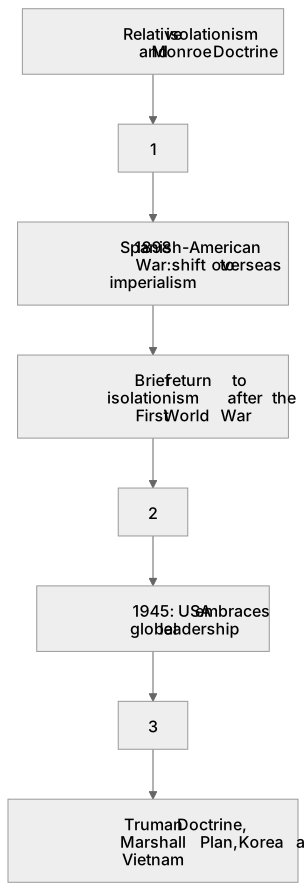
1Box 1
2Box 2
3Box 3
There is more to this lesson
The full lesson goes on to check your understanding and help you earn the marks. Create a free account to carry on, with your progress saved.
A week of Premium from your first lesson · Then the free plan continues · No card, no charge
Test your understanding of 1K The making of a Superpower: USA, 1865–1975 – consequence in this period through the following key questions:: How did the role of the USA in world affairs change?
Active recall beats re-reading. Take an instant quiz now to test what you’ve learned and lock it into long-term memory.
A week of Premium from your first lesson · Then the free plan continues · No card, no charge