AQA · A-Level · History
Course version: 7042 · Version from Sept 2017
USA, 1865–1975 – consequence in this period through the following key…
Full specification wording
1K The making of a Superpower: USA, 1865–1975 – consequence in this period through the following key questions:: In what ways did the economy and society of the USA change and develop?
From 1865 to 1975, the United States transitioned from an agrarian nation to a global industrial superpower.
Checked against the AQA 7042 specification (opens in a new tab) on .
- Point 2 of 6
- 3 key terms
Study notes
From the checked teaching notes for this specification point.
The idea
From 1865 to 1975, the United States transitioned from an agrarian nation to a global industrial superpower. The economy developed through rapid industrialisation, the rise of corporate monopolies during the Gilded Age, and the establishment of a consumer-driven, post-war boom economy. This economic metamorphosis drove profound societal changes. Urbanisation accelerated as millions migrated to cities, fundamentally altering the demographic landscape. Society was further reshaped by waves of mass immigration, the Great Migration of African Americans escaping the Jim Crow South, and evolving gender roles, culminating in the transformative civil rights and feminist movements of the mid-twentieth century.
What earns the marks
- Analyse the transition from an agricultural economy to an industrial and consumer-based economy, noting the impact of mass production techniques.
- Evaluate the social consequences of economic growth, including rapid urbanisation, the expansion of the middle class, and persistent wealth inequality.
- Assess the demographic changes driven by mass European immigration and internal population shifts, such as the Great Migration of African Americans.
- Examine the development of social movements, including organised labour, civil rights, and feminism, as responses to economic and societal inequalities.
Common mistakes and how to put them right
Treating economic growth as a continuous upward trajectory.
Put it right: Acknowledge the cyclical nature of the economy, explicitly discussing the devastating impact of the 1893 Panic and the 1929 Great Depression.
Discussing society as a homogenous group.
Put it right: Differentiate the societal experiences of various groups, such as African Americans, Native Americans, women, and new immigrants, who faced distinct challenges.
Failing to link economic and social changes.
Put it right: Explicitly connect economic developments, like the demand for factory labour, to social changes, such as urbanisation and immigration patterns.
Exam tips
- Support economic arguments with specific developments, such as the expansion of the railway network or the introduction of Ford's assembly line.
- When evaluating societal change, contrast the experiences of rural and urban populations to demonstrate a nuanced understanding of the period.
- Use the concept of the 'American Dream' as a thematic framework to evaluate how successfully different social groups integrated into the developing economy.
Try the lesson
The start of the 1K The making of a Superpower: USA, 1865–1975 – consequence in this period through the following key questions:: In what ways did the economy and society of the USA change and develop? lesson, made from checked teaching notes for this specification point.
Have a go first
Which of the following was the most significant driver of economic change in the United States during the late 19th century?
Listen
From 1865 to 1975, the United States transitioned from an agrarian nation to a global industrial superpower. The economy developed through rapid industrialisation, the rise of corporate monopolies during the Gilded Age, and the establishment of a consumer-driven, post-war boom economy. This economic metamorphosis drove profound societal changes. Urbanisation accelerated as millions migrated to cities, fundamentally altering the demographic landscape. Society was further reshaped by waves of mass immigration, the Great Migration of African Americans escaping the Jim Crow South, and evolving gender roles, culminating in the transformative civil rights and feminist movements of the mid-twentieth century. A strong answer earns marks for these points. Analyse the transition from an agricultural economy to an industrial and consumer-based economy, noting the impact of mass production techniques. Evaluate the social consequences of economic growth, including rapid urbanisation, the expansion of the middle class, and persistent wealth inequality. Assess the demographic changes driven by mass European immigration and internal population shifts, such as the Great Migration of African Americans. Examine the development of social movements, including organised labour, civil rights, and feminism, as responses to economic and societal inequalities. A common slip: Treating economic growth as a continuous upward trajectory. Instead, acknowledge the cyclical nature of the economy, explicitly discussing the devastating impact of the 1893 Panic and the 1929 Great Depression. Exam tip: Support economic arguments with specific developments, such as the expansion of the railway network or the introduction of Ford's assembly line.
See it
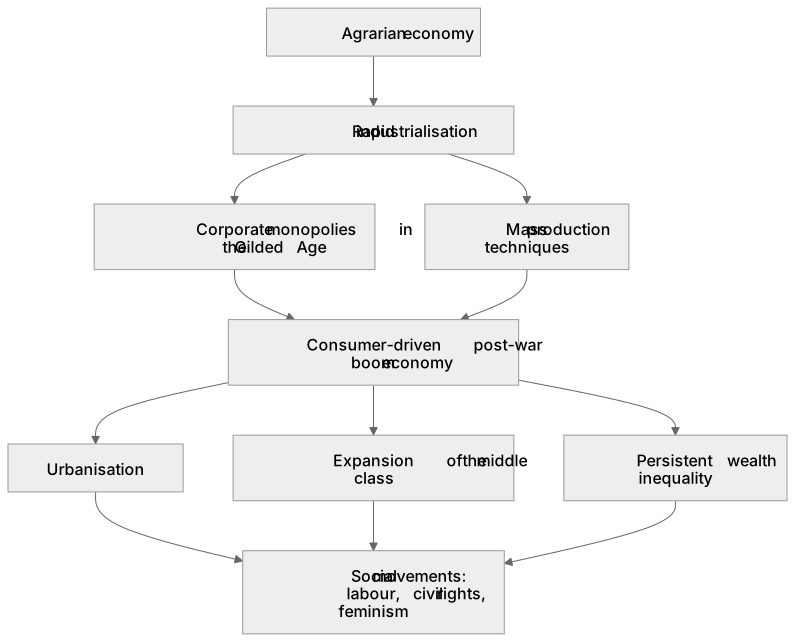
Key words
Say what each word means before you turn the card.
Industrialisation and Consumerism
Try answering aloud or in your head before turning the card.
Urbanisation and Migration
Try answering aloud or in your head before turning the card.
Social Inequality and Civil Rights
Try answering aloud or in your head before turning the card.
See every definition
- Industrialisation and Consumerism
- The economy developed through rapid industrialisation and the establishment of a consumer-driven, post-war boom economy.
- Urbanisation and Migration
- Urbanisation accelerated as millions migrated to cities, fundamentally altering the demographic landscape.
- Social Inequality and Civil Rights
- Social movements, including organised labour, civil rights and feminism, developed as responses to economic and societal inequalities.
Label the diagram
Some boxes have lost their names. Pick the right name for each number.
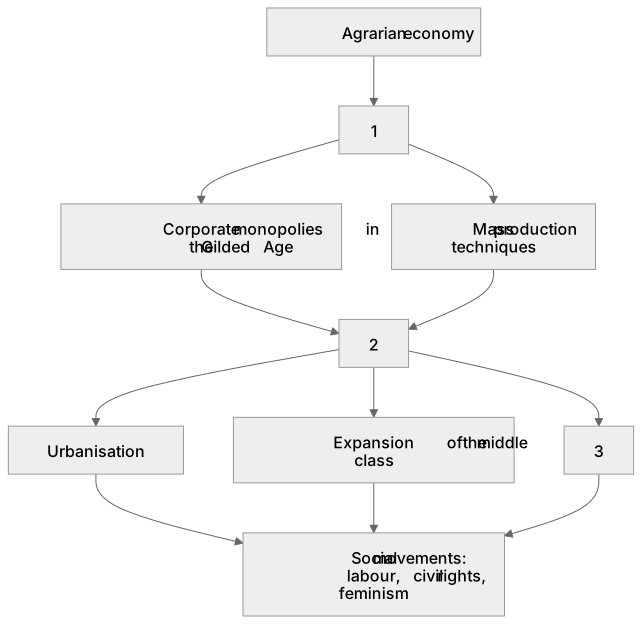
1Box 1
2Box 2
3Box 3
There is more to this lesson
The full lesson goes on to check your understanding and help you earn the marks. Create a free account to carry on, with your progress saved.
A week of Premium from your first lesson · Then the free plan continues · No card, no charge
Test your understanding of 1K The making of a Superpower: USA, 1865–1975 – consequence in this period through the following key questions:: In what ways did the economy and society of the USA change and develop?
Active recall beats re-reading. Take an instant quiz now to test what you’ve learned and lock it into long-term memory.
A week of Premium from your first lesson · Then the free plan continues · No card, no charge