AQA · A-Level · History
Course version: 7042 · Version from Sept 2017
USA, 1865–1975 – consequence in this period through the following key…
Full specification wording
1K The making of a Superpower: USA, 1865–1975 – consequence in this period through the following key questions:: How important was the role of key individuals and groups and how were they affected by developments?
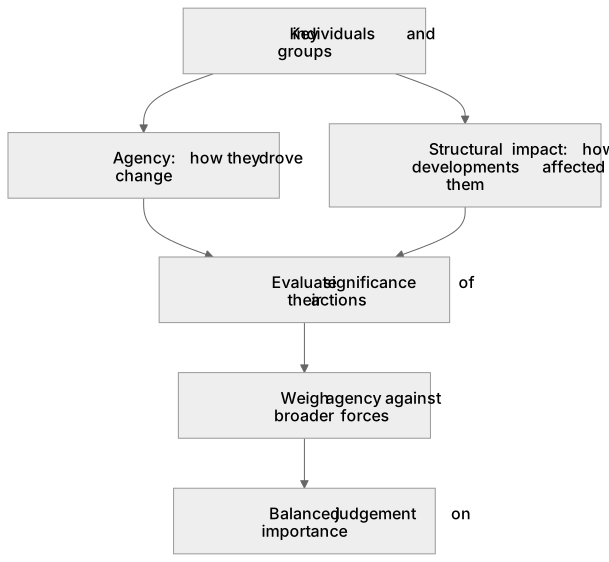
This requires a dual approach: assessing agency (how figures like FDR or Martin Luther King Jr., and groups like the NAACP, drove change) and structural impact (how economic shifts, wars, or…
Checked against the AQA 7042 specification (opens in a new tab) on .
- Point 6 of 6
- 4 key terms
Study notes
From the checked teaching notes for this specification point.
The idea
This requires a dual approach: assessing agency (how figures like FDR or Martin Luther King Jr., and groups like the NAACP, drove change) and structural impact (how economic shifts, wars, or legislation affected these actors). Similarly, they must examine how the Cold War influenced the strategies of civil rights groups. The focus is on the dynamic interaction between human agency and historical context across the century.
What earns the marks
- Evaluate the extent to which specific presidents, such as Woodrow Wilson, Franklin D. Roosevelt, and Lyndon B. Johnson, drove political and social change.
- Assess the impact of grassroots movements and campaign groups, including suffragists and civil rights activists, on national policy.
- Analyse how major economic developments, such as the Great Depression, altered the power and influence of different social classes and groups.
- Examine the reciprocal relationship between key individuals or groups and historical events, demonstrating how they both shaped and were shaped by their context.
Common mistakes and how to put them right
Focusing solely on presidents.
Put it right: Ensure a balanced analysis that includes marginalised groups, social movements, and economic leaders.
Describing what individuals did without evaluating their importance.
Put it right: Explicitly weigh the significance of their actions against broader social or economic forces.
Ignoring the second part of the question.
Put it right: Explicitly address how individuals and groups were affected by historical developments, not just how they caused them.
Exam tips
- When discussing a key individual, contrast their impact with the influence of a relevant group or broader structural factor to build a strong evaluation.
- Use the concept of a catalyst versus an underlying cause to evaluate the true importance of an individual's actions.
- Ensure you cover a range of groups, including women, African Americans, Native Americans, and the working class, across the whole time period.
Try the lesson
The start of the 1K The making of a Superpower: USA, 1865–1975 – consequence in this period through the following key questions:: How important was the role of key individuals and groups and how were they affected by developments? lesson, made from checked teaching notes for this specification point.
Have a go first
How did President Franklin D. Roosevelt primarily respond to the economic developments of the Great Depression during the 1930s?
Listen
This requires a dual approach: assessing agency (how figures like FDR or Martin Luther King Jr., and groups like the NAACP, drove change) and structural impact (how economic shifts, wars, or legislation affected these actors). Similarly, they must examine how the Cold War influenced the strategies of civil rights groups. The focus is on the dynamic interaction between human agency and historical context across the century. A strong answer earns marks for these points. Evaluate the extent to which specific presidents, such as Woodrow Wilson, Franklin D. Roosevelt, and Lyndon B. Johnson, drove political and social change. Assess the impact of grassroots movements and campaign groups, including suffragists and civil rights activists, on national policy. Analyse how major economic developments, such as the Great Depression, altered the power and influence of different social classes and groups. Examine the reciprocal relationship between key individuals or groups and historical events, demonstrating how they both shaped and were shaped by their context. A common slip: Focusing solely on presidents. Instead, ensure a balanced analysis that includes marginalised groups, social movements, and economic leaders. Exam tip: When discussing a key individual, contrast their impact with the influence of a relevant group or broader structural factor to build a strong evaluation.
See it
Key words
Say what each word means before you turn the card.
Leadership and presidential power
Try answering aloud or in your head before turning the card.
Social movements and civil rights
Try answering aloud or in your head before turning the card.
Economic transformation and class
Try answering aloud or in your head before turning the card.
The interaction of agency and structure
Try answering aloud or in your head before turning the card.
See every definition
- Leadership and presidential power
- The extent to which specific presidents drove political and social change, which students must evaluate.
- Social movements and civil rights
- The impact of grassroots movements and campaign groups, including suffragists and civil rights activists, on national policy.
- Economic transformation and class
- How major economic developments, such as the Great Depression, altered the power and influence of different social classes and groups.
- The interaction of agency and structure
- The reciprocal relationship between key individuals or groups and historical events, showing how they both shaped and were shaped by their context.
Label the diagram
Some boxes have lost their names. Pick the right name for each number.
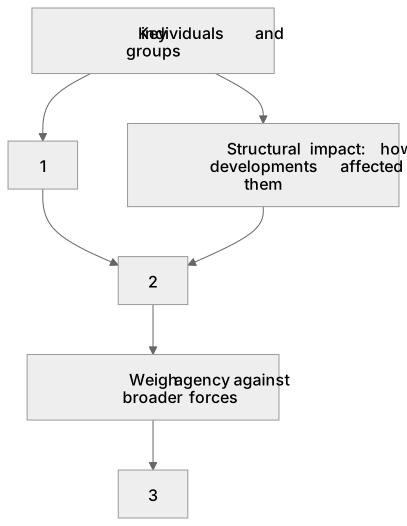
1Box 1
2Box 2
3Box 3
There is more to this lesson
The full lesson goes on to check your understanding and help you earn the marks. Create a free account to carry on, with your progress saved.
A week of Premium from your first lesson · Then the free plan continues · No card, no charge
Test your understanding of 1K The making of a Superpower: USA, 1865–1975 – consequence in this period through the following key questions:: How important was the role of key individuals and groups and how were they affected by developments?
Active recall beats re-reading. Take an instant quiz now to test what you’ve learned and lock it into long-term memory.
A week of Premium from your first lesson · Then the free plan continues · No card, no charge