AQA · A-Level · History
Course version: 7042 · Version from Sept 2017
USA, 1865–1975 – consequence in this period through the following key…
Full specification wording
1K The making of a Superpower: USA, 1865–1975 – consequence in this period through the following key questions:: How united was the USA during this period?
This question requires students to evaluate the extent of unity and division within the USA from 1865 to 1975.
Checked against the AQA 7042 specification (opens in a new tab) on .
- Point 5 of 6
- 3 key terms
Study notes
From the checked teaching notes for this specification point.
The idea
This question requires students to evaluate the extent of unity and division within the USA from 1865 to 1975. For example, Reconstruction highlighted deep regional and racial divides, while the Second World War temporarily unified the nation through shared purpose. However, this unity was often fragile, as seen in the Civil Rights Movement and anti-Vietnam War protests, which exposed enduring racial, generational, and ideological fractures.
What earns the marks
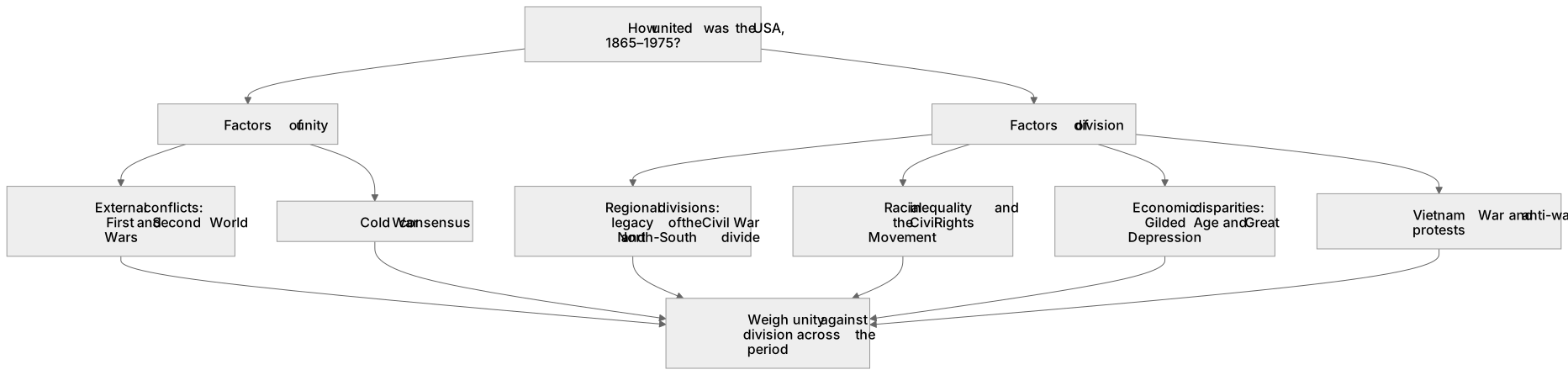
- Assess the impact of regional divisions, particularly the legacy of the Civil War and the North-South divide.
- Evaluate the role of racial inequality and the Civil Rights Movement in highlighting and challenging national disunity.
- Analyse the unifying effects of external conflicts, such as the First and Second World Wars, compared to the divisive nature of the Vietnam War.
- Examine economic disparities, including the Gilded Age and the Great Depression, as sources of social and political fragmentation.
Common mistakes and how to put them right
Treating the USA as a monolith.
Put it right: Acknowledge regional, racial, and class differences when discussing national unity.
Assuming wars always unified the country.
Put it right: Contrast the unifying effect of the Second World War with the deep divisions caused by the Vietnam War.
Ignoring the changing nature of unity over time.
Put it right: Trace how the basis of unity shifted from post-Civil War reconstruction to Cold War consensus and subsequent fragmentation.
Exam tips
- Use specific turning points, such as the 1929 Wall Street Crash or the 1964 Civil Rights Act, to anchor your arguments about unity and division.
- Always weigh factors of unity against factors of division within any given sub-period to provide a balanced evaluation.
- Consider how different groups, such as African Americans, women, and immigrants, experienced the concept of national unity differently.
Try the lesson
The start of the 1K The making of a Superpower: USA, 1865–1975 – consequence in this period through the following key questions:: How united was the USA during this period? lesson, made from checked teaching notes for this specification point.
Have a go first
Which of the following issues was the most significant cause of national disunity in the USA immediately following the end of the Civil War in 1865?
Listen
This question requires students to evaluate the extent of unity and division within the USA from 1865 to 1975. For example, Reconstruction highlighted deep regional and racial divides, while the Second World War temporarily unified the nation through shared purpose. However, this unity was often fragile, as seen in the Civil Rights Movement and anti-Vietnam War protests, which exposed enduring racial, generational, and ideological fractures. A strong answer earns marks for these points. Assess the impact of regional divisions, particularly the legacy of the Civil War and the North-South divide. Evaluate the role of racial inequality and the Civil Rights Movement in highlighting and challenging national disunity. Analyse the unifying effects of external conflicts, such as the First and Second World Wars, compared to the divisive nature of the Vietnam War. Examine economic disparities, including the Gilded Age and the Great Depression, as sources of social and political fragmentation. A common slip: Treating the USA as a monolith. Instead, acknowledge regional, racial, and class differences when discussing national unity. Exam tip: Use specific turning points, such as the 1929 Wall Street Crash or the 1964 Civil Rights Act, to anchor your arguments about unity and division.
See it
Key words
Say what each word means before you turn the card.
Racial and social inequality
Try answering aloud or in your head before turning the card.
Economic prosperity and disparity
Try answering aloud or in your head before turning the card.
Impact of foreign policy and war
Try answering aloud or in your head before turning the card.
See every definition
- Racial and social inequality
- Racial inequality and the Civil Rights Movement highlighted and challenged national disunity, exposing enduring racial fractures.
- Economic prosperity and disparity
- Economic disparities, including the Gilded Age and the Great Depression, acted as sources of social and political fragmentation.
- Impact of foreign policy and war
- External conflicts such as the First and Second World Wars had unifying effects, compared to the divisive nature of the Vietnam War.
Label the diagram
Some boxes have lost their names. Pick the right name for each number.
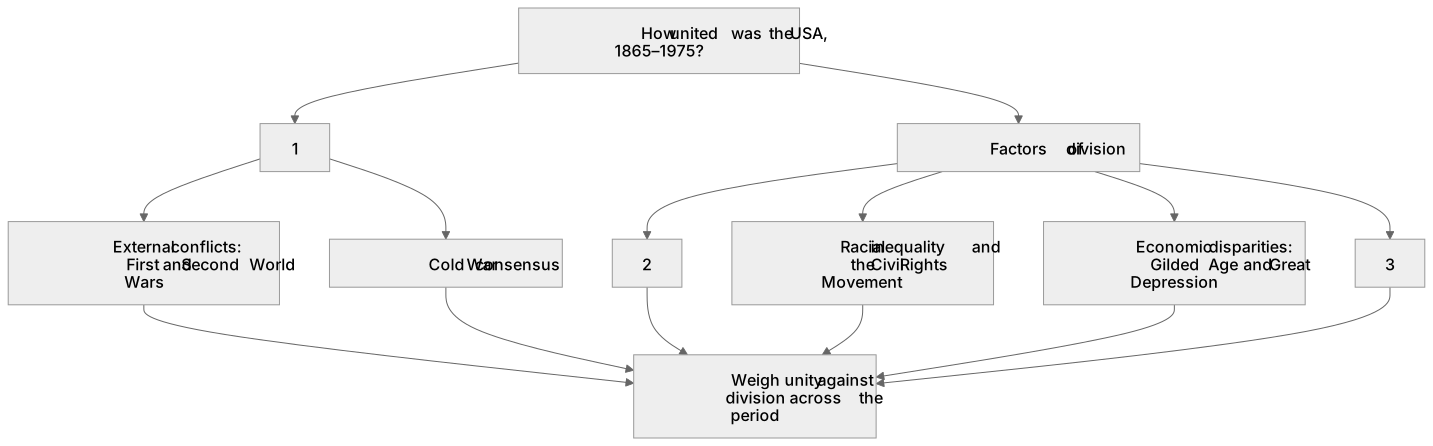
1Box 1
2Box 2
3Box 3
There is more to this lesson
The full lesson goes on to check your understanding and help you earn the marks. Create a free account to carry on, with your progress saved.
A week of Premium from your first lesson · Then the free plan continues · No card, no charge
Test your understanding of 1K The making of a Superpower: USA, 1865–1975 – consequence in this period through the following key questions:: How united was the USA during this period?
Active recall beats re-reading. Take an instant quiz now to test what you’ve learned and lock it into long-term memory.
A week of Premium from your first lesson · Then the free plan continues · No card, no charge