AQA · A-Level · History
Course version: 7042 · Version from Sept 2017
USA, 1865–1975 – only) Crisis of identity, 1920–1945 (A-level only):…
Full specification wording
1K The making of a Superpower: USA, 1865–1975 – only) Crisis of identity, 1920–1945 (A-level only): Domestic politics: Harding, Coolidge and Republican conservatism; Hoover and the Depression
The 1920s saw a resurgence of Republican conservatism under Presidents Harding and Coolidge, characterised by 'laissez-faire' economics, high tariffs like the Fordney-McCumber Act, and a retreat…
Checked against the AQA 7042 specification (opens in a new tab) on .
- Point 1 of 6
Study notes
From the checked teaching notes for this specification point.
The idea
The 1920s saw a resurgence of Republican conservatism under Presidents Harding and Coolidge, characterised by 'laissez-faire' economics, high tariffs like the Fordney-McCumber Act, and a retreat from Progressive interventionism. Harding's 'Return to Normalcy' was marred by the Teapot Dome scandal, while Coolidge championed big business, famously declaring 'the chief business of the American people is business'. This conservative consensus fractured under Herbert Hoover when the 1929 Wall Street Crash triggered the Great Depression. Hoover's initial reliance on voluntarism and rugged individualism proved inadequate, forcing him to establish the Reconstruction Finance Corporation, which failed to halt the decline.
What earns the marks
- Identify the core tenets of Republican conservatism in the 1920s, including laissez-faire economics, tax cuts, and protectionist tariffs.
- Evaluate the impact of Harding's 'Return to Normalcy' and the political fallout from the Teapot Dome scandal on public trust.
- Analyse Coolidge's pro-business policies and his ideological commitment to minimal federal intervention in the economy.
- Assess Hoover's response to the Great Depression, contrasting his belief in 'rugged individualism' with his later, limited federal interventions like the Reconstruction Finance Corporation.
Common mistakes and how to put them right
Claiming Hoover did absolutely nothing to combat the Depression.
Put it right: Hoover did intervene later in his presidency, such as creating the Reconstruction Finance Corporation, though it was insufficient.
Confusing the specific policies of Harding and Coolidge.
Put it right: Attribute the 'Return to Normalcy' and Teapot Dome to Harding, and the strict pro-business, minimal-government philosophy specifically to Coolidge.
Assuming Republican conservatism meant no government action at all.
Put it right: Republicans actively used government power to support business, such as raising tariffs and breaking strikes, rather than being purely hands-off.
Exam tips
- Use specific legislative examples, such as the Fordney-McCumber Tariff or the Hawley-Smoot Tariff, to demonstrate the practical application of Republican conservatism.
- When evaluating Hoover, balance the traditional view of his 'do-nothing' presidency against revisionist perspectives that highlight his unprecedented, albeit limited, federal interventions.
- Link the economic policies of Harding and Coolidge directly to the structural weaknesses that exacerbated the 1929 Wall Street Crash.
Try the lesson
The start of the 1K The making of a Superpower: USA, 1865–1975 – only) Crisis of identity, 1920–1945 (A-level only): Domestic politics: Harding, Coolidge and Republican conservatism; Hoover and the Depression lesson, made from checked teaching notes for this specification point.
Have a go first
Which policy principle was a central feature of the Republican conservatism championed by Presidents Harding and Coolidge during the 1920s?
Listen
The 1920s saw a resurgence of Republican conservatism under Presidents Harding and Coolidge, characterised by 'laissez-faire' economics, high tariffs like the Fordney-McCumber Act, and a retreat from Progressive interventionism. Harding's 'Return to Normalcy' was marred by the Teapot Dome scandal, while Coolidge championed big business, famously declaring 'the chief business of the American people is business'. This conservative consensus fractured under Herbert Hoover when the 1929 Wall Street Crash triggered the Great Depression. Hoover's initial reliance on voluntarism and rugged individualism proved inadequate, forcing him to establish the Reconstruction Finance Corporation, which failed to halt the decline. A strong answer earns marks for these points. Identify the core tenets of Republican conservatism in the 1920s, including laissez-faire economics, tax cuts, and protectionist tariffs. Evaluate the impact of Harding's 'Return to Normalcy' and the political fallout from the Teapot Dome scandal on public trust. Analyse Coolidge's pro-business policies and his ideological commitment to minimal federal intervention in the economy. Assess Hoover's response to the Great Depression, contrasting his belief in 'rugged individualism' with his later, limited federal interventions like the Reconstruction Finance Corporation. A common slip: Claiming Hoover did absolutely nothing to combat the Depression. Instead, Hoover did intervene later in his presidency, such as creating the Reconstruction Finance Corporation, though it was insufficient. Exam tip: Use specific legislative examples, such as the Fordney-McCumber Tariff or the Hawley-Smoot Tariff, to demonstrate the practical application of Republican conservatism.
See it
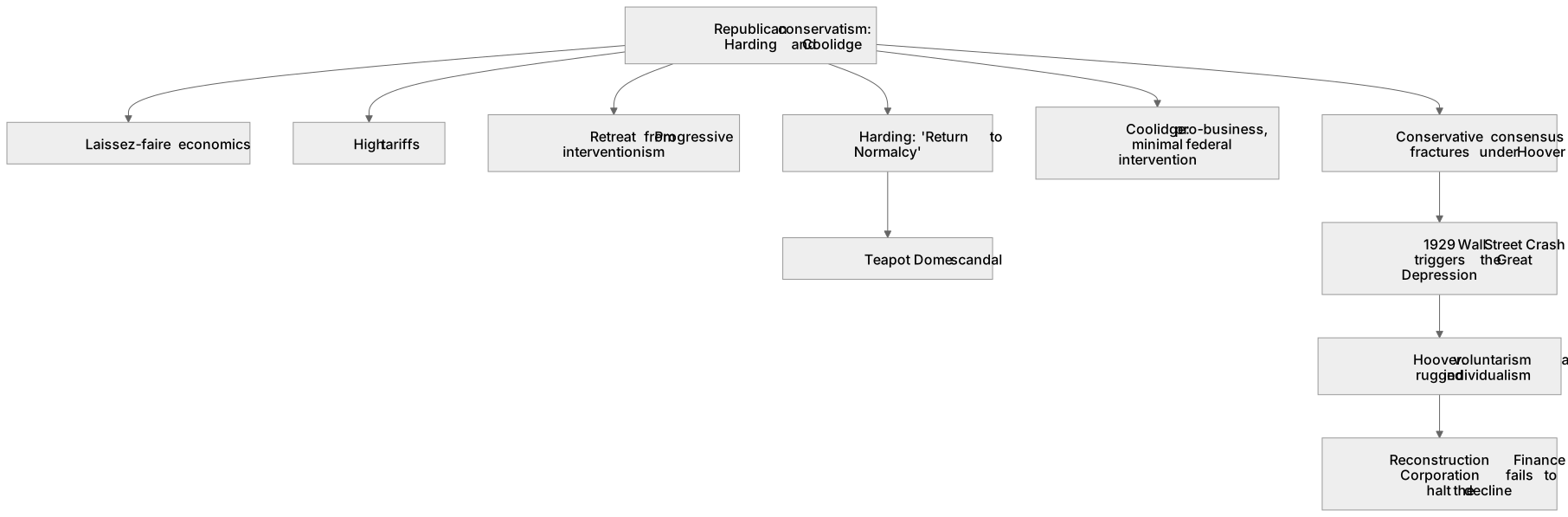
Label the diagram
Some boxes have lost their names. Pick the right name for each number.
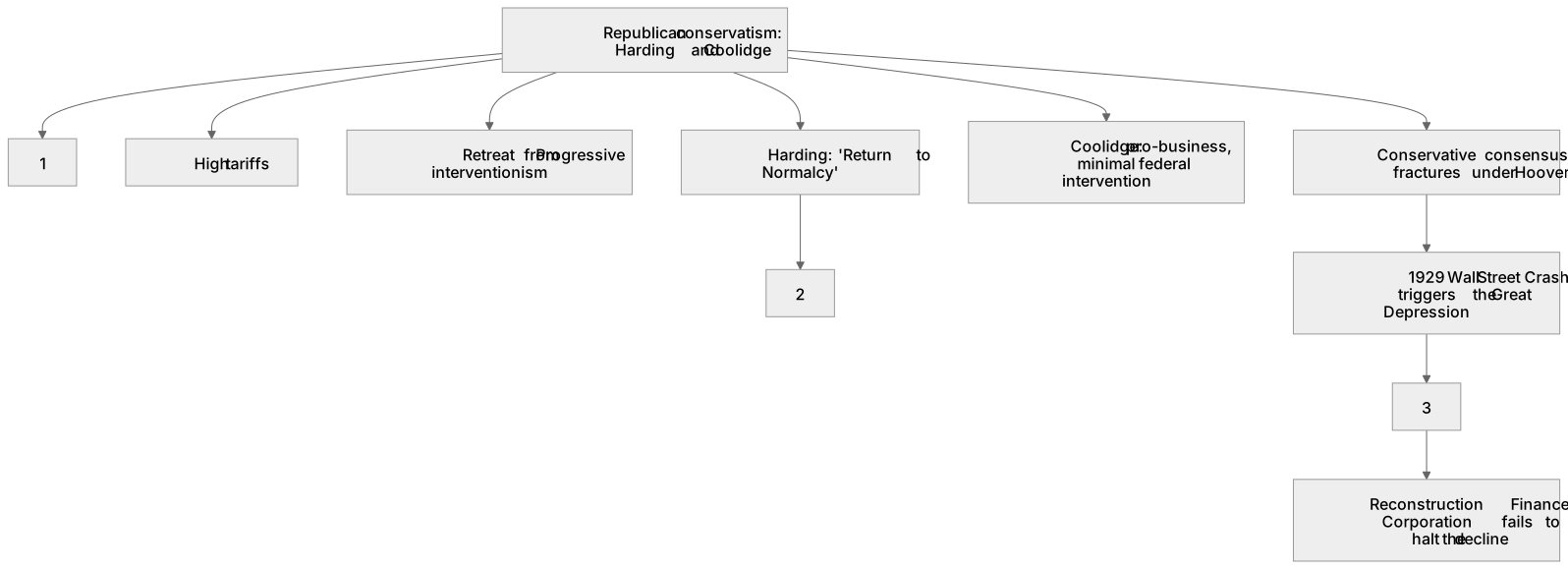
1Box 1
2Box 2
3Box 3
There is more to this lesson
The full lesson goes on to check your understanding and help you earn the marks. Create a free account to carry on, with your progress saved.
A week of Premium from your first lesson · Then the free plan continues · No card, no charge
Test your understanding of 1K The making of a Superpower: USA, 1865–1975 – only) Crisis of identity, 1920–1945 (A-level only): Domestic politics: Harding, Coolidge and Republican conservatism; Hoover and the Depression
Active recall beats re-reading. Take an instant quiz now to test what you’ve learned and lock it into long-term memory.
A week of Premium from your first lesson · Then the free plan continues · No card, no charge