AQA · A-Level · History
Course version: 7042 · Version from Sept 2017
USA, 1865–1975 – only) Crisis of identity, 1920–1945 (A-level only): FD…
Full specification wording
1K The making of a Superpower: USA, 1865–1975 – only) Crisis of identity, 1920–1945 (A-level only): FD Roosevelt and the New Deals: conflict of ideas over the role of the Federal Government
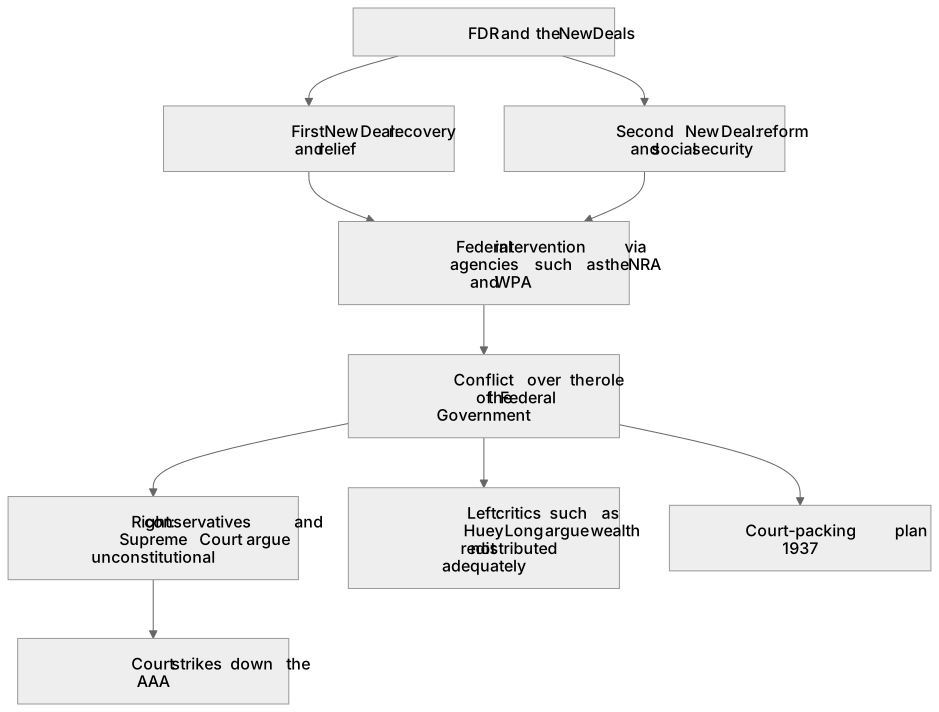
Franklin D. Roosevelt transformed the Federal Government's role through his First and Second New Deals.
Checked against the AQA 7042 specification (opens in a new tab) on .
- Point 2 of 6
Study notes
From the checked teaching notes for this specification point.
The idea
Franklin D. Roosevelt transformed the Federal Government's role through his First and Second New Deals. Abandoning laissez-faire, FDR used unprecedented federal intervention for relief, recovery, and reform via agencies like the NRA and WPA. This expansion of federal power sparked intense ideological conflict. Conservatives and the Supreme Court argued the New Deal was unconstitutional, famously striking down the AAA. Conversely, left-wing critics like Huey Long argued it failed to redistribute wealth adequately. This conflict over the state's role redefined American political alignments, establishing a liberal consensus while cementing enduring debates over federal authority versus states' rights.
What earns the marks
- Differentiate between the aims and legislative focus of the First New Deal (recovery and relief) and the Second New Deal (reform and social security).
- Analyse the ideological opposition from the political right, including the Liberty League and Supreme Court rulings against federal overreach.
- Evaluate the criticisms from the political left, such as Huey Long's 'Share Our Wealth' movement and Dr Townsend's pension plans.
- Assess how FDR's policies permanently altered the constitutional and practical role of the Federal Government in managing the economy and providing social welfare.
Common mistakes and how to put them right
Treating the New Deal as a single, cohesive ideological programme.
Put it right: Distinguish between the First and Second New Deals, noting the shift from emergency economic planning to long-term social reform.
Stating that the Supreme Court opposed all New Deal legislation.
Put it right: Specify that the Court struck down specific acts like the NRA and AAA on constitutional grounds of states' rights and executive overreach.
Assuming the New Deal ended the Great Depression.
Put it right: Clarify that while the New Deal provided relief and reform, it was the industrial mobilisation for the Second World War that ultimately ended the economic depression.
Exam tips
- Use the 'alphabet agencies' (e.g., TVA, CCC, WPA) as specific evidence to demonstrate the expanding scope of federal intervention.
- When discussing the 'conflict of ideas', ensure you balance the conservative critique of federal overreach with the radical critique that FDR was too conservative.
- Analyse FDR's 'court-packing' plan of 1937 as a key example of the constitutional crisis generated by the expanding role of the Federal Government.
Try the lesson
The start of the 1K The making of a Superpower: USA, 1865–1975 – only) Crisis of identity, 1920–1945 (A-level only): FD Roosevelt and the New Deals: conflict of ideas over the role of the Federal Government lesson, made from checked teaching notes for this specification point.
Have a go first
Which group of political opponents formed the American Liberty League in 1934 to campaign against Franklin D. Roosevelt's New Deal?
Listen
Franklin D. Roosevelt transformed the Federal Government's role through his First and Second New Deals. Abandoning laissez-faire, FDR used unprecedented federal intervention for relief, recovery, and reform via agencies like the NRA and WPA. This expansion of federal power sparked intense ideological conflict. Conservatives and the Supreme Court argued the New Deal was unconstitutional, famously striking down the AAA. Conversely, left-wing critics like Huey Long argued it failed to redistribute wealth adequately. This conflict over the state's role redefined American political alignments, establishing a liberal consensus while cementing enduring debates over federal authority versus states' rights. A strong answer earns marks for these points. Differentiate between the aims and legislative focus of the First New Deal (recovery and relief) and the Second New Deal (reform and social security). Analyse the ideological opposition from the political right, including the Liberty League and Supreme Court rulings against federal overreach. Evaluate the criticisms from the political left, such as Huey Long's 'Share Our Wealth' movement and Dr Townsend's pension plans. Assess how FDR's policies permanently altered the constitutional and practical role of the Federal Government in managing the economy and providing social welfare. A common slip: Treating the New Deal as a single, cohesive ideological programme. Instead, distinguish between the First and Second New Deals, noting the shift from emergency economic planning to long-term social reform. Exam tip: Use the 'alphabet agencies' (e.g., TVA, CCC, WPA) as specific evidence to demonstrate the expanding scope of federal intervention.
See it
Label the diagram
Some boxes have lost their names. Pick the right name for each number.
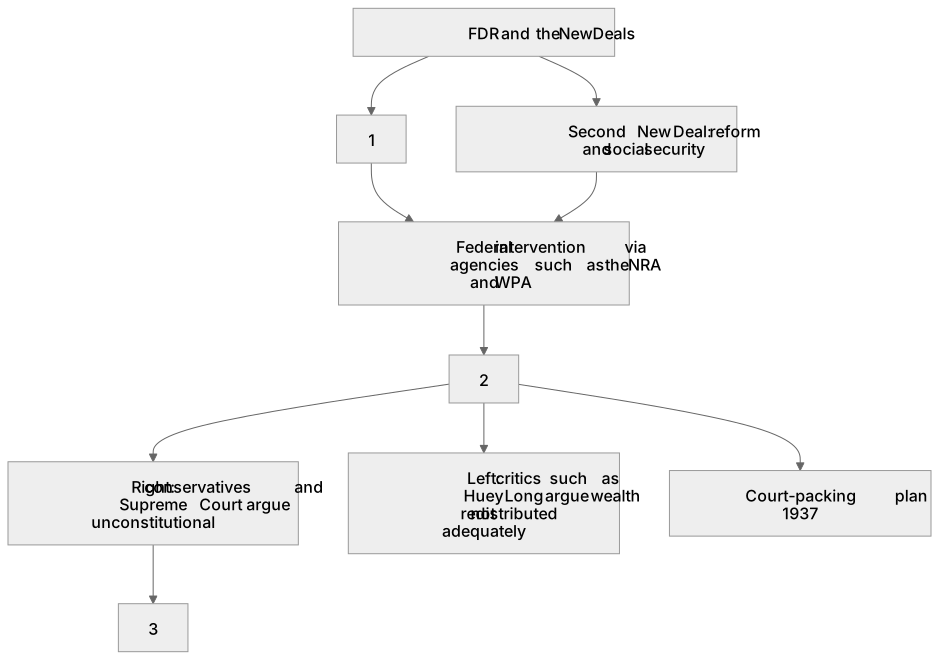
1Box 1
2Box 2
3Box 3
There is more to this lesson
The full lesson goes on to check your understanding and help you earn the marks. Create a free account to carry on, with your progress saved.
A week of Premium from your first lesson · Then the free plan continues · No card, no charge
Test your understanding of 1K The making of a Superpower: USA, 1865–1975 – only) Crisis of identity, 1920–1945 (A-level only): FD Roosevelt and the New Deals: conflict of ideas over the role of the Federal Government
Active recall beats re-reading. Take an instant quiz now to test what you’ve learned and lock it into long-term memory.
A week of Premium from your first lesson · Then the free plan continues · No card, no charge