AQA · A-Level · History
Course version: 7042 · Version from Sept 2017
USA, 1865–1975 – only) Crisis of identity, 1920–1945 (A-level only):…
Full specification wording
1K The making of a Superpower: USA, 1865–1975 – only) Crisis of identity, 1920–1945 (A-level only): Social, regional and ethnic divisions: countryside versus city; divisions between North, West and South; African-Americans and the rise of the Ku Klux Klan
The 1920s witnessed profound social, regional, and ethnic divisions in the USA.
Checked against the AQA 7042 specification (opens in a new tab) on .
- Point 5 of 6
- 4 key terms
Study notes
From the checked teaching notes for this specification point.
The idea
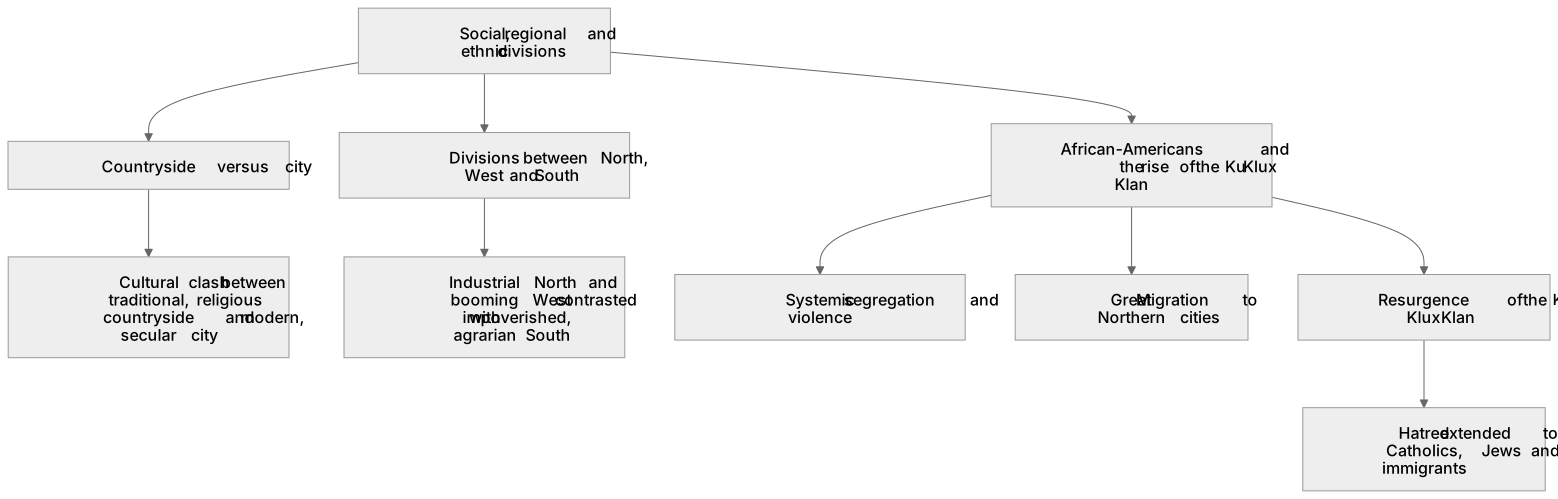
The 1920s witnessed profound social, regional, and ethnic divisions in the USA. The cultural clash between the traditional, religious countryside and the modern, secular city was epitomised by the Scopes Trial and Prohibition. Regional disparities deepened: the industrial North and booming West contrasted sharply with the impoverished, agrarian South. Ethnic tensions escalated, particularly affecting African-Americans who faced systemic segregation and violence, prompting the Great Migration to Northern cities. This climate of nativism and racial prejudice fuelled the resurgence of the Ku Klux Klan, which expanded its hatred beyond African-Americans to target Catholics, Jews, and immigrants, claiming millions of members nationwide by the mid-1920s.
What earns the marks
- Explain the rural-urban divide, focusing on cultural conflicts like Prohibition and religious fundamentalism versus modern urban lifestyles.
- Analyse regional economic and social differences, contrasting the industrialised North and expanding West with the economically stagnant, agricultural South.
- Evaluate the experiences of African-Americans, including the push and pull factors of the Great Migration and the reality of de facto segregation in the North.
- Assess the reasons for the rise of the Second Ku Klux Klan, noting its broadened nativist agenda targeting immigrants, Catholics, and Jews alongside African-Americans.
Common mistakes and how to put them right
Assuming the KKK only operated in the South.
Put it right: Note that the Second KKK was a national organisation with significant political influence in Northern and Western states like Indiana and Oregon.
Claiming the Great Migration completely resolved African-American hardships.
Put it right: Explain that while escaping Southern Jim Crow laws, migrants faced severe de facto segregation, race riots, and economic discrimination in Northern cities.
Treating the rural-urban divide as purely economic.
Put it right: Emphasise that the countryside versus city division was also deeply ideological, involving clashes over religion, morality, and immigration.
Exam tips
- Use specific examples like the 1925 Scopes Trial to illustrate the ideological clash between traditional rural values and modern urban ideas.
- When discussing regional divisions, link economic disparities to social attitudes, such as how Southern agricultural depression fuelled racial scapegoating.
- Connect the rise of the KKK to broader national themes of nativism and the Red Scare to demonstrate a synoptic understanding of 1920s American society.
Try the lesson
The start of the 1K The making of a Superpower: USA, 1865–1975 – only) Crisis of identity, 1920–1945 (A-level only): Social, regional and ethnic divisions: countryside versus city; divisions between North, West and South; African-Americans and the rise of the Ku Klux Klan lesson, made from checked teaching notes for this specification point.
Have a go first
Which of the following groups was a primary target of the resurgent Ku Klux Klan during the 1920s, alongside African-Americans?
Listen
The 1920s witnessed profound social, regional, and ethnic divisions in the USA. The cultural clash between the traditional, religious countryside and the modern, secular city was epitomised by the Scopes Trial and Prohibition. Regional disparities deepened: the industrial North and booming West contrasted sharply with the impoverished, agrarian South. Ethnic tensions escalated, particularly affecting African-Americans who faced systemic segregation and violence, prompting the Great Migration to Northern cities. This climate of nativism and racial prejudice fuelled the resurgence of the Ku Klux Klan, which expanded its hatred beyond African-Americans to target Catholics, Jews, and immigrants, claiming millions of members nationwide by the mid-1920s. A strong answer earns marks for these points. Explain the rural-urban divide, focusing on cultural conflicts like Prohibition and religious fundamentalism versus modern urban lifestyles. Analyse regional economic and social differences, contrasting the industrialised North and expanding West with the economically stagnant, agricultural South. Evaluate the experiences of African-Americans, including the push and pull factors of the Great Migration and the reality of de facto segregation in the North. Assess the reasons for the rise of the Second Ku Klux Klan, noting its broadened nativist agenda targeting immigrants, Catholics, and Jews alongside African-Americans. A common slip: Assuming the KKK only operated in the South. Instead, note that the Second KKK was a national organisation with significant political influence in Northern and Western states like Indiana and Oregon. Exam tip: Use specific examples like the 1925 Scopes Trial to illustrate the ideological clash between traditional rural values and modern urban ideas.
See it
Key words
Say what each word means before you turn the card.
Nativism and xenophobia
Try answering aloud or in your head before turning the card.
Modernity versus traditionalism
Try answering aloud or in your head before turning the card.
Racial inequality and civil rights
Try answering aloud or in your head before turning the card.
Regional economic disparity
Try answering aloud or in your head before turning the card.
See every definition
- Nativism and xenophobia
- A climate of nativism and racial prejudice fuelled the resurgence of the Ku Klux Klan, which expanded its hatred to target Catholics, Jews, and immigrants.
- Modernity versus traditionalism
- The cultural clash between the traditional, religious countryside and the modern, secular city was epitomised by the Scopes Trial and Prohibition.
- Racial inequality and civil rights
- Ethnic tensions escalated, particularly affecting African-Americans who faced systemic segregation and violence, prompting the Great Migration to Northern cities.
- Regional economic disparity
- The industrial North and booming West contrasted sharply with the impoverished, agrarian South.
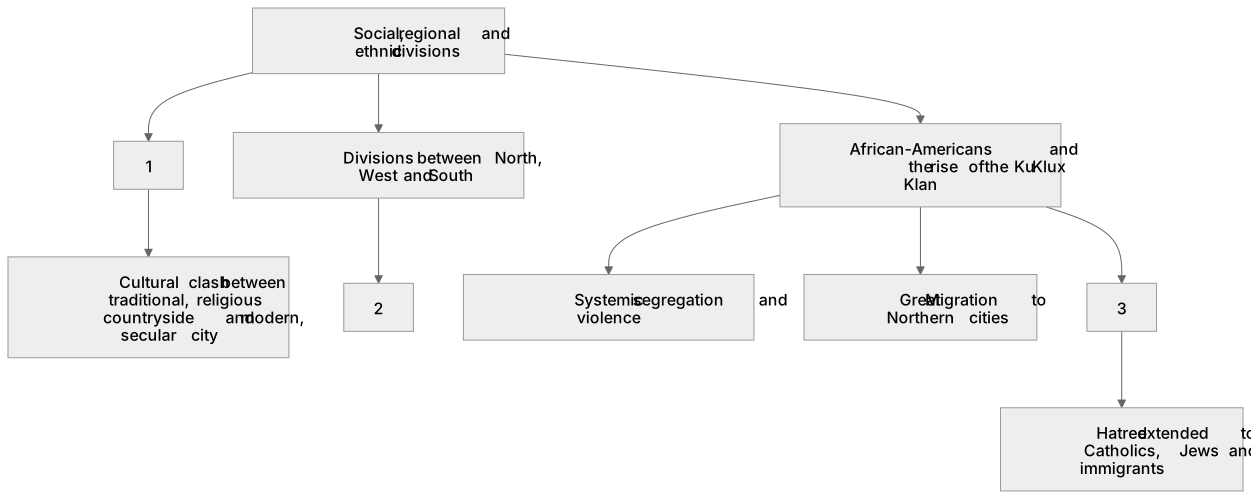
Label the diagram
Some boxes have lost their names. Pick the right name for each number.
1Box 1
2Box 2
3Box 3
There is more to this lesson
The full lesson goes on to check your understanding and help you earn the marks. Create a free account to carry on, with your progress saved.
A week of Premium from your first lesson · Then the free plan continues · No card, no charge
Test your understanding of 1K The making of a Superpower: USA, 1865–1975 – only) Crisis of identity, 1920–1945 (A-level only): Social, regional and ethnic divisions: countryside versus city; divisions between North, West and South; African-Americans and the rise of the Ku Klux Klan
Active recall beats re-reading. Take an instant quiz now to test what you’ve learned and lock it into long-term memory.
A week of Premium from your first lesson · Then the free plan continues · No card, no charge