AQA · A-Level · History
Course version: 7042 · Version from Sept 2017
USA, 1865–1975 – only) Crisis of identity, 1920–1945 (A-level only):…
Full specification wording
1K The making of a Superpower: USA, 1865–1975 – only) Crisis of identity, 1920–1945 (A-level only): Social and cultural developments: ‘the Jazz Age’ in the 1920s; new social values and the role of women; the failure of prohibition and its significance; social impact of the Depression and the Second World War
The 1920s 'Jazz Age' introduced new social values, epitomised by the 'flapper' lifestyle, which challenged traditional gender roles and expanded women's social freedoms, though political and…
Checked against the AQA 7042 specification (opens in a new tab) on .
- Point 4 of 6
Study notes
From the checked teaching notes for this specification point.
The idea
The 1920s 'Jazz Age' introduced new social values, epitomised by the 'flapper' lifestyle, which challenged traditional gender roles and expanded women's social freedoms, though political and economic gains remained limited. Prohibition failed spectacularly, fostering organised crime and widespread defiance, significantly undermining respect for federal law. The Great Depression devastated society, causing mass unemployment, homelessness, and internal migration, profoundly altering family dynamics. Conversely, the Second World War had a transformative social impact, drawing millions of women into the industrial workforce and accelerating African American migration, reshaping American society.
What earns the marks
- Analyse the cultural shifts of the Jazz Age, including the clash between modern urban values and traditional rural conservatism.
- Evaluate changes in the role of women, contrasting the social liberation of the 1920s with the practical economic necessities of the 1930s and 1940s.
- Assess the significance of Prohibition's failure, focusing on the rise of organised crime and the exposure of federal enforcement limitations.
- Compare the social impacts of the Depression, such as poverty and migration, with those of the Second World War, including workforce expansion and demographic shifts.
Common mistakes and how to put them right
Assuming the 'flapper' lifestyle represented the experience of all American women in the 1920s.
Put it right by acknowledging that these new social values were largely confined to young, urban, middle-class women.
Stating Prohibition reduced crime.
Put it right by explaining that it significantly increased organised crime and corruption, leading to its eventual repeal.
Treating the social impact of the Second World War as entirely positive.
Put it right by noting the persistence of racial segregation and the internment of Japanese Americans alongside employment gains.
Exam tips
- Contrast the social conservatism of rural America with the progressive 'Jazz Age' culture of the cities to demonstrate nuance in 1920s social values.
- When discussing the social impact of the Depression, reference specific phenomena like the Dust Bowl migration to provide concrete evidence.
- Evaluate how the Second World War acted as a catalyst for long-term social change, particularly regarding women's employment and civil rights expectations.
Try the lesson
The start of the 1K The making of a Superpower: USA, 1865–1975 – only) Crisis of identity, 1920–1945 (A-level only): Social and cultural developments: ‘the Jazz Age’ in the 1920s; new social values and the role of women; the failure of prohibition and its significance; social impact of the Depression and the Second World War lesson, made from checked teaching notes for this specification point.
Have a go first
Which statement best describes the extent of change in the social and economic status of women in the United States during the 1920s?
Listen
The 1920s 'Jazz Age' introduced new social values, epitomised by the 'flapper' lifestyle, which challenged traditional gender roles and expanded women's social freedoms, though political and economic gains remained limited. Prohibition failed spectacularly, fostering organised crime and widespread defiance, significantly undermining respect for federal law. The Great Depression devastated society, causing mass unemployment, homelessness, and internal migration, profoundly altering family dynamics. Conversely, the Second World War had a transformative social impact, drawing millions of women into the industrial workforce and accelerating African American migration, reshaping American society. A strong answer earns marks for these points. Analyse the cultural shifts of the Jazz Age, including the clash between modern urban values and traditional rural conservatism. Evaluate changes in the role of women, contrasting the social liberation of the 1920s with the practical economic necessities of the 1930s and 1940s. Assess the significance of Prohibition's failure, focusing on the rise of organised crime and the exposure of federal enforcement limitations. Compare the social impacts of the Depression, such as poverty and migration, with those of the Second World War, including workforce expansion and demographic shifts. A common slip: Assuming the 'flapper' lifestyle represented the experience of all American women in the 1920s. Instead, acknowledging that these new social values were largely confined to young, urban, middle-class women. Exam tip: Contrast the social conservatism of rural America with the progressive 'Jazz Age' culture of the cities to demonstrate nuance in 1920s social values.
See it

Label the diagram
Some boxes have lost their names. Pick the right name for each number.
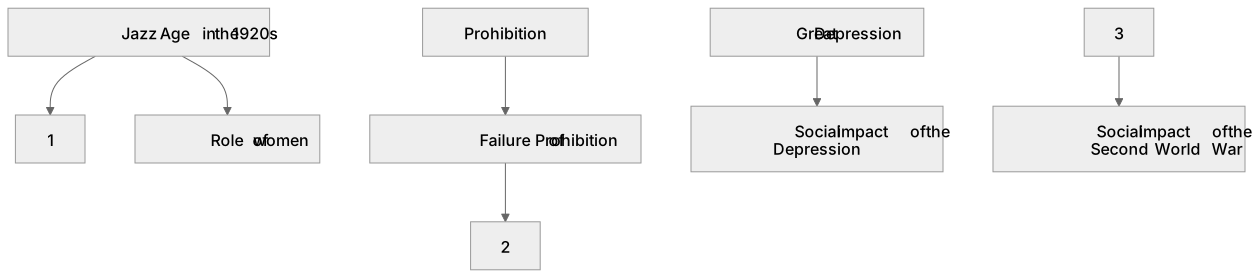
1Box 1
2Box 2
3Box 3
There is more to this lesson
The full lesson goes on to check your understanding and help you earn the marks. Create a free account to carry on, with your progress saved.
A week of Premium from your first lesson · Then the free plan continues · No card, no charge
Test your understanding of 1K The making of a Superpower: USA, 1865–1975 – only) Crisis of identity, 1920–1945 (A-level only): Social and cultural developments: ‘the Jazz Age’ in the 1920s; new social values and the role of women; the failure of prohibition and its significance; social impact of the Depression and the Second World War
Active recall beats re-reading. Take an instant quiz now to test what you’ve learned and lock it into long-term memory.
A week of Premium from your first lesson · Then the free plan continues · No card, no charge