AQA · A-Level · History
Course version: 7042 · Version from Sept 2017
USA, 1865–1975 – Populism, progressivism and imperialism, 1890–1920:…
Full specification wording
1K The making of a Superpower: USA, 1865–1975 – Populism, progressivism and imperialism, 1890–1920: Political tensions and divisions: the reaction against Big Business at national and state level
The late 19th and early 20th centuries witnessed intense political tensions and divisions as Americans reacted against the monopolistic practices of Big Business.
Checked against the AQA 7042 specification (opens in a new tab) on .
- Point 1 of 6
Study notes
From the checked teaching notes for this specification point.
The idea
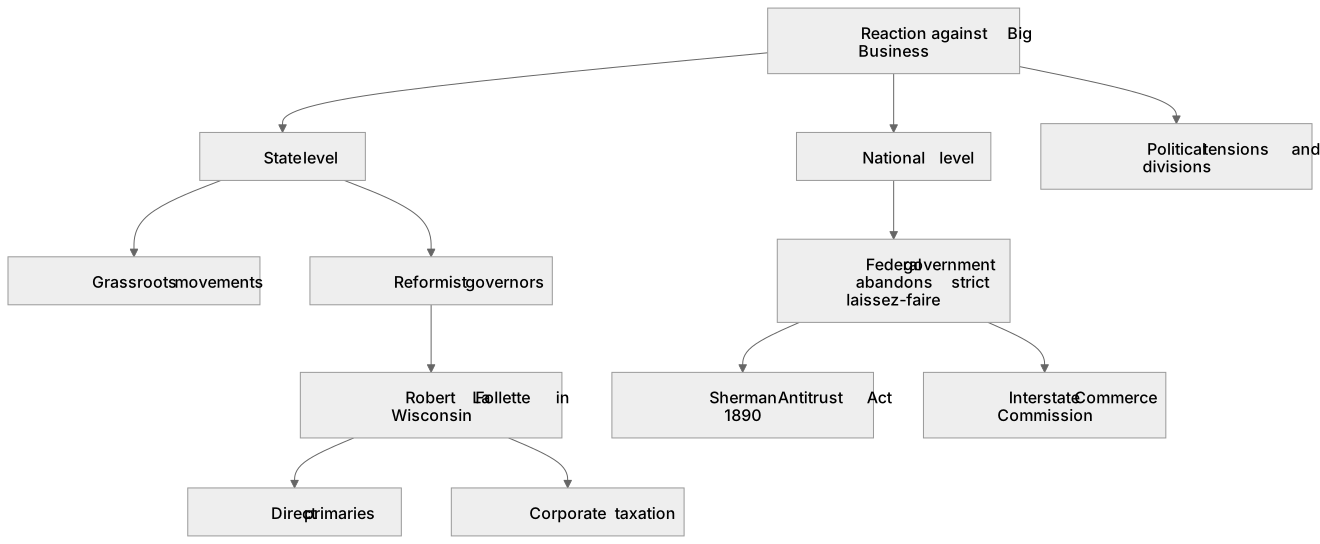
The late 19th and early 20th centuries witnessed intense political tensions and divisions as Americans reacted against the monopolistic practices of Big Business. At the state level, this reaction was spearheaded by grassroots movements and reformist governors, such as Robert La Follette in Wisconsin, who introduced direct primaries and corporate taxation to curb corporate dominance. At the national level, these divisions forced the federal government to abandon strict laissez-faire policies. This culminated in landmark federal legislation, notably the Sherman Antitrust Act of 1890 and the establishment of the Interstate Commerce Commission, designed to regulate trusts and railroads.
What earns the marks
- Identify specific state-level reforms, such as the 'Wisconsin Idea' championed by Robert La Follette, which targeted corporate monopolies.
- Explain the national legislative response to Big Business, including the Sherman Antitrust Act (1890) and the Hepburn Act (1906).
- Analyse the political divisions caused by these reactions, particularly the split within the Republican Party between conservatives and progressives.
- Evaluate the effectiveness of early regulatory attempts, noting how the Supreme Court often diluted national antitrust legislation initially.
Common mistakes and how to put them right
Assuming the reaction against Big Business was entirely successful.
Put it right: In reality, early national legislation like the Sherman Antitrust Act was often used against trade unions rather than corporations.
Claiming that all politicians supported regulation.
Put it right: Conservative factions in both major parties strongly resisted state and national interference in business.
Exam tips
- Use specific examples of 'robber barons' or trusts (like Standard Oil) to contextualise the political backlash against Big Business.
- When evaluating political divisions, contrast the pro-business stance of the 'Old Guard' Republicans with the reformist agenda of the Progressives.
- Explicitly structure your essays to compare the effectiveness of state-level grassroots reforms against top-down national legislation.
Try the lesson
The start of the 1K The making of a Superpower: USA, 1865–1975 – Populism, progressivism and imperialism, 1890–1920: Political tensions and divisions: the reaction against Big Business at national and state level lesson, made from checked teaching notes for this specification point.
Have a go first
Which 1890 federal law represented the first major national effort to restrict the monopolistic practices of Big Business?
Listen
The late 19th and early 20th centuries witnessed intense political tensions and divisions as Americans reacted against the monopolistic practices of Big Business. At the state level, this reaction was spearheaded by grassroots movements and reformist governors, such as Robert La Follette in Wisconsin, who introduced direct primaries and corporate taxation to curb corporate dominance. At the national level, these divisions forced the federal government to abandon strict laissez-faire policies. This culminated in landmark federal legislation, notably the Sherman Antitrust Act of 1890 and the establishment of the Interstate Commerce Commission, designed to regulate trusts and railroads. A strong answer earns marks for these points. Identify specific state-level reforms, such as the 'Wisconsin Idea' championed by Robert La Follette, which targeted corporate monopolies. Explain the national legislative response to Big Business, including the Sherman Antitrust Act (1890) and the Hepburn Act (1906). Analyse the political divisions caused by these reactions, particularly the split within the Republican Party between conservatives and progressives. Evaluate the effectiveness of early regulatory attempts, noting how the Supreme Court often diluted national antitrust legislation initially. Exam tip: Use specific examples of 'robber barons' or trusts (like Standard Oil) to contextualise the political backlash against Big Business.
See it
Label the diagram
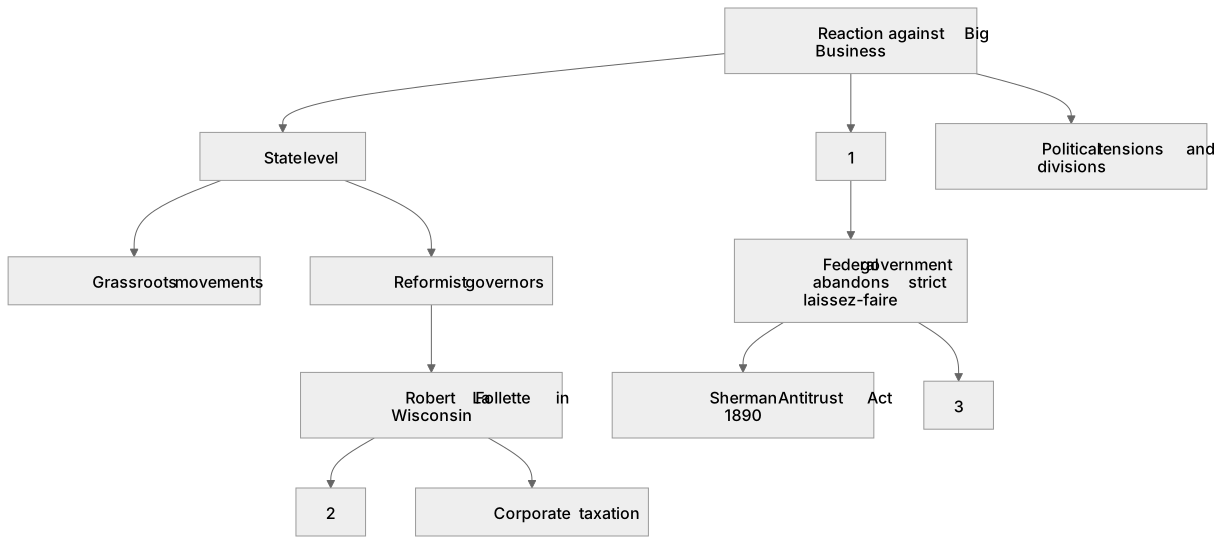
Some boxes have lost their names. Pick the right name for each number.
1Box 1
2Box 2
3Box 3
There is more to this lesson
The full lesson goes on to check your understanding and help you earn the marks. Create a free account to carry on, with your progress saved.
A week of Premium from your first lesson · Then the free plan continues · No card, no charge
Test your understanding of 1K The making of a Superpower: USA, 1865–1975 – Populism, progressivism and imperialism, 1890–1920: Political tensions and divisions: the reaction against Big Business at national and state level
Active recall beats re-reading. Take an instant quiz now to test what you’ve learned and lock it into long-term memory.
A week of Premium from your first lesson · Then the free plan continues · No card, no charge