AQA · A-Level · History
Course version: 7042 · Version from Sept 2017
USA, 1865–1975 – Populism, progressivism and imperialism, 1890–1920: The…
Full specification wording
1K The making of a Superpower: USA, 1865–1975 – Populism, progressivism and imperialism, 1890–1920: The ideas and influence of Bryan, Roosevelt and Taft; Populism, Progressivism and Wilson’s New Freedom
This era was defined by transformative ideologies and leaders.
Checked against the AQA 7042 specification (opens in a new tab) on .
- Point 2 of 6
- 4 key terms
Study notes
From the checked teaching notes for this specification point.
The idea
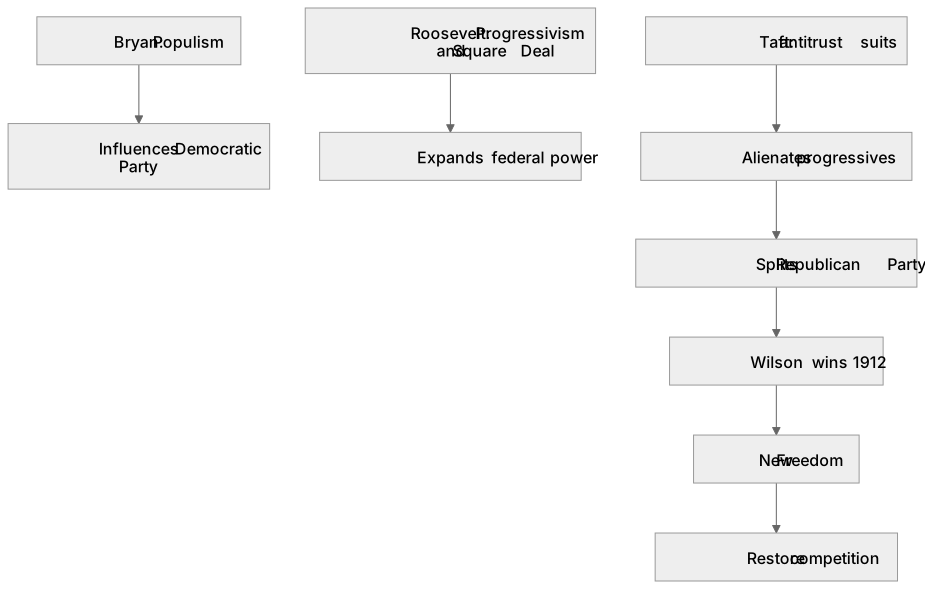
This era was defined by transformative ideologies and leaders. William Jennings Bryan championed Populism, advocating for bimetallism and agrarian rights, heavily influencing the Democratic Party. Theodore Roosevelt embodied Progressivism through his 'Square Deal', expanding federal power to regulate trusts and conserve nature. William Howard Taft continued antitrust suits but alienated progressives, splitting the Republican Party. This division enabled Woodrow Wilson’s 1912 victory with his 'New Freedom' platform, which sought to restore competition by dismantling monopolies, lowering tariffs, and reforming banking via the Federal Reserve Act.
What earns the marks
- Assess William Jennings Bryan's role in integrating Populist ideas, such as the 'free silver' movement, into mainstream Democratic politics.
- Evaluate Theodore Roosevelt's 'Square Deal' and his use of the presidency as a 'bully pulpit' to advance Progressive conservation and trust-busting.
- Analyse William Howard Taft's presidency, noting his success in initiating antitrust lawsuits alongside his political failure to maintain Republican unity.
- Examine Woodrow Wilson's 'New Freedom' legislation, specifically the Underwood Tariff, the Clayton Antitrust Act, and the creation of the Federal Reserve.
Common mistakes and how to put them right
Confusing Roosevelt's 'New Nationalism' with Wilson's 'New Freedom'.
Put it right: Roosevelt favoured regulating monopolies, whereas Wilson initially campaigned on dismantling them to restore small-business competition.
Viewing Taft solely as a conservative failure.
Put it right: Taft actually initiated more antitrust suits than Roosevelt and supported the 16th and 17th Amendments.
Treating Populism and Progressivism as identical.
Put it right: Populism was primarily a rural, agrarian movement, while Progressivism was largely urban, middle-class, and focused on scientific efficiency.
Exam tips
- Contrast the political bases of Populism (agrarian/rural) and Progressivism (urban/middle-class) to demonstrate a nuanced understanding of reform movements.
- Use the 1912 presidential election as a focal point to analyse the ideological clash between Taft, Roosevelt, and Wilson.
- Link Wilson's 'New Freedom' reforms directly to the economic grievances originally raised by Bryan and the Populists in the 1890s.
Try the lesson
The start of the 1K The making of a Superpower: USA, 1865–1975 – Populism, progressivism and imperialism, 1890–1920: The ideas and influence of Bryan, Roosevelt and Taft; Populism, Progressivism and Wilson’s New Freedom lesson, made from checked teaching notes for this specification point.
Have a go first
Which economic policy was a central pillar of William Jennings Bryan’s Populist-backed presidential campaign in 1896?
Listen
This era was defined by transformative ideologies and leaders. William Jennings Bryan championed Populism, advocating for bimetallism and agrarian rights, heavily influencing the Democratic Party. Theodore Roosevelt embodied Progressivism through his 'Square Deal', expanding federal power to regulate trusts and conserve nature. William Howard Taft continued antitrust suits but alienated progressives, splitting the Republican Party. This division enabled Woodrow Wilson’s 1912 victory with his 'New Freedom' platform, which sought to restore competition by dismantling monopolies, lowering tariffs, and reforming banking via the Federal Reserve Act. A strong answer earns marks for these points. Assess William Jennings Bryan's role in integrating Populist ideas, such as the 'free silver' movement, into mainstream Democratic politics. Evaluate Theodore Roosevelt's 'Square Deal' and his use of the presidency as a 'bully pulpit' to advance Progressive conservation and trust-busting. Analyse William Howard Taft's presidency, noting his success in initiating antitrust lawsuits alongside his political failure to maintain Republican unity. Examine Woodrow Wilson's 'New Freedom' legislation, specifically the Underwood Tariff, the Clayton Antitrust Act, and the creation of the Federal Reserve. Exam tip: Contrast the political bases of Populism (agrarian/rural) and Progressivism (urban/middle-class) to demonstrate a nuanced understanding of reform movements.
See it
Key words
Say what each word means before you turn the card.
Populism
Try answering aloud or in your head before turning the card.
Progressivism
Try answering aloud or in your head before turning the card.
New Freedom
Try answering aloud or in your head before turning the card.
Square Deal
Try answering aloud or in your head before turning the card.
See every definition
- Populism
- A movement championed by William Jennings Bryan, advocating for bimetallism and agrarian rights and heavily influencing the Democratic Party.
- Progressivism
- An ideology embodied by Theodore Roosevelt through his 'Square Deal', expanding federal power to regulate trusts and conserve nature.
- New Freedom
- Woodrow Wilson's platform which sought to restore competition by dismantling monopolies, lowering tariffs, and reforming banking via the Federal Reserve Act.
- Square Deal
- Theodore Roosevelt's embodiment of Progressivism, expanding federal power to regulate trusts and conserve nature.
Label the diagram
Some boxes have lost their names. Pick the right name for each number.
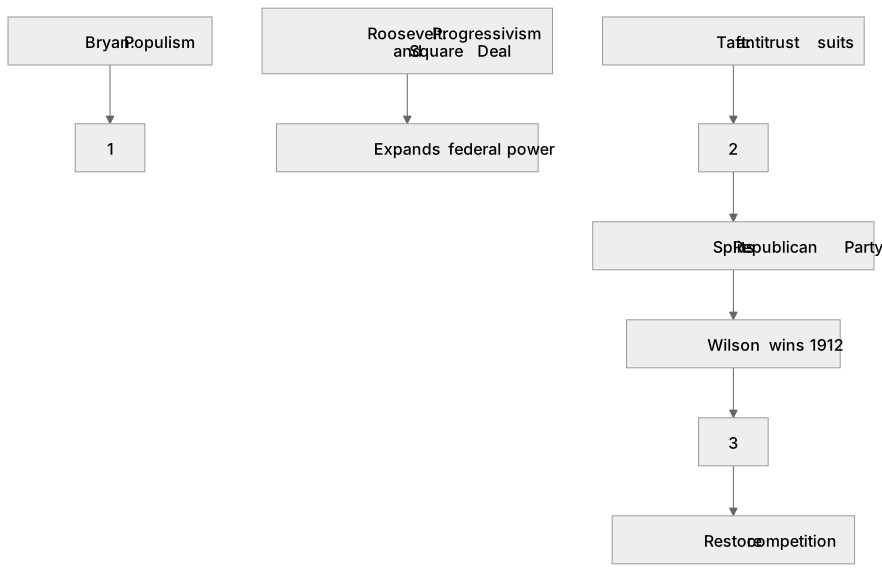
1Box 1
2Box 2
3Box 3
There is more to this lesson
The full lesson goes on to check your understanding and help you earn the marks. Create a free account to carry on, with your progress saved.
A week of Premium from your first lesson · Then the free plan continues · No card, no charge
Test your understanding of 1K The making of a Superpower: USA, 1865–1975 – Populism, progressivism and imperialism, 1890–1920: The ideas and influence of Bryan, Roosevelt and Taft; Populism, Progressivism and Wilson’s New Freedom
Active recall beats re-reading. Take an instant quiz now to test what you’ve learned and lock it into long-term memory.
A week of Premium from your first lesson · Then the free plan continues · No card, no charge