AQA · A-Level · History
Course version: 7042 · Version from Sept 2017
USA, 1865–1975 – Populism, progressivism and imperialism, 1890–1920: The…
Full specification wording
1K The making of a Superpower: USA, 1865–1975 – Populism, progressivism and imperialism, 1890–1920: The USA by 1920: economic power; social and ethnic divisions; political reaction and renewed isolationism
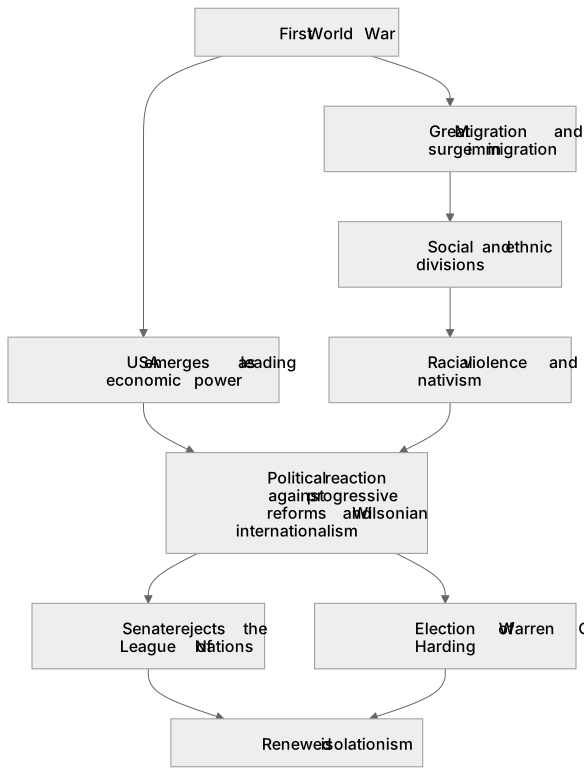
By 1920, the USA emerged from the First World War as the world's leading economic power, transitioning from a debtor to a major creditor nation with booming industrial output.
Checked against the AQA 7042 specification (opens in a new tab) on .
- Point 6 of 6
- 4 key terms
Study notes
From the checked teaching notes for this specification point.
The idea
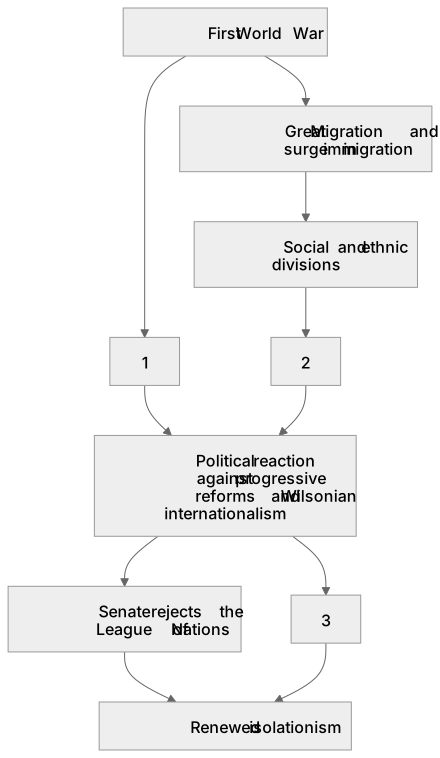
By 1920, the USA emerged from the First World War as the world's leading economic power, transitioning from a debtor to a major creditor nation with booming industrial output. However, this prosperity masked deep social and ethnic divisions, exacerbated by the Great Migration of African Americans and a surge in immigration, which fuelled racial violence and nativism. The period witnessed a fierce political reaction against progressive reforms and Wilsonian internationalism. This culminated in the Senate's rejection of the League of Nations and the election of Warren G. Harding, signalling a return to 'normalcy' and renewed isolationism in foreign policy.
What earns the marks
- Assess the extent of US economic power by 1920, focusing on its status as a global creditor and the expansion of its manufacturing base during the war.
- Analyse the causes and impacts of social and ethnic divisions, including the 1919 Red Scare, race riots such as the Red Summer, and rising anti-immigrant sentiment.
- Evaluate the political reaction against Wilson's domestic and foreign policies, leading to the Republican resurgence in the 1920 election.
- Explain the concept of 'renewed isolationism', detailing the Senate's refusal to ratify the Treaty of Versailles or join the League of Nations.
Common mistakes and how to put them right
Assuming the US economy was struggling immediately after the First World War.
Put it right by highlighting that while there was a brief post-war recession, the US emerged as the dominant global economic power and creditor.
Treating isolationism as a complete withdrawal from world affairs.
Put it right by defining renewed isolationism as avoiding political and military entanglements, while still engaging heavily in international trade and finance.
Ignoring the domestic racial tensions of the era.
Put it right: Explicitly linking the Great Migration and post-war demobilisation to the severe racial violence of 1919.
Exam tips
- Use the rejection of the League of Nations as the primary case study for demonstrating the political shift towards renewed isolationism.
- Connect the economic boom to social tensions, showing how competition for jobs and housing in northern cities exacerbated ethnic and racial divisions.
- Contrast Wilson's internationalist vision with Harding's successful 1920 campaign for a 'return to normalcy' to illustrate the political reaction of the era.
Try the lesson
The start of the 1K The making of a Superpower: USA, 1865–1975 – Populism, progressivism and imperialism, 1890–1920: The USA by 1920: economic power; social and ethnic divisions; political reaction and renewed isolationism lesson, made from checked teaching notes for this specification point.
Have a go first
Which action best demonstrates the political reaction and renewed isolationism in the United States immediately following the First World War?
Listen
By 1920, the USA emerged from the First World War as the world's leading economic power, transitioning from a debtor to a major creditor nation with booming industrial output. However, this prosperity masked deep social and ethnic divisions, exacerbated by the Great Migration of African Americans and a surge in immigration, which fuelled racial violence and nativism. The period witnessed a fierce political reaction against progressive reforms and Wilsonian internationalism. This culminated in the Senate's rejection of the League of Nations and the election of Warren G. Harding, signalling a return to 'normalcy' and renewed isolationism in foreign policy. A strong answer earns marks for these points. Assess the extent of US economic power by 1920, focusing on its status as a global creditor and the expansion of its manufacturing base during the war. Analyse the causes and impacts of social and ethnic divisions, including the 1919 Red Scare, race riots such as the Red Summer, and rising anti-immigrant sentiment. Evaluate the political reaction against Wilson's domestic and foreign policies, leading to the Republican resurgence in the 1920 election. Explain the concept of 'renewed isolationism', detailing the Senate's refusal to ratify the Treaty of Versailles or join the League of Nations. A common slip: Assuming the US economy was struggling immediately after the First World War. Instead, highlighting that while there was a brief post-war recession, the US emerged as the dominant global economic power and creditor. Exam tip: Use the rejection of the League of Nations as the primary case study for demonstrating the political shift towards renewed isolationism.
See it
Key words
Say what each word means before you turn the card.
Economic Dominance
Try answering aloud or in your head before turning the card.
Nativism and Racism
Try answering aloud or in your head before turning the card.
Isolationism
Try answering aloud or in your head before turning the card.
Political Conservatism
Try answering aloud or in your head before turning the card.
See every definition
- Economic Dominance
- By 1920 the USA emerged from the First World War as the world's leading economic power, transitioning from a debtor to a major creditor nation with booming industrial output.
- Nativism and Racism
- Deep social and ethnic divisions were exacerbated by the Great Migration of African Americans and a surge in immigration, which fuelled racial violence and nativism.
- Isolationism
- Renewed isolationism meant avoiding political and military entanglements, while still engaging heavily in international trade and finance.
- Political Conservatism
- A fierce political reaction against progressive reforms and Wilsonian internationalism culminated in the Senate's rejection of the League of Nations and the election of Warren G. Harding.
Label the diagram
Some boxes have lost their names. Pick the right name for each number.
1Box 1
2Box 2
3Box 3
There is more to this lesson
The full lesson goes on to check your understanding and help you earn the marks. Create a free account to carry on, with your progress saved.
A week of Premium from your first lesson · Then the free plan continues · No card, no charge
Test your understanding of 1K The making of a Superpower: USA, 1865–1975 – Populism, progressivism and imperialism, 1890–1920: The USA by 1920: economic power; social and ethnic divisions; political reaction and renewed isolationism
Active recall beats re-reading. Take an instant quiz now to test what you’ve learned and lock it into long-term memory.
A week of Premium from your first lesson · Then the free plan continues · No card, no charge