AQA · A-Level · History
Course version: 7042 · Version from Sept 2017
USA, 1865–1975 – The Era of Reconstruction and the Gilded Age, 1865–1890:…
Full specification wording
1K The making of a Superpower: USA, 1865–1975 – The Era of Reconstruction and the Gilded Age, 1865–1890: The politics of the Gilded Age and the era of weak presidents; political corruption
The Gilded Age (circa 1870–1890) was characterised by rapid economic growth masking deep political corruption and a succession of weak, forgettable presidents.
Checked against the AQA 7042 specification (opens in a new tab) on .
- Point 2 of 6
- 4 key terms
Study notes
From the checked teaching notes for this specification point.
The idea
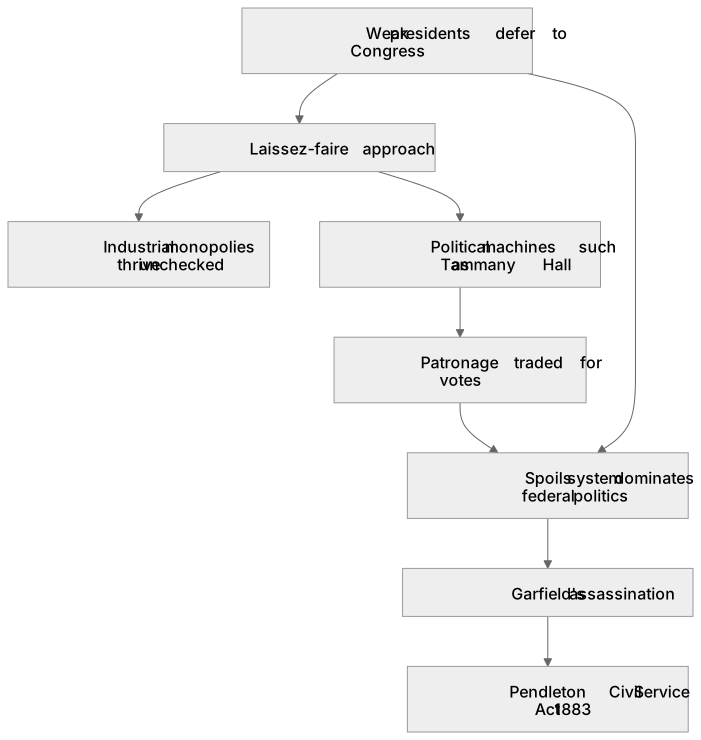
The Gilded Age (circa 1870–1890) was characterised by rapid economic growth masking deep political corruption and a succession of weak, forgettable presidents. Executives like Hayes, Garfield, and Arthur largely deferred to Congress and powerful party bosses, adhering to a laissez-faire approach that allowed industrial monopolies to thrive unchecked. Political corruption was systemic, epitomised by urban machines like New York's Tammany Hall under Boss Tweed, which traded patronage for votes. The spoils system dominated federal politics until Garfield’s assassination spurred the Pendleton Civil Service Act of 1883. This era demonstrates how weak federal leadership enabled corporate dominance and entrenched political graft.
What earns the marks
- Analyse the concept of 'weak presidents' (Hayes, Garfield, Arthur, Cleveland, Harrison) who lacked strong mandates and deferred to congressional power.
- Evaluate the role of political machines, such as Tammany Hall, in controlling urban politics through patronage, graft, and immigrant voter mobilisation.
- Examine the impact of the spoils system on federal governance and the significance of the Pendleton Civil Service Act (1883) in attempting reform.
- Discuss the close relationship between big business and politicians, including bribery and the lack of federal regulation over emerging monopolies.
- Assess the ideological dominance of laissez-faire capitalism and Social Darwinism in justifying government inaction during the Gilded Age.
Common mistakes and how to put them right
Confusing the Gilded Age with the Progressive Era.
Put it right: The Gilded Age was marked by laissez-faire and corruption, whereas the Progressive Era sought to actively reform these exact issues.
Assuming all Gilded Age presidents achieved nothing.
Put it right: Arthur, for example, surprisingly championed the Pendleton Act despite being a product of the spoils system himself.
Treating political machines as entirely negative.
Put it right: While corrupt, they often provided essential social services and assimilation support to new immigrants that the federal government ignored.
Exam tips
- Use specific examples of corruption, such as Boss Tweed and Tammany Hall, to illustrate the mechanics of machine politics in exam answers.
- Connect the weakness of the presidency to the intense partisan deadlock and the frequent split control of Congress during this period.
- Argue how the assassination of President Garfield served as a catalyst for civil service reform, shifting the government away from the patronage system.
Try the lesson
The start of the 1K The making of a Superpower: USA, 1865–1975 – The Era of Reconstruction and the Gilded Age, 1865–1890: The politics of the Gilded Age and the era of weak presidents; political corruption lesson, made from checked teaching notes for this specification point.
Have a go first
Which term is most commonly used to describe the system of political corruption and patronage that dominated the Gilded Age?
Listen
The Gilded Age (circa 1870–1890) was characterised by rapid economic growth masking deep political corruption and a succession of weak, forgettable presidents. Executives like Hayes, Garfield, and Arthur largely deferred to Congress and powerful party bosses, adhering to a laissez-faire approach that allowed industrial monopolies to thrive unchecked. Political corruption was systemic, epitomised by urban machines like New York's Tammany Hall under Boss Tweed, which traded patronage for votes. The spoils system dominated federal politics until Garfield’s assassination spurred the Pendleton Civil Service Act of 1883. This era demonstrates how weak federal leadership enabled corporate dominance and entrenched political graft. A strong answer earns marks for these points. Analyse the concept of 'weak presidents' (Hayes, Garfield, Arthur, Cleveland, Harrison) who lacked strong mandates and deferred to congressional power. Evaluate the role of political machines, such as Tammany Hall, in controlling urban politics through patronage, graft, and immigrant voter mobilisation. Examine the impact of the spoils system on federal governance and the significance of the Pendleton Civil Service Act (1883) in attempting reform. Discuss the close relationship between big business and politicians, including bribery and the lack of federal regulation over emerging monopolies. Exam tip: Use specific examples of corruption, such as Boss Tweed and Tammany Hall, to illustrate the mechanics of machine politics in exam answers.
See it
Watch it explained
What is the one idea the video explains? Say it in a sentence.
Read the described scene instead
The Gilded Age, roughly eighteen seventy to eighteen ninety, saw rapid economic growth while political corruption and weak leadership sat close beneath the surface. This lesson examines how laissez-faire ideas, patronage, and urban machines shaped Gilded Age politics. Presidents such as Hayes, Garfield, Arthur, Cleveland, and Harrison often lacked strong mandates. They largely deferred to Congress and powerful party bosses, and their weakness helped intense partisan deadlock and frequent split control of Congress. Federal leadership therefore did little to check industrial monopolies. Urban political machines, notably New York's Tammany Hall under Boss Tweed, controlled city politics through patronage and graft. They traded jobs and favours for votes, mobilised immigrant voters, and sometimes provided social services and assimilation support that federal government ignored. At federal level, the spoils system made patronage central to governance. Consider why Garfield's assassination mattered. The spoils system had made federal appointments a tool of party patronage. After Garfield was shot by a disappointed office seeker, pressure grew for reform, leading to the Pendleton Civil Service Act of eighteen eighty-three. Pause here and trace that causal chain before the answer: patronage created grievance, assassination created shock, and reform followed. Laissez-faire capitalism and Social Darwinism justified government inaction. Big business and politicians grew closely connected through bribery and influence, while federal regulation over emerging monopolies remained weak. This relationship helped corporate dominance become entrenched during the Gilded Age. Avoid confusing the Gilded Age with the Progressive Era. The Gilded Age is marked by laissez-faire and corruption, while the Progressive Era sought to reform those problems. Also, Arthur surprisingly championed the Pendleton Act despite being a product of the spoils system. And machines were corrupt, but they often provided services and assimilation support to immigrants. To recap, the Gilded Age combined rapid growth with weak presidents, patronage, and machine politics. Laissez-faire ideology and close business-government ties limited reform, and the Pendleton Act was a significant but partial response to the spoils system. Use these connections to explain how corruption and corporate influence persisted.
Key words
Say what each word means before you turn the card.
Laissez-faire capitalism
Try answering aloud or in your head before turning the card.
Political patronage and reform
Try answering aloud or in your head before turning the card.
Urbanisation and machine politics
Try answering aloud or in your head before turning the card.
Corporate influence on government
Try answering aloud or in your head before turning the card.
See every definition
- Laissez-faire capitalism
- An approach allowing industrial monopolies to thrive unchecked, adhered to by executives who largely deferred to Congress and powerful party bosses.
- Political patronage and reform
- The spoils system dominated federal politics until Garfield's assassination spurred the Pendleton Civil Service Act of 1883, which attempted reform.
- Urbanisation and machine politics
- Systemic political corruption was epitomised by urban machines like New York's Tammany Hall under Boss Tweed, which traded patronage for votes.
- Corporate influence on government
- Weak federal leadership enabled corporate dominance and entrenched political graft, with a close relationship between big business and politicians.
Label the diagram
Some boxes have lost their names. Pick the right name for each number.
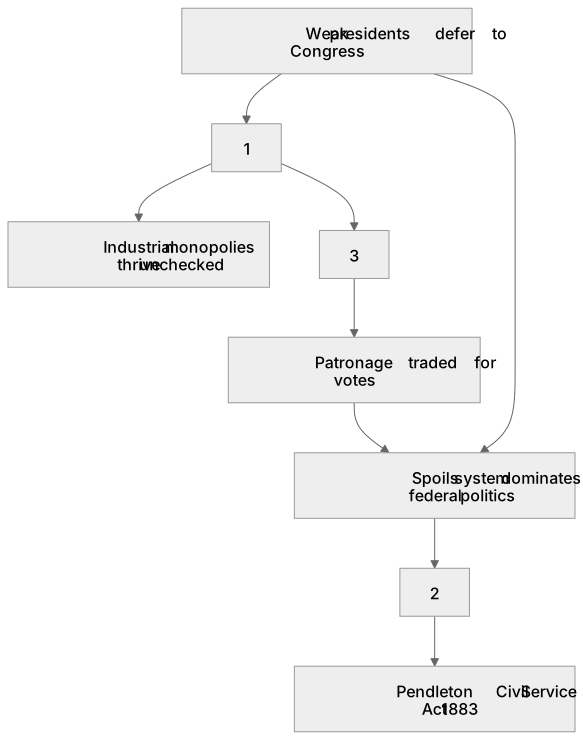
1Box 1
2Box 2
3Box 3
There is more to this lesson
The full lesson goes on to check your understanding and help you earn the marks. Create a free account to carry on, with your progress saved.
A week of Premium from your first lesson · Then the free plan continues · No card, no charge
Test your understanding of 1K The making of a Superpower: USA, 1865–1975 – The Era of Reconstruction and the Gilded Age, 1865–1890: The politics of the Gilded Age and the era of weak presidents; political corruption
Active recall beats re-reading. Take an instant quiz now to test what you’ve learned and lock it into long-term memory.
A week of Premium from your first lesson · Then the free plan continues · No card, no charge