AQA · A-Level · History
Course version: 7042 · Version from Sept 2017
USA, 1865–1975 – The Era of Reconstruction and the Gilded Age, 1865–1890:…
Full specification wording
1K The making of a Superpower: USA, 1865–1975 – The Era of Reconstruction and the Gilded Age, 1865–1890: The weaknesses of Federal Government: Johnson, Grant and the failure of Radical Reconstruction
The post-Civil War era exposed severe weaknesses in the Federal Government, undermining efforts to rebuild the South.
Checked against the AQA 7042 specification (opens in a new tab) on .
- Point 1 of 6
- 4 key terms
Study notes
From the checked teaching notes for this specification point.
The idea
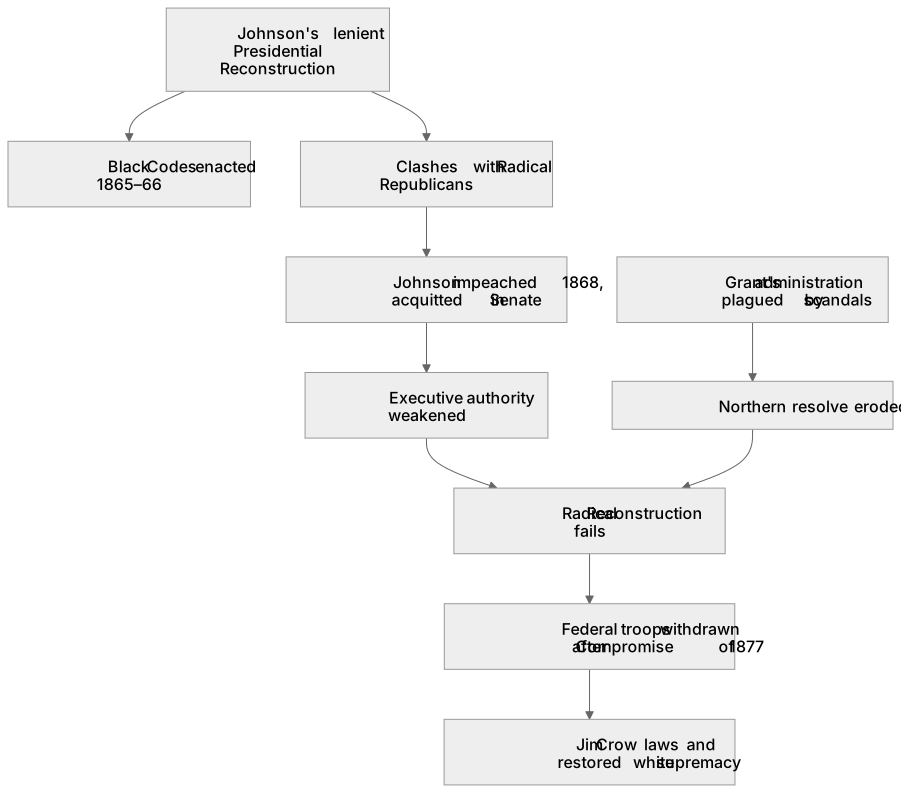
The post-Civil War era exposed severe weaknesses in the Federal Government, undermining efforts to rebuild the South. Andrew Johnson’s leniency allowed Southern states to enact oppressive Black Codes in 1865–66. His bitter clashes with Radical Republicans culminated in his 1868 impeachment, severely weakening executive authority. Ulysses S. Grant, though a war hero, presided over an administration plagued by scandals, such as the Whiskey Ring, which distracted from Reconstruction efforts and eroded Northern resolve. Consequently, Radical Reconstruction failed; federal troops were withdrawn following the Compromise of 1877, allowing Southern states to establish Jim Crow laws and restore white supremacy, highlighting federal impotence.
What earns the marks
- Assess Johnson's lenient Presidential Reconstruction, which permitted the early enactment of Black Codes, and his subsequent impeachment by Congress.
- Evaluate the impact of Johnson's 1868 impeachment on the balance of power, noting it permanently weakened the executive branch during this era.
- Analyse the scandals of Grant's presidency, such as Crédit Mobilier and the Whiskey Ring, and how they eroded Northern public support for federal intervention.
- Explain the failure of Radical Reconstruction, focusing on the Compromise of 1877, the withdrawal of federal troops, and the subsequent rise of Jim Crow laws.
Common mistakes and how to put them right
Stating Johnson was 'nearly impeached' or removed from office.
Put it right: Clarify that Johnson was successfully impeached by the House of Representatives in 1868, but acquitted by a single vote in the Senate.
Placing the enactment of Black Codes after the end of Radical Reconstruction.
Put it right: Sequence correctly; Black Codes were passed in 1865–66 under Johnson's lenient policies, prompting the start of Radical Reconstruction.
Blaming Grant personally for orchestrating all corruption.
Put it right: Note that while his administration was highly corrupt, Grant himself was largely naive and overly loyal to dishonest associates.
Exam tips
- Link the scandals of Grant's administration directly to the declining Northern appetite for funding and enforcing Reconstruction in the South.
- Contrast Johnson's lenient Presidential Reconstruction with the harsher Congressional (Radical) Reconstruction to demonstrate the deep divisions within the federal government.
- Use the Compromise of 1877 as the definitive endpoint of Radical Reconstruction when evaluating the long-term failure of federal policy.
Try the lesson
The start of the 1K The making of a Superpower: USA, 1865–1975 – The Era of Reconstruction and the Gilded Age, 1865–1890: The weaknesses of Federal Government: Johnson, Grant and the failure of Radical Reconstruction lesson, made from checked teaching notes for this specification point.
Have a go first
Which action by President Andrew Johnson most clearly demonstrated the weakness of his relationship with the Radical Republicans in Congress?
Listen
The post-Civil War era exposed severe weaknesses in the Federal Government, undermining efforts to rebuild the South. Andrew Johnson’s leniency allowed Southern states to enact oppressive Black Codes in 1865–66. His bitter clashes with Radical Republicans culminated in his 1868 impeachment, severely weakening executive authority. Ulysses S. Grant, though a war hero, presided over an administration plagued by scandals, such as the Whiskey Ring, which distracted from Reconstruction efforts and eroded Northern resolve. Consequently, Radical Reconstruction failed; federal troops were withdrawn following the Compromise of 1877, allowing Southern states to establish Jim Crow laws and restore white supremacy, highlighting federal impotence. A strong answer earns marks for these points. Assess Johnson's lenient Presidential Reconstruction, which permitted the early enactment of Black Codes, and his subsequent impeachment by Congress. Evaluate the impact of Johnson's 1868 impeachment on the balance of power, noting it permanently weakened the executive branch during this era. Analyse the scandals of Grant's presidency, such as Crédit Mobilier and the Whiskey Ring, and how they eroded Northern public support for federal intervention. Explain the failure of Radical Reconstruction, focusing on the Compromise of 1877, the withdrawal of federal troops, and the subsequent rise of Jim Crow laws. A common slip: Stating Johnson was 'nearly impeached' or removed from office. Instead, Clarify that Johnson was successfully impeached by the House of Representatives in 1868, but acquitted by a single vote in the Senate. Exam tip: Link the scandals of Grant's administration directly to the declining Northern appetite for funding and enforcing Reconstruction in the South.
See it
Put the events in order
Put these events in the order they happened, earliest first.
- 1. Southern states enact oppressive Black Codes under Johnson's leniency
- 2. Compromise sees withdrawal of federal troops
- 3. Johnson impeached by the House of Representatives
Key words
Say what each word means before you turn the card.
Executive versus Legislative power
Try answering aloud or in your head before turning the card.
Political corruption and scandal
Try answering aloud or in your head before turning the card.
Federalism and states' rights
Try answering aloud or in your head before turning the card.
Civil Rights and racial inequality
Try answering aloud or in your head before turning the card.
See every definition
- Executive versus Legislative power
- Bitter clashes between Johnson and Radical Republicans culminated in his 1868 impeachment, which permanently weakened the executive branch during this era.
- Political corruption and scandal
- Grant's administration was plagued by scandals such as the Whiskey Ring, which distracted from Reconstruction efforts and eroded Northern resolve.
- Federalism and states' rights
- Federal troops were withdrawn following the Compromise of 1877, allowing Southern states to establish Jim Crow laws and restore white supremacy, highlighting federal impotence.
- Civil Rights and racial inequality
- Johnson's leniency allowed Southern states to enact oppressive Black Codes in 1865–66, and after the withdrawal of federal troops Southern states established Jim Crow laws and restored white supremacy.
Label the diagram
Some boxes have lost their names. Pick the right name for each number.
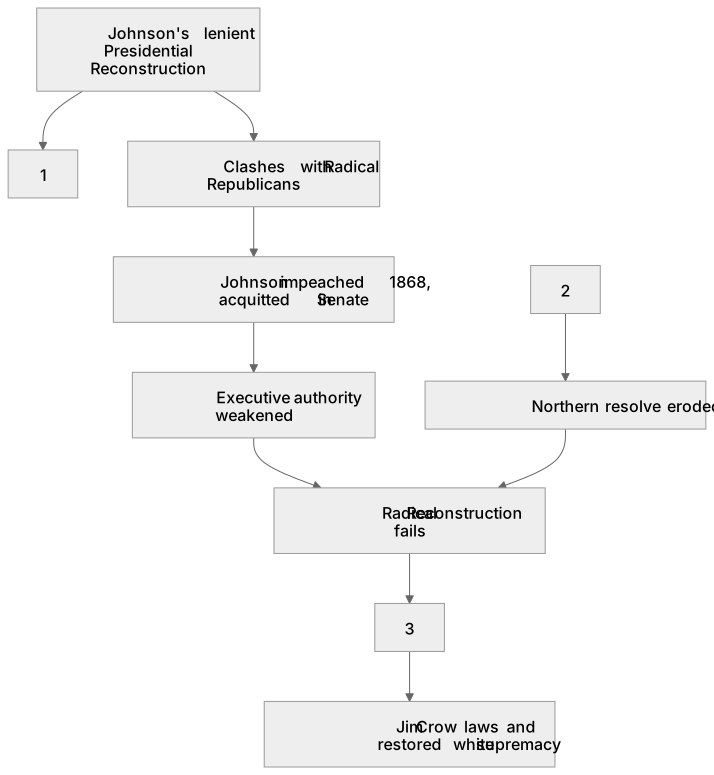
1Box 1
2Box 2
3Box 3
There is more to this lesson
The full lesson goes on to check your understanding and help you earn the marks. Create a free account to carry on, with your progress saved.
A week of Premium from your first lesson · Then the free plan continues · No card, no charge
Test your understanding of 1K The making of a Superpower: USA, 1865–1975 – The Era of Reconstruction and the Gilded Age, 1865–1890: The weaknesses of Federal Government: Johnson, Grant and the failure of Radical Reconstruction
Active recall beats re-reading. Take an instant quiz now to test what you’ve learned and lock it into long-term memory.
A week of Premium from your first lesson · Then the free plan continues · No card, no charge