AQA · A-Level · History
Course version: 7042 · Version from Sept 2017
USA, 1865–1975 – The Superpower, 1945–1975 (A-level only): Domestic…
Full specification wording
1K The making of a Superpower: USA, 1865–1975 – The Superpower, 1945–1975 (A-level only): Domestic politics: Truman, Eisenhower and post-war reconstruction
Post-war reconstruction under Truman and Eisenhower shaped modern American domestic politics.
Checked against the AQA 7042 specification (opens in a new tab) on .
- Point 1 of 6
- 4 key terms
Study notes
From the checked teaching notes for this specification point.
The idea
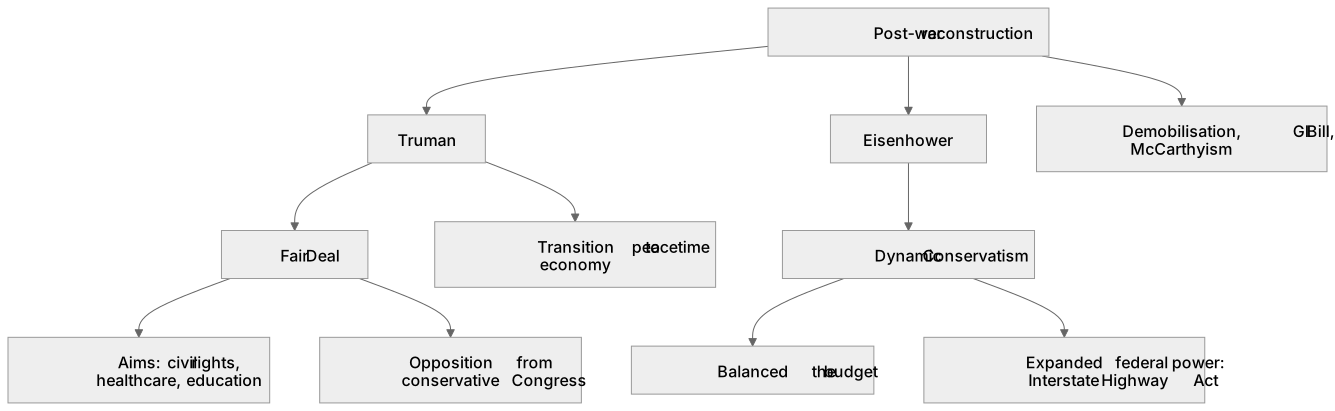
Post-war reconstruction under Truman and Eisenhower shaped modern American domestic politics. Truman’s 'Fair Deal' attempted to expand the New Deal, focusing on civil rights, healthcare, and education, but faced fierce opposition from a conservative Congress, though he successfully managed the transition to a peacetime economy. Eisenhower’s 'Dynamic Conservatism' balanced the budget while expanding federal power through infrastructure projects like the 1956 Interstate Highway Act. Both presidents navigated the complexities of post-war reconstruction, dealing with demobilisation, the GI Bill's economic impact, and the anti-communist hysteria of McCarthyism, which heavily influenced domestic policy and political discourse during this era.
What earns the marks
- Evaluate Truman's success in transitioning the US to a peacetime economy, including the impact of the GI Bill and his handling of post-war strikes.
- Analyse the aims and limitations of Truman's Fair Deal, noting congressional opposition to healthcare and civil rights legislation.
- Assess Eisenhower's 'Dynamic Conservatism', focusing on his acceptance of New Deal premises alongside fiscal conservatism.
- Examine the domestic impact of the Cold War, specifically how McCarthyism constrained domestic political agendas under both administrations.
Common mistakes and how to put them right
Assuming Truman's Fair Deal was entirely successful.
Put it right: Recognise that a conservative coalition in Congress blocked major initiatives like national healthcare.
Characterising Eisenhower as a strictly laissez-faire conservative.
Put it right: Explain his 'Dynamic Conservatism' which expanded Social Security and funded the Interstate Highway System.
Treating post-war reconstruction solely as an economic process.
Put it right: Include the social and political dimensions, such as the Red Scare and early civil rights executive orders.
Exam tips
- Contrast Truman's combative relationship with Congress against Eisenhower's more conciliatory, bipartisan approach to domestic legislation.
- Use specific legislative examples, such as the Taft-Hartley Act (1947) or the Interstate Highway Act (1956), to support arguments about domestic policy.
- Link domestic political developments to the broader context of the Cold War, showing how foreign policy anxieties influenced domestic anti-communism.
Try the lesson
The start of the 1K The making of a Superpower: USA, 1865–1975 – The Superpower, 1945–1975 (A-level only): Domestic politics: Truman, Eisenhower and post-war reconstruction lesson, made from checked teaching notes for this specification point.
Have a go first
Which of the following terms was used by President Harry S. Truman to describe his domestic legislative programme following the Second World War?
Listen
Post-war reconstruction under Truman and Eisenhower shaped modern American domestic politics. Truman’s 'Fair Deal' attempted to expand the New Deal, focusing on civil rights, healthcare, and education, but faced fierce opposition from a conservative Congress, though he successfully managed the transition to a peacetime economy. Eisenhower’s 'Dynamic Conservatism' balanced the budget while expanding federal power through infrastructure projects like the 1956 Interstate Highway Act. Both presidents navigated the complexities of post-war reconstruction, dealing with demobilisation, the GI Bill's economic impact, and the anti-communist hysteria of McCarthyism, which heavily influenced domestic policy and political discourse during this era. A strong answer earns marks for these points. Evaluate Truman's success in transitioning the US to a peacetime economy, including the impact of the GI Bill and his handling of post-war strikes. Analyse the aims and limitations of Truman's Fair Deal, noting congressional opposition to healthcare and civil rights legislation. Assess Eisenhower's 'Dynamic Conservatism', focusing on his acceptance of New Deal premises alongside fiscal conservatism. Examine the domestic impact of the Cold War, specifically how McCarthyism constrained domestic political agendas under both administrations. A common slip: Assuming Truman's Fair Deal was entirely successful. Instead, recognise that a conservative coalition in Congress blocked major initiatives like national healthcare. Exam tip: Contrast Truman's combative relationship with Congress against Eisenhower's more conciliatory, bipartisan approach to domestic legislation.
See it
Key words
Say what each word means before you turn the card.
Fair Deal
Try answering aloud or in your head before turning the card.
Dynamic Conservatism
Try answering aloud or in your head before turning the card.
McCarthyism
Try answering aloud or in your head before turning the card.
Post-war reconstruction
Try answering aloud or in your head before turning the card.
See every definition
- Fair Deal
- Truman's attempt to expand the New Deal, focusing on civil rights, healthcare and education, which faced fierce opposition from a conservative Congress.
- Dynamic Conservatism
- Eisenhower's approach that balanced the budget while expanding federal power through infrastructure projects such as the 1956 Interstate Highway Act.
- McCarthyism
- Anti-communist hysteria that heavily influenced domestic policy and political discourse during the era of Truman and Eisenhower.
- Post-war reconstruction
- The process under Truman and Eisenhower involving demobilisation, the GI Bill's economic impact and the transition to a peacetime economy.
Label the diagram
Some boxes have lost their names. Pick the right name for each number.
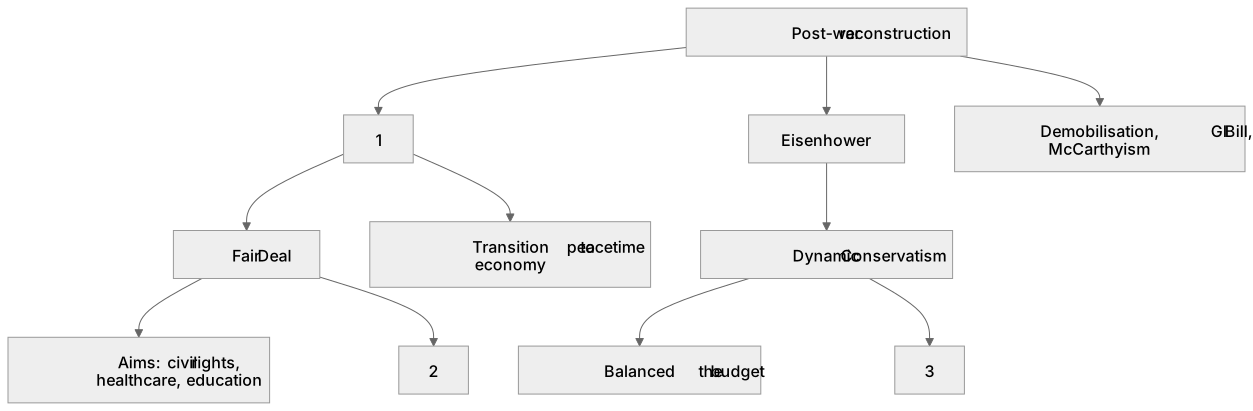
1Box 1
2Box 2
3Box 3
There is more to this lesson
The full lesson goes on to check your understanding and help you earn the marks. Create a free account to carry on, with your progress saved.
A week of Premium from your first lesson · Then the free plan continues · No card, no charge
Test your understanding of 1K The making of a Superpower: USA, 1865–1975 – The Superpower, 1945–1975 (A-level only): Domestic politics: Truman, Eisenhower and post-war reconstruction
Active recall beats re-reading. Take an instant quiz now to test what you’ve learned and lock it into long-term memory.
A week of Premium from your first lesson · Then the free plan continues · No card, no charge