AQA · A-Level · History
Course version: 7042 · Version from Sept 2017
USA, 1865–1975 – The Superpower, 1945–1975 (A-level only): Kennedy,…
Full specification wording
1K The making of a Superpower: USA, 1865–1975 – The Superpower, 1945–1975 (A-level only): Kennedy, Johnson and Nixon; New Frontier; the Great Society; Nixon and Republican revival
The 1960s and early 1970s witnessed profound shifts in US domestic politics.
Checked against the AQA 7042 specification (opens in a new tab) on .
- Point 2 of 6
- 4 key terms
Study notes
From the checked teaching notes for this specification point.
The idea
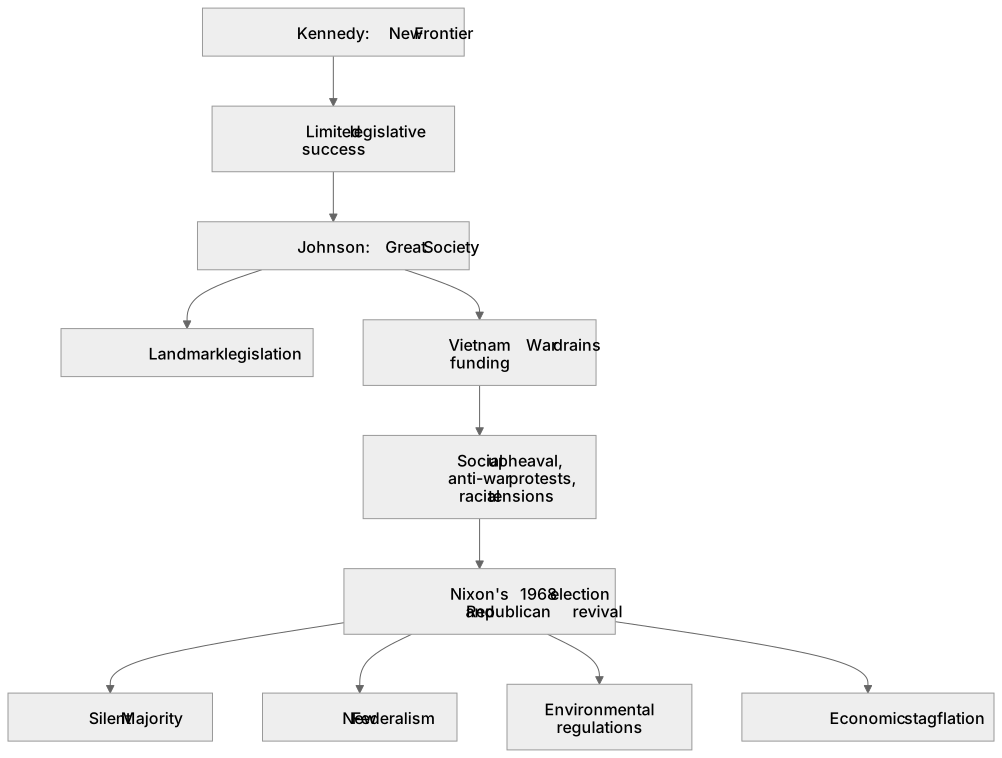
The 1960s and early 1970s witnessed profound shifts in US domestic politics. Kennedy’s 'New Frontier' promised progressive change in civil rights, healthcare, and poverty, but achieved limited legislative success before his assassination. Johnson capitalised on this legacy to launch the 'Great Society', securing landmark legislation like the Civil Rights Act (1964), Medicare, and Medicaid, though the Vietnam War ultimately drained its funding. The resulting social upheaval, anti-war protests, and racial tensions facilitated Nixon’s 1968 election and a Republican revival. Nixon appealed to the 'Silent Majority', implementing a 'New Federalism' that sought to decentralise power, whilst simultaneously expanding environmental regulations and grappling with emerging economic stagflation before Watergate.
What earns the marks
- Assess the legislative achievements of Kennedy's New Frontier, contrasting his rhetorical success with his struggles against a conservative Congress.
- Evaluate the scope and impact of Johnson's Great Society, particularly the Civil Rights Act, Voting Rights Act, and the War on Poverty.
- Analyse the factors contributing to the Republican revival under Nixon, including the backlash against civil rights, anti-war protests, and social liberalism.
- Examine Nixon's domestic policies, noting the contradiction between his conservative 'New Federalism' rhetoric and his expansion of federal environmental and social agencies.
Common mistakes and how to put them right
Overstating Kennedy's legislative achievements.
Put it right: Distinguish between Kennedy's inspirational rhetoric and the actual legislation passed, much of which was stalled in Congress.
Viewing Nixon's domestic policy as purely conservative.
Put it right: Acknowledge his creation of the Environmental Protection Agency (EPA) and support for affirmative action initiatives.
Claiming economic stagnation caused Nixon's 1968 election.
Put it right: Recognise that the economy was expanding in 1968; Nixon's election was driven by social upheaval, while stagflation became a major issue during his presidency.
Exam tips
- Compare the legislative effectiveness of Kennedy and Johnson, noting how Johnson used his congressional experience and the post-assassination mood to pass stalled bills.
- Use the concept of the 'Silent Majority' to explain the political realignment that enabled Nixon's Republican revival in 1968 and 1972.
- Evaluate the long-term legacy of the Great Society by balancing its successes in reducing poverty against criticisms of welfare dependency.
Try the lesson
The start of the 1K The making of a Superpower: USA, 1865–1975 – The Superpower, 1945–1975 (A-level only): Kennedy, Johnson and Nixon; New Frontier; the Great Society; Nixon and Republican revival lesson, made from checked teaching notes for this specification point.
Have a go first
Which of the following legislative achievements was a central component of Lyndon B. Johnson's 'Great Society' programme?
Listen
The 1960s and early 1970s witnessed profound shifts in US domestic politics. Kennedy’s 'New Frontier' promised progressive change in civil rights, healthcare, and poverty, but achieved limited legislative success before his assassination. Johnson capitalised on this legacy to launch the 'Great Society', securing landmark legislation like the Civil Rights Act (1964), Medicare, and Medicaid, though the Vietnam War ultimately drained its funding. The resulting social upheaval, anti-war protests, and racial tensions facilitated Nixon’s 1968 election and a Republican revival. Nixon appealed to the 'Silent Majority', implementing a 'New Federalism' that sought to decentralise power, whilst simultaneously expanding environmental regulations and grappling with emerging economic stagflation before Watergate. A strong answer earns marks for these points. Assess the legislative achievements of Kennedy's New Frontier, contrasting his rhetorical success with his struggles against a conservative Congress. Evaluate the scope and impact of Johnson's Great Society, particularly the Civil Rights Act, Voting Rights Act, and the War on Poverty. Analyse the factors contributing to the Republican revival under Nixon, including the backlash against civil rights, anti-war protests, and social liberalism. Examine Nixon's domestic policies, noting the contradiction between his conservative 'New Federalism' rhetoric and his expansion of federal environmental and social agencies. A common slip: Overstating Kennedy's legislative achievements. Instead, Distinguish between Kennedy's inspirational rhetoric and the actual legislation passed, much of which was stalled in Congress. Exam tip: Compare the legislative effectiveness of Kennedy and Johnson, noting how Johnson used his congressional experience and the post-assassination mood to pass stalled bills.
See it
Key words
Say what each word means before you turn the card.
New Frontier
Try answering aloud or in your head before turning the card.
Great Society
Try answering aloud or in your head before turning the card.
Silent Majority
Try answering aloud or in your head before turning the card.
New Federalism
Try answering aloud or in your head before turning the card.
See every definition
- New Frontier
- Kennedy's programme that promised progressive change in civil rights, healthcare and poverty, but achieved limited legislative success before his assassination.
- Great Society
- Johnson's programme, launched on Kennedy's legacy, which secured landmark legislation such as the Civil Rights Act (1964), Medicare and Medicaid, though the Vietnam War ultimately drained its funding.
- Silent Majority
- The group Nixon appealed to, whose support facilitated his 1968 election and a Republican revival amid social upheaval, anti-war protests and racial tensions.
- New Federalism
- Nixon's policy that sought to decentralise power, whilst he simultaneously expanded environmental regulations and grappled with emerging economic stagflation before Watergate.
Label the diagram
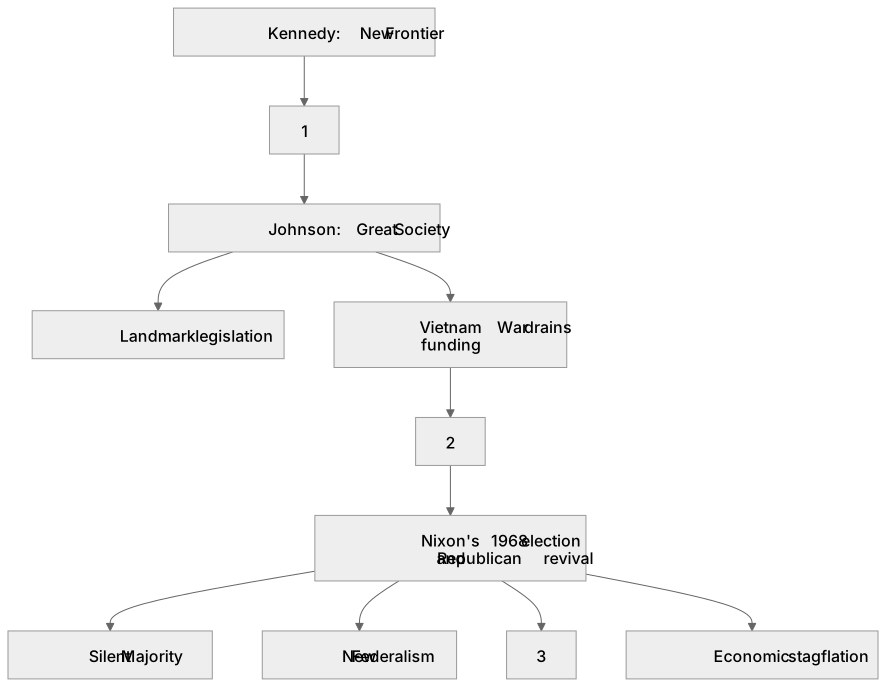
Some boxes have lost their names. Pick the right name for each number.
1Box 1
2Box 2
3Box 3
There is more to this lesson
The full lesson goes on to check your understanding and help you earn the marks. Create a free account to carry on, with your progress saved.
A week of Premium from your first lesson · Then the free plan continues · No card, no charge
Test your understanding of 1K The making of a Superpower: USA, 1865–1975 – The Superpower, 1945–1975 (A-level only): Kennedy, Johnson and Nixon; New Frontier; the Great Society; Nixon and Republican revival
Active recall beats re-reading. Take an instant quiz now to test what you’ve learned and lock it into long-term memory.
A week of Premium from your first lesson · Then the free plan continues · No card, no charge