AQA · A-Level · History
Course version: 7042 · Version from Sept 2017
USA, 1865–1975 – The Superpower, 1945–1975 (A-level only): The USA by…
Full specification wording
1K The making of a Superpower: USA, 1865–1975 – The Superpower, 1945–1975 (A-level only): The USA by 1975: its place as a Superpower; the limits of social cohesion; new cultural developments, including the role of women and the position of African-Americans
By 1975, the USA retained its global Superpower status, though this was bruised by the Vietnam War and the 1973 oil crisis.
Checked against the AQA 7042 specification (opens in a new tab) on .
- Point 6 of 6
- 4 key terms
Study notes
From the checked teaching notes for this specification point.
The idea
By 1975, the USA retained its global Superpower status, though this was bruised by the Vietnam War and the 1973 oil crisis. Domestically, the limits of social cohesion were starkly visible following a decade of protests and the Watergate scandal, which deeply eroded public trust. New cultural developments transformed society, driven by the counterculture and a rejection of 1950s conformity. The role of women shifted significantly due to second-wave feminism, highlighted by the fight for the Equal Rights Amendment. Meanwhile, the position of African-Americans evolved from the legislative victories of the civil rights movement to ongoing struggles against de facto segregation and economic inequality in urban centres.
What earns the marks
- Evaluate the extent to which the USA's Superpower status was undermined by military failure in Vietnam and economic stagnation by 1975.
- Analyse the factors contributing to the breakdown of social cohesion, including political scandals like Watergate and generational divides.
- Assess the impact of second-wave feminism on the social and economic role of women, noting both achievements and conservative backlash.
- Examine the position of African-Americans by 1975, contrasting the legal successes of the 1960s with persistent economic and social inequalities.
Common mistakes and how to put them right
Assuming the civil rights legislation of the 1960s resolved all racial issues.
Put it right: Discuss the persistence of de facto segregation, poverty, and racial tensions in the 1970s.
Overstating the decline of the USA as a Superpower.
Put it right: Balance the setbacks of Vietnam and economic crises with the USA's continued massive military and economic dominance.
Treating the feminist movement as universally successful.
Put it right: Acknowledge the limitations, such as the failure to ratify the Equal Rights Amendment (ERA) and the rise of conservative opposition.
Exam tips
- When discussing social cohesion, explicitly link cultural shifts and political events like Watergate to the decline in deference and trust in authority.
- Use specific examples of cultural developments, such as the influence of mass media or the counterculture, to illustrate broader societal changes.
- Compare the position of African-Americans and women in 1975 to their status in 1945 to effectively measure the extent of change.
Try the lesson
The start of the 1K The making of a Superpower: USA, 1865–1975 – The Superpower, 1945–1975 (A-level only): The USA by 1975: its place as a Superpower; the limits of social cohesion; new cultural developments, including the role of women and the position of African-Americans lesson, made from checked teaching notes for this specification point.
Have a go first
Which piece of federal legislation legally prohibited discrimination in public accommodations and employment on the basis of race, colour, religion, sex, or national origin?
Listen
By 1975, the USA retained its global Superpower status, though this was bruised by the Vietnam War and the 1973 oil crisis. Domestically, the limits of social cohesion were starkly visible following a decade of protests and the Watergate scandal, which deeply eroded public trust. New cultural developments transformed society, driven by the counterculture and a rejection of 1950s conformity. The role of women shifted significantly due to second-wave feminism, highlighted by the fight for the Equal Rights Amendment. Meanwhile, the position of African-Americans evolved from the legislative victories of the civil rights movement to ongoing struggles against de facto segregation and economic inequality in urban centres. A strong answer earns marks for these points. Evaluate the extent to which the USA's Superpower status was undermined by military failure in Vietnam and economic stagnation by 1975. Analyse the factors contributing to the breakdown of social cohesion, including political scandals like Watergate and generational divides. Assess the impact of second-wave feminism on the social and economic role of women, noting both achievements and conservative backlash. Examine the position of African-Americans by 1975, contrasting the legal successes of the 1960s with persistent economic and social inequalities. A common slip: Assuming the civil rights legislation of the 1960s resolved all racial issues. Instead, discuss the persistence of de facto segregation, poverty, and racial tensions in the 1970s. Exam tip: When discussing social cohesion, explicitly link cultural shifts and political events like Watergate to the decline in deference and trust in authority.
See it
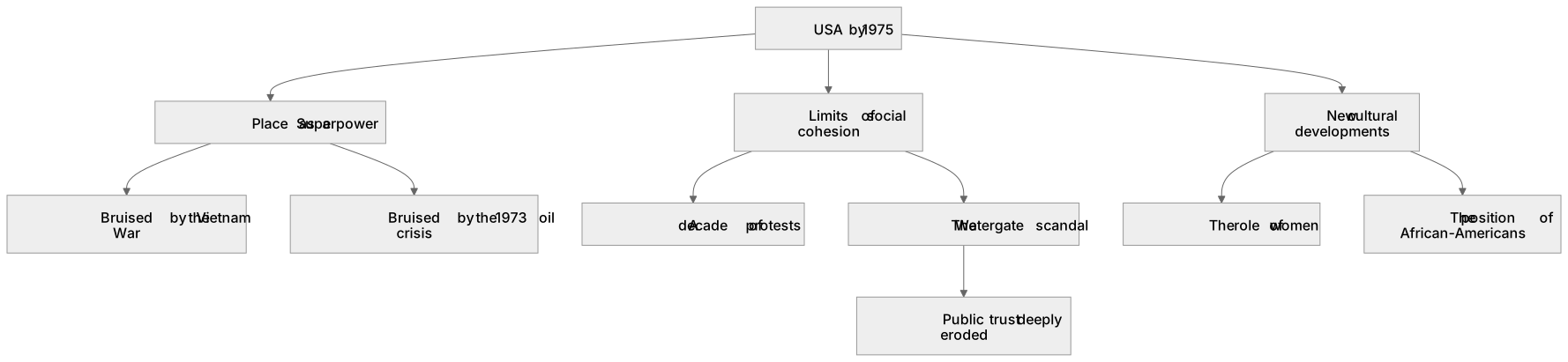
Key words
Say what each word means before you turn the card.
Superpower status and decline
Try answering aloud or in your head before turning the card.
Social fragmentation and cohesion
Try answering aloud or in your head before turning the card.
Cultural rebellion and conservatism
Try answering aloud or in your head before turning the card.
Civil rights and equality
Try answering aloud or in your head before turning the card.
See every definition
- Superpower status and decline
- The USA retained its global Superpower status by 1975, though this was bruised by the Vietnam War and the 1973 oil crisis.
- Social fragmentation and cohesion
- The limits of social cohesion were starkly visible following a decade of protests and the Watergate scandal, which deeply eroded public trust.
- Cultural rebellion and conservatism
- New cultural developments transformed society, driven by the counterculture and a rejection of 1950s conformity.
- Civil rights and equality
- The position of African-Americans evolved from the legislative victories of the civil rights movement to ongoing struggles against de facto segregation and economic inequality in urban centres.
Label the diagram
Some boxes have lost their names. Pick the right name for each number.
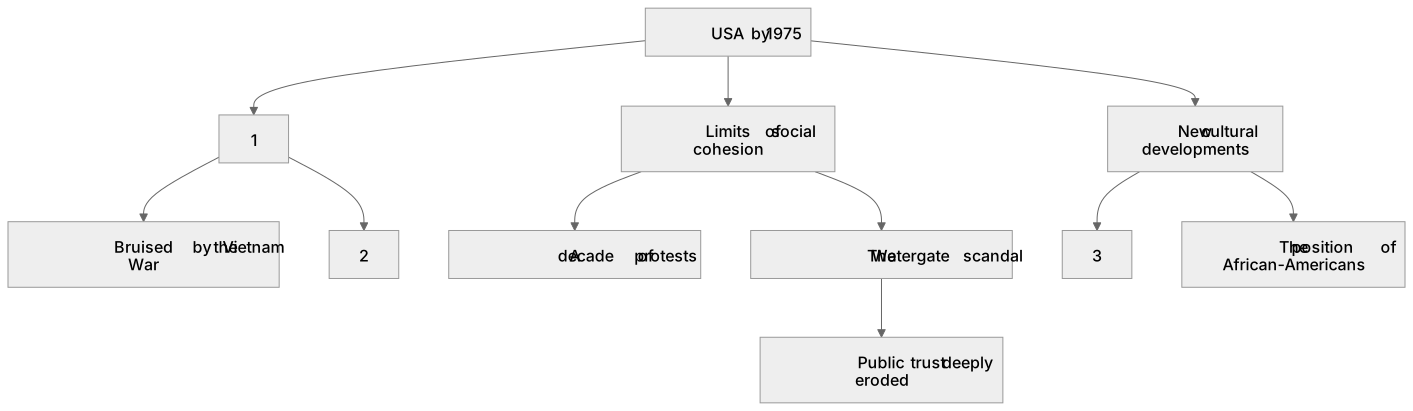
1Box 1
2Box 2
3Box 3
There is more to this lesson
The full lesson goes on to check your understanding and help you earn the marks. Create a free account to carry on, with your progress saved.
A week of Premium from your first lesson · Then the free plan continues · No card, no charge
Test your understanding of 1K The making of a Superpower: USA, 1865–1975 – The Superpower, 1945–1975 (A-level only): The USA by 1975: its place as a Superpower; the limits of social cohesion; new cultural developments, including the role of women and the position of African-Americans
Active recall beats re-reading. Take an instant quiz now to test what you’ve learned and lock it into long-term memory.
A week of Premium from your first lesson · Then the free plan continues · No card, no charge