AQA · A-Level · History
Course version: 7042 · Version from Sept 2017
USA, 1865–1975 – The Superpower, 1945–1975 (A-level only): The USA and…
Full specification wording
1K The making of a Superpower: USA, 1865–1975 – The Superpower, 1945–1975 (A-level only): The USA and international relations: the Cold War and relations with the USSR and China; the Vietnam War
Between 1945 and 1975, US foreign policy was dominated by the Cold War and the doctrine of containment.
Checked against the AQA 7042 specification (opens in a new tab) on .
- Point 5 of 6
Study notes
From the checked teaching notes for this specification point.
The idea
Between 1945 and 1975, US foreign policy was dominated by the Cold War and the doctrine of containment. Relations with the USSR fluctuated from intense brinkmanship, such as the 1962 Cuban Missile Crisis, to periods of détente under Nixon, culminating in the SALT I agreement. Simultaneously, relations with China shifted dramatically; initially refusing to recognise the communist PRC, Nixon's 1972 visit exploited the Sino-Soviet split. The Vietnam War became the most devastating application of containment, escalating under Johnson before ending in a humiliating withdrawal by 1973. This conflict severely damaged America's international prestige, forcing a re-evaluation of its global role.
What earns the marks
- Assess the impact of the Truman Doctrine and containment on the escalation of the Cold War with the USSR.
- Evaluate the significance of Nixon's 1972 visit to China in altering the balance of Cold War power and pressuring the USSR into détente.
- Analyse the reasons for US escalation in the Vietnam War under Kennedy and Johnson, including the Domino Theory.
- Examine the consequences of the Vietnam War on US international relations and the shift towards the Nixon Doctrine.
Common mistakes and how to put them right
Treating the communist bloc as a monolith throughout the period.
Put it right: Acknowledge the Sino-Soviet split and how the USA exploited it during the 1970s.
Assuming détente meant the end of the Cold War.
Put it right: Define détente as a relaxation of tensions and management of competition, not a resolution of ideological conflict.
Viewing the Vietnam War solely as a military failure.
Put it right: Evaluate the political and diplomatic failures, including the inability to win 'hearts and minds' or maintain domestic support.
Exam tips
- Link developments in Asia, such as relations with China and the Vietnam War, back to the overarching strategy of containing the USSR.
- Use specific treaties and events, like SALT I or the Gulf of Tonkin Resolution, to substantiate arguments about changing international relations.
- Contrast the foreign policy approaches of different presidents, such as Johnson's escalation in Vietnam versus Nixon's pursuit of détente.
Try the lesson
The start of the 1K The making of a Superpower: USA, 1865–1975 – The Superpower, 1945–1975 (A-level only): The USA and international relations: the Cold War and relations with the USSR and China; the Vietnam War lesson, made from checked teaching notes for this specification point.
Have a go first
Which diplomatic event in 1972 marked a significant shift in the United States' approach to international relations during the Cold War?
Listen
Between 1945 and 1975, US foreign policy was dominated by the Cold War and the doctrine of containment. Relations with the USSR fluctuated from intense brinkmanship, such as the 1962 Cuban Missile Crisis, to periods of détente under Nixon, culminating in the SALT I agreement. Simultaneously, relations with China shifted dramatically; initially refusing to recognise the communist PRC, Nixon's 1972 visit exploited the Sino-Soviet split. The Vietnam War became the most devastating application of containment, escalating under Johnson before ending in a humiliating withdrawal by 1973. This conflict severely damaged America's international prestige, forcing a re-evaluation of its global role. A strong answer earns marks for these points. Assess the impact of the Truman Doctrine and containment on the escalation of the Cold War with the USSR. Evaluate the significance of Nixon's 1972 visit to China in altering the balance of Cold War power and pressuring the USSR into détente. Analyse the reasons for US escalation in the Vietnam War under Kennedy and Johnson, including the Domino Theory. Examine the consequences of the Vietnam War on US international relations and the shift towards the Nixon Doctrine. A common slip: Treating the communist bloc as a monolith throughout the period. Instead, acknowledge the Sino-Soviet split and how the USA exploited it during the 1970s. Exam tip: Link developments in Asia, such as relations with China and the Vietnam War, back to the overarching strategy of containing the USSR.
See it
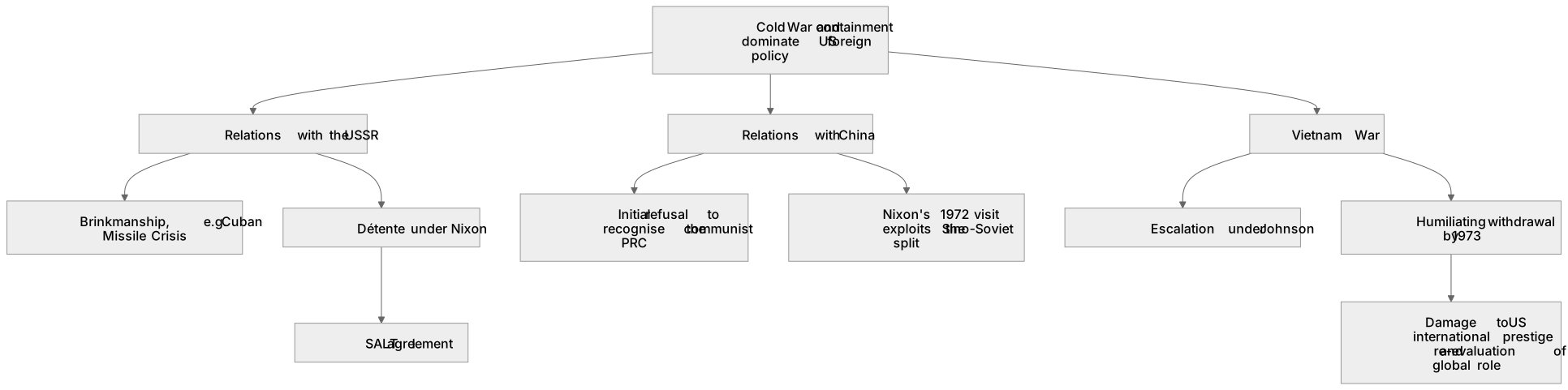
Put the events in order
Put these events in the order they happened, earliest first.
- 1. Cuban Missile Crisis shows intense brinkmanship with the USSR
- 2. Vietnam War ends in a humiliating US withdrawal
- 3. Nixon visits China, exploiting the Sino-Soviet split
Label the diagram
Some boxes have lost their names. Pick the right name for each number.
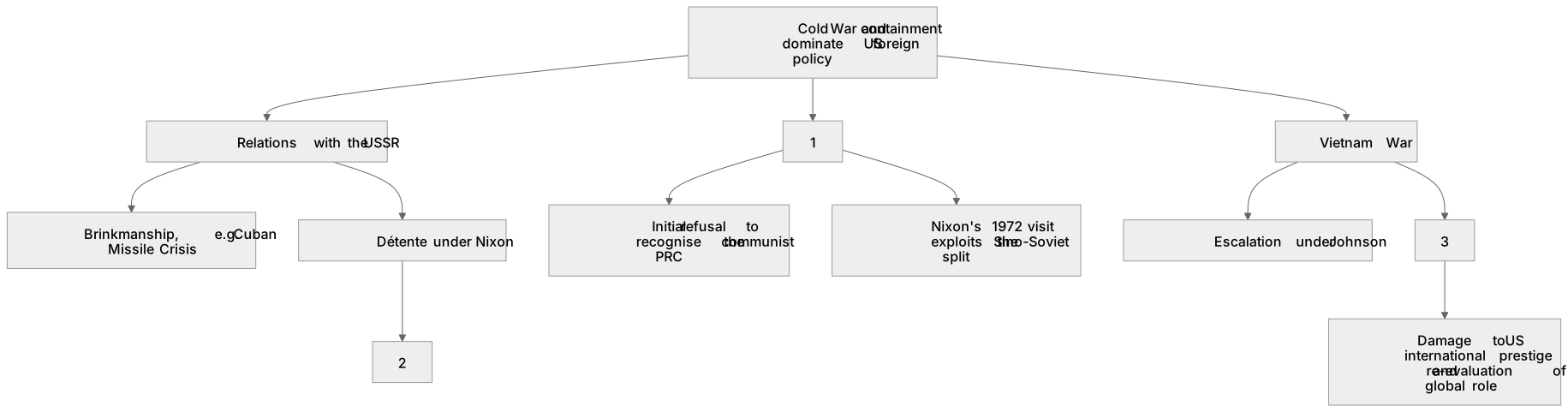
1Box 1
2Box 2
3Box 3
There is more to this lesson
The full lesson goes on to check your understanding and help you earn the marks. Create a free account to carry on, with your progress saved.
A week of Premium from your first lesson · Then the free plan continues · No card, no charge
Test your understanding of 1K The making of a Superpower: USA, 1865–1975 – The Superpower, 1945–1975 (A-level only): The USA and international relations: the Cold War and relations with the USSR and China; the Vietnam War
Active recall beats re-reading. Take an instant quiz now to test what you’ve learned and lock it into long-term memory.
A week of Premium from your first lesson · Then the free plan continues · No card, no charge