AQA · A-Level · History
Course version: 7042 · Version from Sept 2017
Germany, 1871–1991 – consequence in this period through the following key…
Full specification wording
1L The quest for political stability: Germany, 1871–1991 – consequence in this period through the following key questions:: How important was the role of key individuals and groups and how were they affected by developments?
This theme demands an evaluation of how prominent leaders and specific societal groups influenced German history, and conversely, how historical developments impacted them.
Checked against the AQA 7042 specification (opens in a new tab) on .
- Point 6 of 6
Study notes
From the checked teaching notes for this specification point.
The idea
This theme demands an evaluation of how prominent leaders and specific societal groups influenced German history, and conversely, how historical developments impacted them. You must assess the agency of key individuals, such as Bismarck's diplomatic manoeuvring, Hitler's dictatorial control, or Adenauer's integration of the FRG into the West. Simultaneously, analyse the role of groups like the industrial working class, the military elite, or persecuted minorities. Crucially, address the second clause by examining how macro-developments, such as hyperinflation, the World Wars, or the Cold War division, altered the status, living conditions, and political power of these individuals and groups over time.
What earns the marks
- Evaluate the extent to which individual leaders drove political change versus being shaped by broader economic or structural circumstances.
- Analyse the changing political and social influence of key groups, such as the Prussian Junkers, the military high command, or the industrial working class.
- Assess how major developments like the First World War or the 1929 Wall Street Crash radicalised specific demographic groups and altered their political allegiances.
- Examine the impact of state policies and historical shifts on the persecution, marginalisation, or emancipation of minority groups and women.
Common mistakes and how to put them right
Describing what individuals did without evaluating their actual importance.
Put it right: Focus on assessing their impact relative to other factors like economics or ideology.
Neglecting the second part of the question regarding how groups were affected by developments.
Put it right: Explicitly link major events like the World Wars to changes in the status or conditions of specific groups.
Treating 'groups' as entirely homogenous.
Put it right: Acknowledge divisions within groups, such as differences between skilled and unskilled workers or Catholic and Protestant voters.
Exam tips
- Structure essays to explicitly address both the influence of individuals and groups, and how they were subsequently affected by major historical developments.
- Contrast the power of the traditional elites in the Kaiserreich with their diminished role in the post-1945 German states.
- When discussing individuals, debate the 'intentionalist' versus 'structuralist' perspectives, particularly regarding Hitler's rule and the Holocaust.
Try the lesson
The start of the 1L The quest for political stability: Germany, 1871–1991 – consequence in this period through the following key questions:: How important was the role of key individuals and groups and how were they affected by developments? lesson, made from checked teaching notes for this specification point.
Have a go first
What was the primary role of Gustav Stresemann in the development of the Weimar Republic during the mid-1920s?
Listen
This theme demands an evaluation of how prominent leaders and specific societal groups influenced German history, and conversely, how historical developments impacted them. You must assess the agency of key individuals, such as Bismarck's diplomatic manoeuvring, Hitler's dictatorial control, or Adenauer's integration of the FRG into the West. Simultaneously, analyse the role of groups like the industrial working class, the military elite, or persecuted minorities. Crucially, address the second clause by examining how macro-developments, such as hyperinflation, the World Wars, or the Cold War division, altered the status, living conditions, and political power of these individuals and groups over time. A strong answer earns marks for these points. Evaluate the extent to which individual leaders drove political change versus being shaped by broader economic or structural circumstances. Analyse the changing political and social influence of key groups, such as the Prussian Junkers, the military high command, or the industrial working class. Assess how major developments like the First World War or the 1929 Wall Street Crash radicalised specific demographic groups and altered their political allegiances. Examine the impact of state policies and historical shifts on the persecution, marginalisation, or emancipation of minority groups and women. A common slip: Describing what individuals did without evaluating their actual importance. Instead, focus on assessing their impact relative to other factors like economics or ideology. Exam tip: Structure essays to explicitly address both the influence of individuals and groups, and how they were subsequently affected by major historical developments.
See it
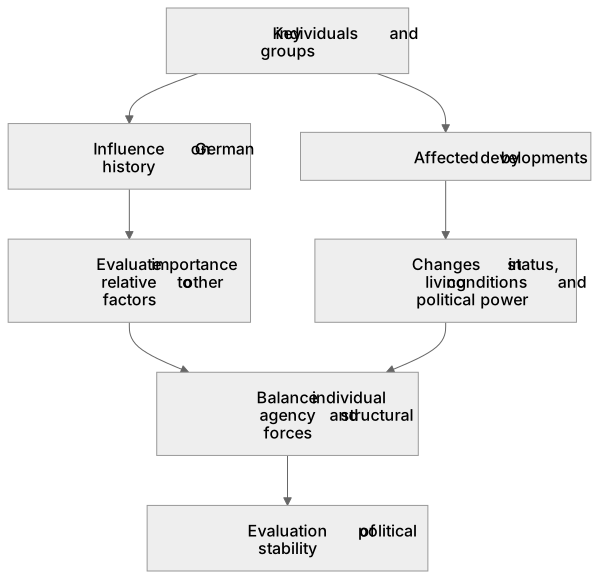
Label the diagram
Some boxes have lost their names. Pick the right name for each number.
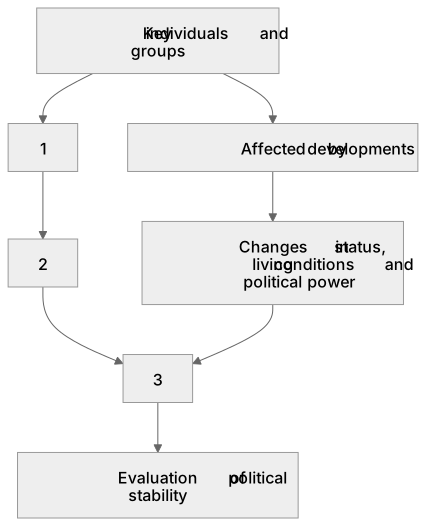
1Box 1
2Box 2
3Box 3
There is more to this lesson
The full lesson goes on to check your understanding and help you earn the marks. Create a free account to carry on, with your progress saved.
A week of Premium from your first lesson · Then the free plan continues · No card, no charge
Test your understanding of 1L The quest for political stability: Germany, 1871–1991 – consequence in this period through the following key questions:: How important was the role of key individuals and groups and how were they affected by developments?
Active recall beats re-reading. Take an instant quiz now to test what you’ve learned and lock it into long-term memory.
A week of Premium from your first lesson · Then the free plan continues · No card, no charge