AQA · A-Level · History
Course version: 7042 · Version from Sept 2017
Germany, 1871–1991 – consequence in this period through the following key…
Full specification wording
1L The quest for political stability: Germany, 1871–1991 – consequence in this period through the following key questions:: How important were ideas and ideology?
This theme requires evaluating how intellectual currents and formal ideologies shaped German political stability between 1871 and 1991.
Checked against the AQA 7042 specification (opens in a new tab) on .
- Point 5 of 6
- 3 key terms
Study notes
From the checked teaching notes for this specification point.
The idea
This theme requires evaluating how intellectual currents and formal ideologies shaped German political stability between 1871 and 1991. You must analyse the impact of broad ideas, such as nationalism, militarism, and democracy, alongside rigid ideologies like Nazism and Marxism-Leninism. For example, consider how Bismarck harnessed conservative nationalism to consolidate the Kaiserreich, whereas the Weimar Republic struggled to embed democratic ideas against authoritarian traditions. Furthermore, assess how the extreme racial ideology of National Socialism drove domestic terror and foreign expansion, contrasting this with the Cold War ideological divide where the FRG embraced Western liberal democracy and the GDR imposed Soviet communism.
What earns the marks
- Assess the unifying and divisive impact of nationalism across different eras, comparing its use in Imperial Germany with its extreme manifestation under the Nazis.
- Evaluate the extent to which Nazi racial, anti-Semitic, and expansionist ideology dictated state policy and ultimately caused the collapse of the Third Reich.
- Analyse the role of democratic ideas in the successes and failures of the Weimar Republic and the Federal Republic of Germany.
- Compare the influence of Marxist-Leninist ideology in the German Democratic Republic with the capitalist, liberal democratic ideology of the Federal Republic of Germany.
Common mistakes and how to put them right
Treating 'ideas' and 'ideology' as identical concepts.
Put it right: Distinguish between broad cultural ideas like militarism and structured political ideologies like Nazism.
Ignoring the continuity of ideas across periods.
Put it right: Trace how authoritarian or nationalist ideas persisted from the Kaiserreich into the Weimar and Nazi eras.
Focusing solely on Nazi ideology.
Put it right: Ensure balanced coverage of other ideologies across the 120-year period, including socialism, liberalism, and Cold War communism.
Exam tips
- Use specific examples of ideological policies, such as the Nuremberg Laws or the GDR's agricultural collectivisation, to support your arguments.
- Weigh the importance of ideology against other factors like economic crises or the role of key individuals when forming a historical judgement.
- Track the evolution of democratic ideas, contrasting their failure in the 1920s and 1930s with their successful implementation in post-1945 West Germany.
Try the lesson
The start of the 1L The quest for political stability: Germany, 1871–1991 – consequence in this period through the following key questions:: How important were ideas and ideology? lesson, made from checked teaching notes for this specification point.
Have a go first
Which of the following best describes the core ideological concept of 'Lebensraum' that influenced German foreign policy in the 1930s?
Listen
This theme requires evaluating how intellectual currents and formal ideologies shaped German political stability between 1871 and 1991. You must analyse the impact of broad ideas, such as nationalism, militarism, and democracy, alongside rigid ideologies like Nazism and Marxism-Leninism. For example, consider how Bismarck harnessed conservative nationalism to consolidate the Kaiserreich, whereas the Weimar Republic struggled to embed democratic ideas against authoritarian traditions. Furthermore, assess how the extreme racial ideology of National Socialism drove domestic terror and foreign expansion, contrasting this with the Cold War ideological divide where the FRG embraced Western liberal democracy and the GDR imposed Soviet communism. A strong answer earns marks for these points. Assess the unifying and divisive impact of nationalism across different eras, comparing its use in Imperial Germany with its extreme manifestation under the Nazis. Evaluate the extent to which Nazi racial, anti-Semitic, and expansionist ideology dictated state policy and ultimately caused the collapse of the Third Reich. Analyse the role of democratic ideas in the successes and failures of the Weimar Republic and the Federal Republic of Germany. Compare the influence of Marxist-Leninist ideology in the German Democratic Republic with the capitalist, liberal democratic ideology of the Federal Republic of Germany. A common slip: Treating 'ideas' and 'ideology' as identical concepts. Instead, distinguish between broad cultural ideas like militarism and structured political ideologies like Nazism. Exam tip: Use specific examples of ideological policies, such as the Nuremberg Laws or the GDR's agricultural collectivisation, to support your arguments.
See it
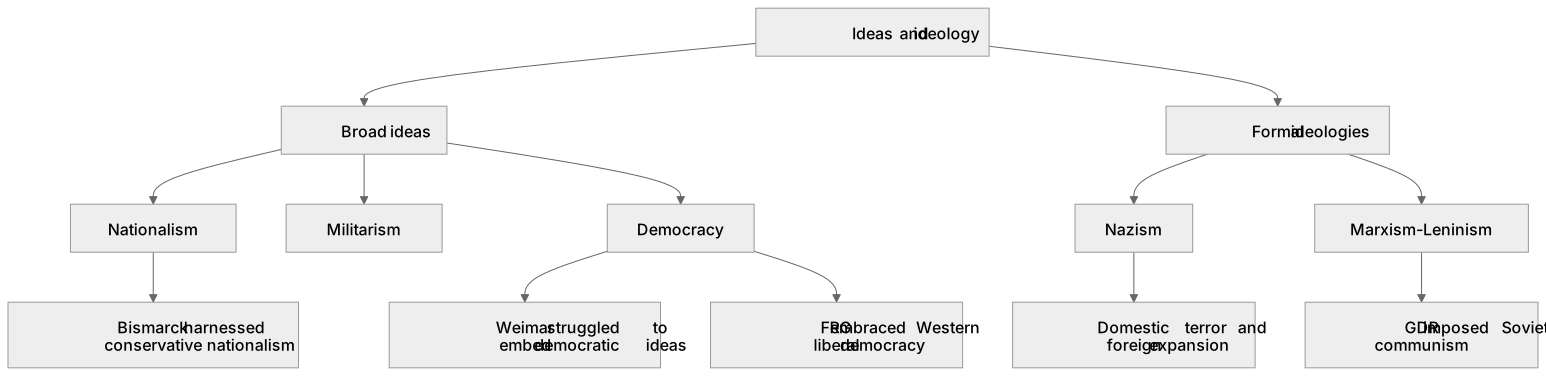
Key words
Say what each word means before you turn the card.
Nationalism
Try answering aloud or in your head before turning the card.
Authoritarianism
Try answering aloud or in your head before turning the card.
Democracy
Try answering aloud or in your head before turning the card.
See every definition
- Nationalism
- A broad idea used to consolidate the Kaiserreich and later manifested in an extreme form under the Nazis.
- Authoritarianism
- A tradition of ideas against which the Weimar Republic struggled to embed democratic ideas.
- Democracy
- A broad idea whose impact must be analysed alongside nationalism and militarism, and whose embedding the Weimar Republic struggled to achieve.
Label the diagram
Some boxes have lost their names. Pick the right name for each number.
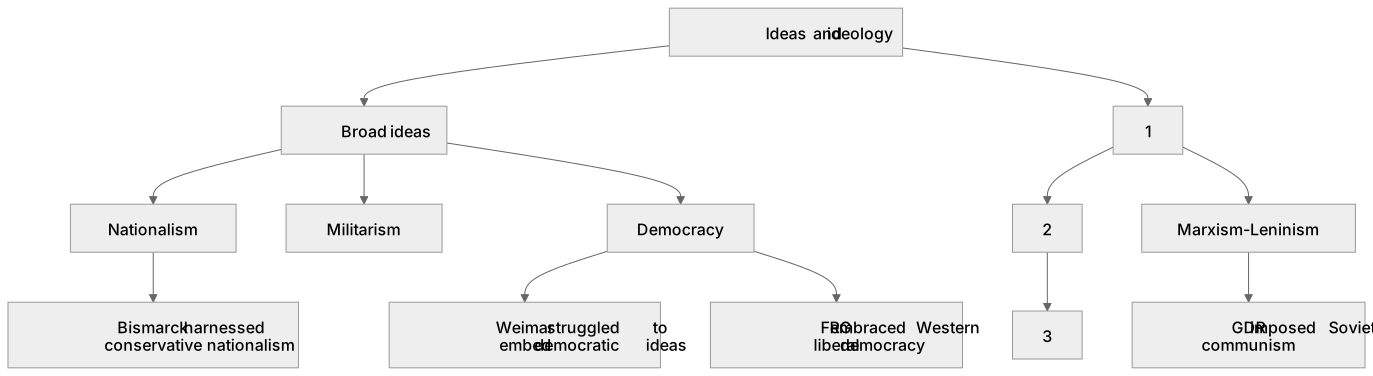
1Box 1
2Box 2
3Box 3
There is more to this lesson
The full lesson goes on to check your understanding and help you earn the marks. Create a free account to carry on, with your progress saved.
A week of Premium from your first lesson · Then the free plan continues · No card, no charge
Test your understanding of 1L The quest for political stability: Germany, 1871–1991 – consequence in this period through the following key questions:: How important were ideas and ideology?
Active recall beats re-reading. Take an instant quiz now to test what you’ve learned and lock it into long-term memory.
A week of Premium from your first lesson · Then the free plan continues · No card, no charge