AQA · A-Level · History
Course version: 7042 · Version from Sept 2017
Germany, 1871–1991 – consequence in this period through the following key…
Full specification wording
1L The quest for political stability: Germany, 1871–1991 – consequence in this period through the following key questions:: What was the extent of social and cultural change?
Evaluating the extent of social and cultural change requires contrasting periods of radical transformation with enduring traditionalism.
Checked against the AQA 7042 specification (opens in a new tab) on .
- Point 4 of 6
- 4 key terms
Study notes
From the checked teaching notes for this specification point.
The idea
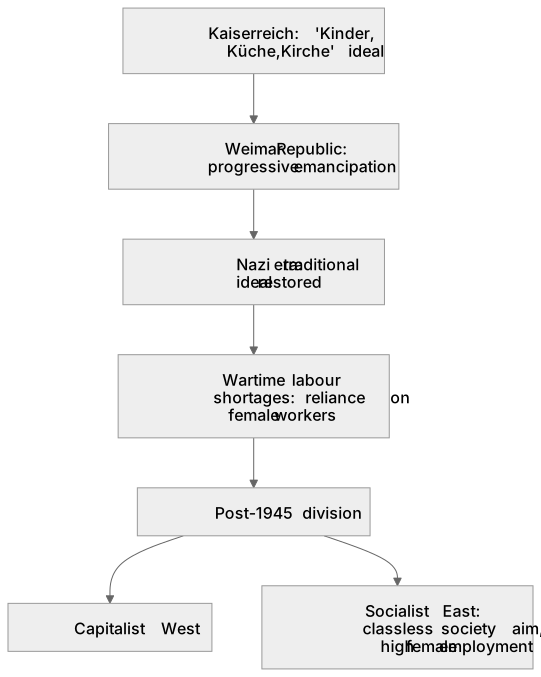
Evaluating the extent of social and cultural change requires contrasting periods of radical transformation with enduring traditionalism. Socially, you must trace the shifting status of women, from the traditional 'Kinder, Küche, Kirche' ideal of the Kaiserreich and Nazi eras to the progressive emancipation of the Weimar Republic and post-1945 states. Culturally, Germany experienced dramatic shifts, such as the avant-garde experimentation of Weimar's Bauhaus movement and cabaret, which was subsequently crushed by the Nazi imposition of 'Gleichschaltung' and völkisch art. By comparing these eras, you can assess whether changes were superficial or deeply rooted, noting how the post-war division created divergent social realities in the capitalist West and socialist East.
What earns the marks
- Assess the changing role and status of women across different regimes, noting periods of progression and regression.
- Evaluate the impact of urbanisation and industrialisation on the traditional class structure and the rise of the working class.
- Analyse cultural shifts, contrasting the liberal experimentation of the Weimar Republic with the cultural conformity enforced by the Third Reich.
- Compare the extent of social mobility and educational reform in the Federal Republic of Germany and the German Democratic Republic.
Common mistakes and how to put them right
Assuming Weimar culture was universally accepted.
Put it right: Highlight that avant-garde culture was largely confined to urban centres like Berlin and faced rural, conservative backlash.
Claiming the Nazis completely reversed women's employment.
Put it right: Note that wartime labour shortages forced the Nazi regime to increasingly rely on female workers despite their ideological stance.
Overlooking the social impact of the GDR.
Put it right: Include the GDR's efforts to create a classless society and its high rates of female employment when discussing post-war social change.
Exam tips
- Always address both 'social' and 'cultural' aspects in your answers to ensure comprehensive coverage of the specification statement.
- Use the concept of continuity versus change to evaluate the 'extent' of transformation, identifying which traditional structures survived political upheavals.
- Support cultural arguments with specific examples, such as the architecture of Walter Gropius or the propaganda films of Leni Riefenstahl.
Try the lesson
The start of the 1L The quest for political stability: Germany, 1871–1991 – consequence in this period through the following key questions:: What was the extent of social and cultural change? lesson, made from checked teaching notes for this specification point.
Have a go first
Which of the following best describes the cultural environment of the Weimar Republic during the 1920s?
Listen
Evaluating the extent of social and cultural change requires contrasting periods of radical transformation with enduring traditionalism. Socially, you must trace the shifting status of women, from the traditional 'Kinder, Küche, Kirche' ideal of the Kaiserreich and Nazi eras to the progressive emancipation of the Weimar Republic and post-1945 states. Culturally, Germany experienced dramatic shifts, such as the avant-garde experimentation of Weimar's Bauhaus movement and cabaret, which was subsequently crushed by the Nazi imposition of 'Gleichschaltung' and völkisch art. By comparing these eras, you can assess whether changes were superficial or deeply rooted, noting how the post-war division created divergent social realities in the capitalist West and socialist East. A strong answer earns marks for these points. Assess the changing role and status of women across different regimes, noting periods of progression and regression. Evaluate the impact of urbanisation and industrialisation on the traditional class structure and the rise of the working class. Analyse cultural shifts, contrasting the liberal experimentation of the Weimar Republic with the cultural conformity enforced by the Third Reich. Compare the extent of social mobility and educational reform in the Federal Republic of Germany and the German Democratic Republic. A common slip: Assuming Weimar culture was universally accepted. Instead, highlight that avant-garde culture was largely confined to urban centres like Berlin and faced rural, conservative backlash. Exam tip: Always address both 'social' and 'cultural' aspects in your answers to ensure comprehensive coverage of the specification statement.
See it
Key words
Say what each word means before you turn the card.
Women and the family
Try answering aloud or in your head before turning the card.
Cultural experimentation versus state control
Try answering aloud or in your head before turning the card.
Urbanisation and demographic shifts
Try answering aloud or in your head before turning the card.
Class structure and social mobility
Try answering aloud or in your head before turning the card.
See every definition
- Women and the family
- The shifting status of women, from the traditional 'Kinder, Küche, Kirche' ideal of the Kaiserreich and Nazi eras to the progressive emancipation of the Weimar Republic and post-1945 states.
- Cultural experimentation versus state control
- The avant-garde experimentation of Weimar's Bauhaus movement and cabaret, subsequently crushed by the Nazi imposition of 'Gleichschaltung' and völkisch art.
- Urbanisation and demographic shifts
- The impact of urbanisation and industrialisation on the traditional class structure and the rise of the working class.
- Class structure and social mobility
- The extent of social mobility and educational reform in the Federal Republic of Germany and the German Democratic Republic.
Label the diagram
Some boxes have lost their names. Pick the right name for each number.
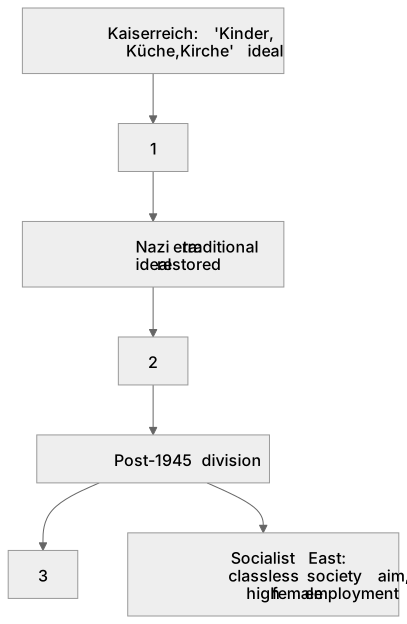
1Box 1
2Box 2
3Box 3
There is more to this lesson
The full lesson goes on to check your understanding and help you earn the marks. Create a free account to carry on, with your progress saved.
A week of Premium from your first lesson · Then the free plan continues · No card, no charge
Test your understanding of 1L The quest for political stability: Germany, 1871–1991 – consequence in this period through the following key questions:: What was the extent of social and cultural change?
Active recall beats re-reading. Take an instant quiz now to test what you’ve learned and lock it into long-term memory.
A week of Premium from your first lesson · Then the free plan continues · No card, no charge