AQA · A-Level · History
Course version: 7042 · Version from Sept 2017
Germany, 1871–1991 – Division to unity: the Federal Republic of Germany,…
Full specification wording
1L The quest for political stability: Germany, 1871–1991 – Division to unity: the Federal Republic of Germany, 1949–1991 (A-level only): Extra-parliamentary opposition and pressure: student protest; urban terrorism and the Baader-Meinhof gang; environmentalism
Extra-parliamentary opposition (APO) grew in the FRG when citizens felt the 1966 Grand Coalition lacked democratic accountability.
Checked against the AQA 7042 specification (opens in a new tab) on .
- Point 3 of 6
- 3 key terms
Study notes
From the checked teaching notes for this specification point.
The idea
Extra-parliamentary opposition (APO) grew in the FRG when citizens felt the 1966 Grand Coalition lacked democratic accountability. Student protests, led by Rudi Dutschke, targeted the Vietnam War, university structures, and the failure to confront Germany's Nazi past. This radicalisation birthed urban terrorism in the 1970s, notably the Baader-Meinhof gang (Red Army Faction), who conducted bombings and kidnappings during the 1977 'German Autumn' to destabilise the state. Concurrently, environmentalism gained traction as a peaceful extra-parliamentary force, protesting nuclear power and pollution. This culminated in the formation of the Green Party in 1980, successfully transitioning grassroots pressure into parliamentary representation.
What earns the marks
- Explain the origins of the APO (Außerparlamentarische Opposition) in response to the 1966 Grand Coalition and perceived democratic deficits.
- Detail the motivations and actions of the student movement, including anti-Vietnam War sentiment and opposition to former Nazis in positions of power.
- Analyse the escalation from student protest to urban terrorism, focusing on the Red Army Faction (Baader-Meinhof gang) and the 1977 German Autumn crisis.
- Evaluate the rise of environmentalism, noting protests against nuclear energy and the evolution of the movement into the Green Party.
Common mistakes and how to put them right
Confusing the APO with the RAF.
Put it right by noting the APO was a broad, mostly peaceful extra-parliamentary movement, whereas the RAF was a violent extremist splinter group.
Assuming environmentalism only began in the 1980s.
Put it right by noting that local anti-nuclear and ecological protests were active throughout the 1970s before the Green Party formed.
Stating that student protests were solely about university conditions.
Put it right by including their broader political aims, such as anti-capitalism and confronting the Nazi past.
Exam tips
- Link the rise of extra-parliamentary opposition directly to the political context of the Grand Coalition, which left no significant opposition in the Bundestag.
- Use the 'German Autumn' of 1977 as a key case study to demonstrate the peak of urban terrorism and the state's response to the Baader-Meinhof gang.
- Contrast the methods and outcomes of the violent RAF with the peaceful environmental movement to evaluate the effectiveness of different forms of extra-parliamentary pressure.
Try the lesson
The start of the 1L The quest for political stability: Germany, 1871–1991 – Division to unity: the Federal Republic of Germany, 1949–1991 (A-level only): Extra-parliamentary opposition and pressure: student protest; urban terrorism and the Baader-Meinhof gang; environmentalism lesson, made from checked teaching notes for this specification point.
Have a go first
Which of the following groups was a prominent left-wing urban terrorist organisation operating in West Germany during the 1970s?
Listen
Extra-parliamentary opposition (APO) grew in the FRG when citizens felt the 1966 Grand Coalition lacked democratic accountability. Student protests, led by Rudi Dutschke, targeted the Vietnam War, university structures, and the failure to confront Germany's Nazi past. This radicalisation birthed urban terrorism in the 1970s, notably the Baader-Meinhof gang (Red Army Faction), who conducted bombings and kidnappings during the 1977 'German Autumn' to destabilise the state. Concurrently, environmentalism gained traction as a peaceful extra-parliamentary force, protesting nuclear power and pollution. This culminated in the formation of the Green Party in 1980, successfully transitioning grassroots pressure into parliamentary representation. A strong answer earns marks for these points. Explain the origins of the APO (Außerparlamentarische Opposition) in response to the 1966 Grand Coalition and perceived democratic deficits. Detail the motivations and actions of the student movement, including anti-Vietnam War sentiment and opposition to former Nazis in positions of power. Analyse the escalation from student protest to urban terrorism, focusing on the Red Army Faction (Baader-Meinhof gang) and the 1977 German Autumn crisis. Evaluate the rise of environmentalism, noting protests against nuclear energy and the evolution of the movement into the Green Party. A common slip: Confusing the APO with the RAF. Instead, noting the APO was a broad, mostly peaceful extra-parliamentary movement, whereas the RAF was a violent extremist splinter group. Exam tip: Link the rise of extra-parliamentary opposition directly to the political context of the Grand Coalition, which left no significant opposition in the Bundestag.
See it
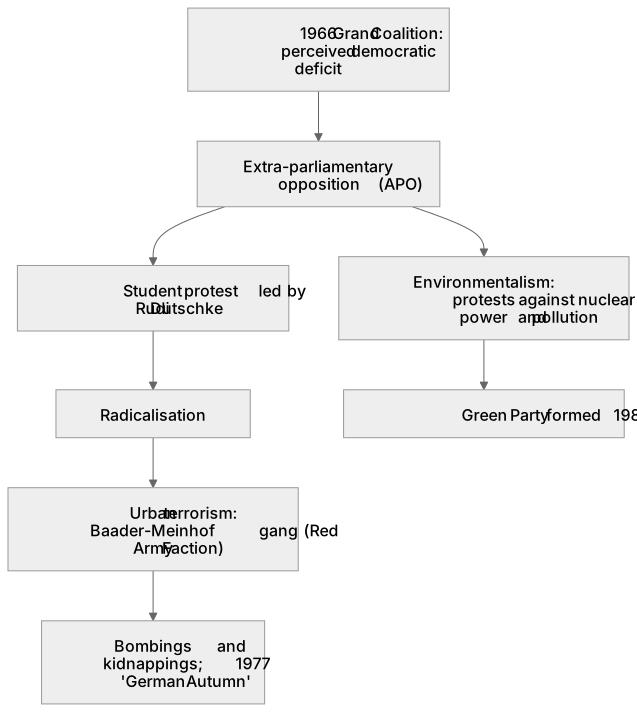
Put the events in order
Put these events in the order they happened, earliest first.
- 1. Grand Coalition formed, leaving no significant Bundestag opposition
- 2. Formation of the Green Party
- 3. German Autumn crisis conducted by the Baader-Meinhof gang
Key words
Say what each word means before you turn the card.
Extra-parliamentary opposition
Try answering aloud or in your head before turning the card.
Environmentalism
Try answering aloud or in your head before turning the card.
German Autumn
Try answering aloud or in your head before turning the card.
See every definition
- Extra-parliamentary opposition
- A broad, mostly peaceful movement that grew in the FRG when citizens felt the 1966 Grand Coalition lacked democratic accountability.
- Environmentalism
- A peaceful extra-parliamentary force that gained traction by protesting nuclear power and pollution, culminating in the formation of the Green Party in 1980.
- German Autumn
- The 1977 crisis during which the Baader-Meinhof gang conducted bombings and kidnappings to destabilise the state.
Label the diagram
Some boxes have lost their names. Pick the right name for each number.
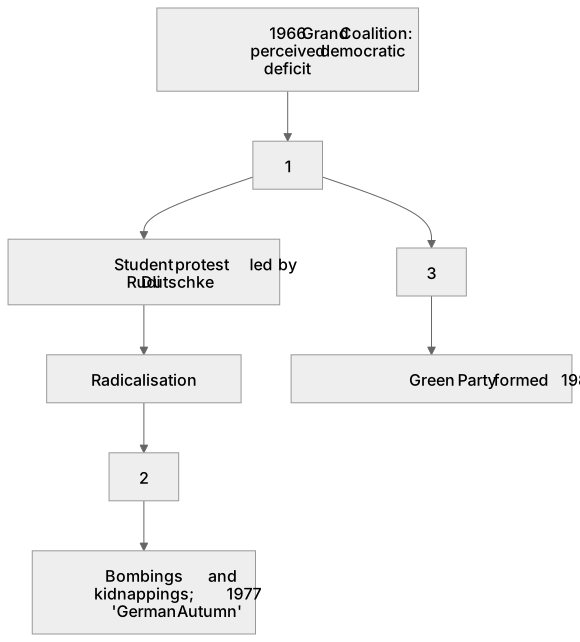
1Box 1
2Box 2
3Box 3
There is more to this lesson
The full lesson goes on to check your understanding and help you earn the marks. Create a free account to carry on, with your progress saved.
A week of Premium from your first lesson · Then the free plan continues · No card, no charge
Test your understanding of 1L The quest for political stability: Germany, 1871–1991 – Division to unity: the Federal Republic of Germany, 1949–1991 (A-level only): Extra-parliamentary opposition and pressure: student protest; urban terrorism and the Baader-Meinhof gang; environmentalism
Active recall beats re-reading. Take an instant quiz now to test what you’ve learned and lock it into long-term memory.
A week of Premium from your first lesson · Then the free plan continues · No card, no charge