AQA · A-Level · History
Course version: 7042 · Version from Sept 2017
Germany, 1871–1991 – Division to unity: the Federal Republic of Germany,…
Full specification wording
1L The quest for political stability: Germany, 1871–1991 – Division to unity: the Federal Republic of Germany, 1949–1991 (A-level only): Government and opposition: governments; parties and policies; chancellors after Adenauer and coalition governments under the three party system; the search for consensus
Following Adenauer, the FRG featured a three-party system: the CDU/CSU, SPD, and FDP.
Checked against the AQA 7042 specification (opens in a new tab) on .
- Point 2 of 6
Study notes
From the checked teaching notes for this specification point.
The idea
Following Adenauer, the FRG featured a three-party system: the CDU/CSU, SPD, and FDP. This necessitated coalition governments, driving a continuous search for consensus between government and opposition. Chancellors like Erhard, Kiesinger, Brandt, Schmidt, and Kohl balanced diverse parties and policies. The Grand Coalition (1966-1969) under Kiesinger exemplified this consensus-building, uniting the CDU and SPD to manage economic challenges. However, this consensus sparked extra-parliamentary opposition (APO), as critics felt traditional opposition was stifled. The FDP frequently acted as kingmaker, shifting alliances to form social-liberal or conservative coalitions, ensuring policies remained moderate and political stability was maintained.
What earns the marks
- Analyse the role of the FDP as the 'kingmaker' within the three-party system and its influence on the formation of coalition governments.
- Evaluate the successes and failures of chancellors after Adenauer (e.g., Erhard, Kiesinger, Brandt, Schmidt, Kohl) in managing coalition dynamics and implementing policies.
- Assess the significance of the Grand Coalition (1966-1969) as a prime example of the search for consensus between the major parties (CDU/CSU and SPD).
- Examine the impact of consensus politics on the emergence of extra-parliamentary opposition (APO) and the Green Party in the late 1970s and 1980s.
Common mistakes and how to put them right
Treating the CDU and CSU as completely separate, competing parties at the federal level.
Put it right: Refer to them as a permanent alliance (CDU/CSU or 'the Union') that operates as a single parliamentary group in the Bundestag.
Assuming the SPD was always in opposition until the 1990s.
Put it right: Note that the SPD was part of the Grand Coalition from 1966 and led the government under Chancellors Brandt and Schmidt from 1969 to 1982.
Overlooking the role of the FDP in changing governments.
Put it right: Highlight that shifts in FDP allegiance (e.g., in 1969 and 1982) were the primary mechanism for changing the governing coalition and Chancellor.
Exam tips
- Use the transition of power in 1969 (to Brandt) and 1982 (to Kohl) to illustrate how the three-party system relied on the FDP to shift the balance of power.
- When discussing the 'search for consensus', contrast the parliamentary stability achieved by the Grand Coalition with the resulting rise of radical opposition outside parliament (the APO).
- Link specific policies, such as Brandt's Ostpolitik, to the ideological shifts within the coalition governments to demonstrate a deep understanding of party dynamics.
Try the lesson
The start of the 1L The quest for political stability: Germany, 1871–1991 – Division to unity: the Federal Republic of Germany, 1949–1991 (A-level only): Government and opposition: governments; parties and policies; chancellors after Adenauer and coalition governments under the three party system; the search for consensus lesson, made from checked teaching notes for this specification point.
Have a go first
Which three political parties dominated the Bundestag and formed the basis of all coalition governments in the Federal Republic of Germany between 1961 and 1983?
Listen
Following Adenauer, the FRG featured a three-party system: the CDU/CSU, SPD, and FDP. This necessitated coalition governments, driving a continuous search for consensus between government and opposition. Chancellors like Erhard, Kiesinger, Brandt, Schmidt, and Kohl balanced diverse parties and policies. The Grand Coalition (1966-1969) under Kiesinger exemplified this consensus-building, uniting the CDU and SPD to manage economic challenges. However, this consensus sparked extra-parliamentary opposition (APO), as critics felt traditional opposition was stifled. The FDP frequently acted as kingmaker, shifting alliances to form social-liberal or conservative coalitions, ensuring policies remained moderate and political stability was maintained. A strong answer earns marks for these points. Analyse the role of the FDP as the 'kingmaker' within the three-party system and its influence on the formation of coalition governments. Evaluate the successes and failures of chancellors after Adenauer (e.g., Erhard, Kiesinger, Brandt, Schmidt, Kohl) in managing coalition dynamics and implementing policies. Assess the significance of the Grand Coalition (1966-1969) as a prime example of the search for consensus between the major parties (CDU/CSU and SPD). Examine the impact of consensus politics on the emergence of extra-parliamentary opposition (APO) and the Green Party in the late 1970s and 1980s. A common slip: Treating the CDU and CSU as completely separate, competing parties at the federal level. Instead, Refer to them as a permanent alliance (CDU/CSU or 'the Union') that operates as a single parliamentary group in the Bundestag. Exam tip: Use the transition of power in 1969 (to Brandt) and 1982 (to Kohl) to illustrate how the three-party system relied on the FDP to shift the balance of power.
See it
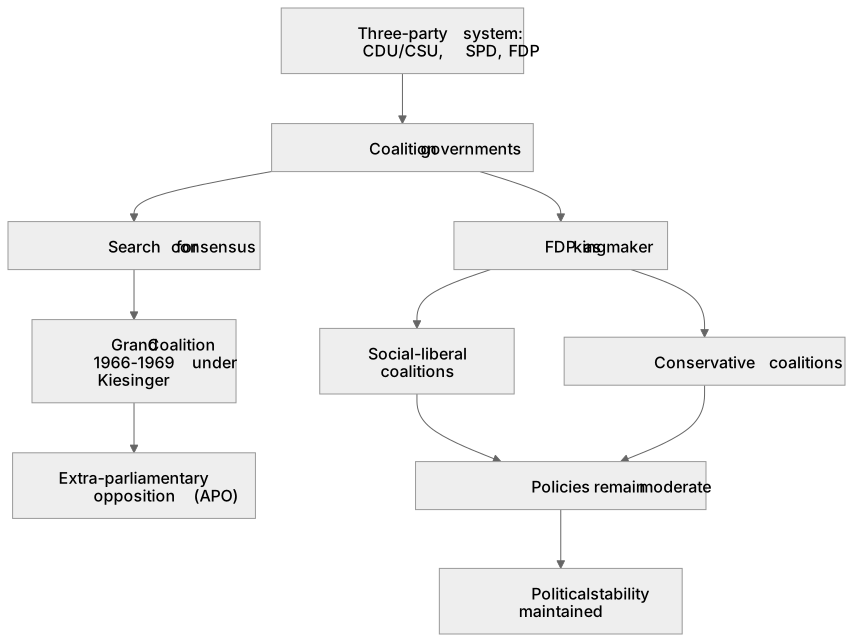
Label the diagram
Some boxes have lost their names. Pick the right name for each number.
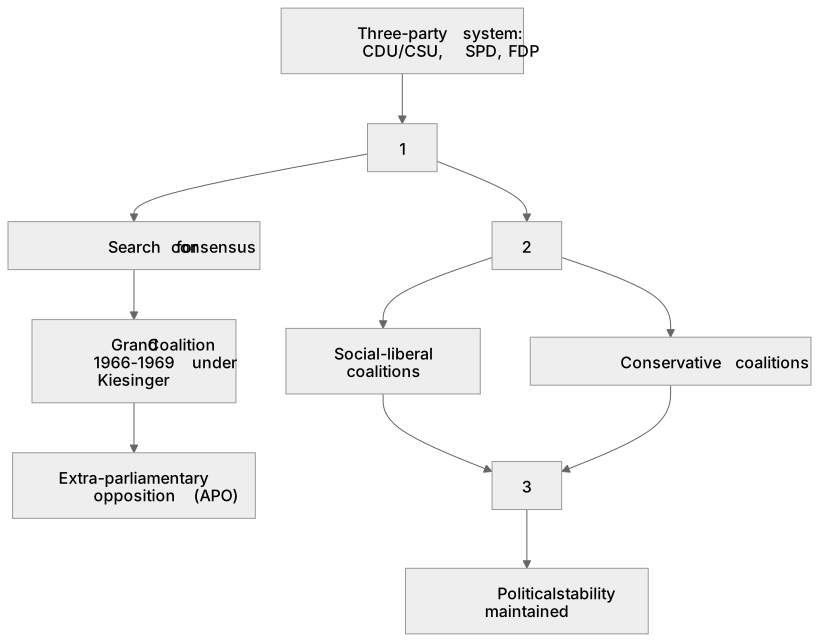
1Box 1
2Box 2
3Box 3
There is more to this lesson
The full lesson goes on to check your understanding and help you earn the marks. Create a free account to carry on, with your progress saved.
A week of Premium from your first lesson · Then the free plan continues · No card, no charge
Test your understanding of 1L The quest for political stability: Germany, 1871–1991 – Division to unity: the Federal Republic of Germany, 1949–1991 (A-level only): Government and opposition: governments; parties and policies; chancellors after Adenauer and coalition governments under the three party system; the search for consensus
Active recall beats re-reading. Take an instant quiz now to test what you’ve learned and lock it into long-term memory.
A week of Premium from your first lesson · Then the free plan continues · No card, no charge