AQA · A-Level · History
Course version: 7042 · Version from Sept 2017
Germany, 1871–1991 – Empire to democracy, 1914–1929: Economic…
Full specification wording
1L The quest for political stability: Germany, 1871–1991 – Empire to democracy, 1914–1929: Economic developments: the impact of war; post-war economic problems and policies; reparations; hyperinflation; Dawes and Young Plans and foreign loans; industrial growth; agriculture
Germany’s economy faced severe structural weaknesses following the First World War, driven by massive war debt and the loss of resource-rich territories.
Checked against the AQA 7042 specification (opens in a new tab) on .
- Point 4 of 6
- 4 key terms
Study notes
From the checked teaching notes for this specification point.
The idea
Germany’s economy faced severe structural weaknesses following the First World War, driven by massive war debt and the loss of resource-rich territories. Post-war policies of deficit spending and the burden of Allied reparations culminated in the catastrophic hyperinflation of 1923. Recovery relied heavily on US capital through the Dawes Plan (1924) and Young Plan (1929), which restructured reparations and injected foreign loans. This stimulated significant industrial growth, with cartels expanding and production exceeding pre-war levels by 1928. However, this prosperity was uneven; agriculture suffered a prolonged depression due to global price drops and high debt, leaving rural communities alienated from the Weimar Republic's economic recovery.
What earns the marks
- Analyse the economic impact of the First World War, focusing on the transition from a war economy to peacetime and the accumulation of national debt.
- Evaluate the role of reparations and government deficit policies in triggering the 1923 hyperinflation crisis.
- Assess the significance of the Dawes and Young Plans in stabilising the currency and facilitating industrial recovery through foreign loans.
- Contrast the rapid industrial growth and modernisation of the mid-1920s with the structural decline and indebtedness of the agricultural sector.
Common mistakes and how to put them right
Blaming hyperinflation solely on the payment of reparations.
Put it right: Explain that hyperinflation was caused by a combination of long-term war debt, post-war deficit financing, and the immediate trigger of the Ruhr crisis.
Treating the Weimar economy in the late 1920s as universally prosperous.
Put it right: Highlight the stark divide between industrial growth and the severe, ongoing agricultural depression.
Confusing the terms of the Dawes and Young Plans.
Put it right: Distinguish the Dawes Plan of 1924, which provided immediate loans and restructured payments, from the Young Plan of 1929, which reduced the total reparations figure and set a timeline.
Exam tips
- Use specific examples, such as the introduction of the Rentenmark or the reliance on short-term US loans, to demonstrate the fragility of the economic recovery.
- When evaluating economic policies, always consider their differing impacts on various social groups, such as the Mittelstand versus industrial workers.
- Link the agricultural depression directly to the later rise in rural support for extremist parties, demonstrating the political consequences of economic developments.
Try the lesson
The start of the 1L The quest for political stability: Germany, 1871–1991 – Empire to democracy, 1914–1929: Economic developments: the impact of war; post-war economic problems and policies; reparations; hyperinflation; Dawes and Young Plans and foreign loans; industrial growth; agriculture lesson, made from checked teaching notes for this specification point.
Have a go first
Which economic agreement, finalised in 1924, helped to stabilise the German economy by restructuring reparation payments and providing foreign loans?
Listen
Germany’s economy faced severe structural weaknesses following the First World War, driven by massive war debt and the loss of resource-rich territories. Post-war policies of deficit spending and the burden of Allied reparations culminated in the catastrophic hyperinflation of 1923. Recovery relied heavily on US capital through the Dawes Plan (1924) and Young Plan (1929), which restructured reparations and injected foreign loans. This stimulated significant industrial growth, with cartels expanding and production exceeding pre-war levels by 1928. However, this prosperity was uneven; agriculture suffered a prolonged depression due to global price drops and high debt, leaving rural communities alienated from the Weimar Republic's economic recovery. A strong answer earns marks for these points. Analyse the economic impact of the First World War, focusing on the transition from a war economy to peacetime and the accumulation of national debt. Evaluate the role of reparations and government deficit policies in triggering the 1923 hyperinflation crisis. Assess the significance of the Dawes and Young Plans in stabilising the currency and facilitating industrial recovery through foreign loans. Contrast the rapid industrial growth and modernisation of the mid-1920s with the structural decline and indebtedness of the agricultural sector. A common slip: Blaming hyperinflation solely on the payment of reparations. Instead, Explain that hyperinflation was caused by a combination of long-term war debt, post-war deficit financing, and the immediate trigger of the Ruhr crisis. Exam tip: Use specific examples, such as the introduction of the Rentenmark or the reliance on short-term US loans, to demonstrate the fragility of the economic recovery.
See it
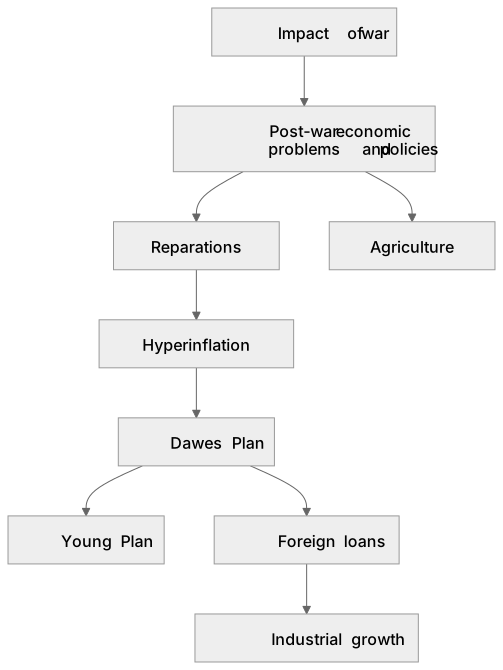
Put the events in order
Put these events in the order they happened, earliest first.
- 1. Catastrophic hyperinflation crisis
- 2. Young Plan reduced total reparations figure
- 3. Dawes Plan restructured reparations and provided loans
Key words
Say what each word means before you turn the card.
hyperinflation
Try answering aloud or in your head before turning the card.
Dawes Plan
Try answering aloud or in your head before turning the card.
Young Plan
Try answering aloud or in your head before turning the card.
reparations
Try answering aloud or in your head before turning the card.
See every definition
- hyperinflation
- The catastrophic inflation of 1923, which followed post-war deficit spending and the burden of Allied reparations.
- Dawes Plan
- The 1924 plan that restructured reparations and provided immediate loans, injecting foreign capital to aid recovery.
- Young Plan
- The 1929 plan that reduced the total reparations figure and set a timeline for payments.
- reparations
- The burden of Allied payments which, alongside war debt and deficit spending, contributed to the 1923 crisis.
Label the diagram
Some boxes have lost their names. Pick the right name for each number.
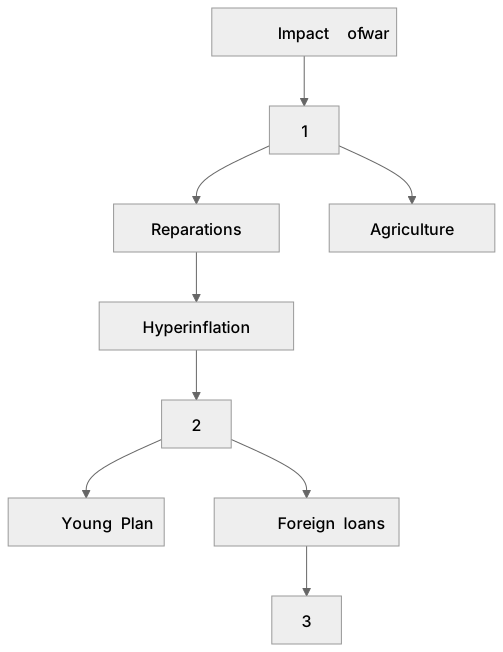
1Box 1
2Box 2
3Box 3
There is more to this lesson
The full lesson goes on to check your understanding and help you earn the marks. Create a free account to carry on, with your progress saved.
A week of Premium from your first lesson · Then the free plan continues · No card, no charge
Test your understanding of 1L The quest for political stability: Germany, 1871–1991 – Empire to democracy, 1914–1929: Economic developments: the impact of war; post-war economic problems and policies; reparations; hyperinflation; Dawes and Young Plans and foreign loans; industrial growth; agriculture
Active recall beats re-reading. Take an instant quiz now to test what you’ve learned and lock it into long-term memory.
A week of Premium from your first lesson · Then the free plan continues · No card, no charge