AQA · A-Level · History
Course version: 7042 · Version from Sept 2017
Germany, 1871–1991 – Empire to democracy, 1914–1929: Social developments:…
Full specification wording
1L The quest for political stability: Germany, 1871–1991 – Empire to democracy, 1914–1929: Social developments: the effect of war on German society; social and cultural changes in Weimar Germany
The First World War profoundly impacted German society, exacerbating class divides, causing severe food shortages (the 'Turnip Winter'), and leaving millions of widows and disabled veterans…
Checked against the AQA 7042 specification (opens in a new tab) on .
- Point 5 of 6
- 4 key terms
Study notes
From the checked teaching notes for this specification point.
The idea
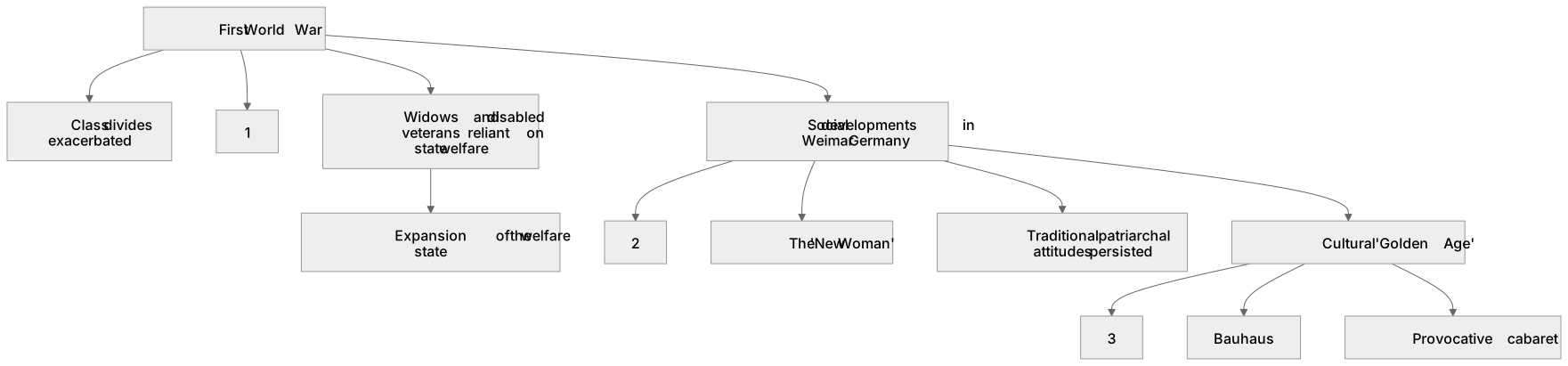
The First World War profoundly impacted German society, exacerbating class divides, causing severe food shortages (the 'Turnip Winter'), and leaving millions of widows and disabled veterans reliant on state welfare. This trauma catalysed significant social developments during the Weimar Republic. Social changes included the expansion of the welfare state, the introduction of women's suffrage, and the emergence of the 'New Woman' who enjoyed greater employment opportunities and sexual freedom, although traditional patriarchal attitudes persisted. Culturally, Weimar Germany experienced a vibrant, experimental 'Golden Age'. Movements like Neue Sachlichkeit (New Objectivity) in art, Bauhaus in architecture, and provocative cabaret challenged traditional norms, reflecting both the liberation and the deep anxieties of the era.
What earns the marks
- Assess the demographic and psychological impact of the First World War, including the burden of war pensions on the Weimar economy.
- Evaluate the extent of social mobility and the changing role of women, contrasting the urban 'New Woman' with rural conservatism.
- Analyse the expansion of the Weimar welfare state, including the 1927 Unemployment Insurance Act, and its strain on government resources.
- Examine cultural experimentation in art (Grosz, Dix), architecture (Bauhaus), and cinema (Expressionism), noting how these polarised German society.
Common mistakes and how to put them right
Claiming that the 'New Woman' represented the experience of all German women.
Put it right: Specify that this was primarily an urban, middle-class phenomenon, while many women remained in traditional domestic roles.
Stating that Weimar culture was universally celebrated across Germany.
Put it right: Explain that avant-garde culture was largely confined to Berlin and other major cities, often provoking intense backlash from conservative and rural populations.
Ignoring the social impact of the First World War when discussing Weimar society.
Put it right: Explicitly link the trauma of war, such as the presence of disabled veterans and war widows, to the social policies and cultural anxieties of the 1920s.
Exam tips
- Use specific cultural examples, such as the artwork of Otto Dix or the architecture of Walter Gropius, to substantiate claims about Weimar cultural shifts.
- When evaluating social changes, always contrast the progressive urban developments with the enduring conservatism of rural areas to demonstrate nuance.
- Link the expansion of the welfare state directly to the social legacy of the First World War to show continuity and cause-and-effect.
Try the lesson
The start of the 1L The quest for political stability: Germany, 1871–1991 – Empire to democracy, 1914–1929: Social developments: the effect of war on German society; social and cultural changes in Weimar Germany lesson, made from checked teaching notes for this specification point.
Have a go first
Which cultural movement, characterised by a focus on practical, functional design and the unification of art and technology, became prominent in Weimar Germany?
Listen
The First World War profoundly impacted German society, exacerbating class divides, causing severe food shortages (the 'Turnip Winter'), and leaving millions of widows and disabled veterans reliant on state welfare. This trauma catalysed significant social developments during the Weimar Republic. Social changes included the expansion of the welfare state, the introduction of women's suffrage, and the emergence of the 'New Woman' who enjoyed greater employment opportunities and sexual freedom, although traditional patriarchal attitudes persisted. Culturally, Weimar Germany experienced a vibrant, experimental 'Golden Age'. Movements like Neue Sachlichkeit (New Objectivity) in art, Bauhaus in architecture, and provocative cabaret challenged traditional norms, reflecting both the liberation and the deep anxieties of the era. A strong answer earns marks for these points. Assess the demographic and psychological impact of the First World War, including the burden of war pensions on the Weimar economy. Evaluate the extent of social mobility and the changing role of women, contrasting the urban 'New Woman' with rural conservatism. Analyse the expansion of the Weimar welfare state, including the 1927 Unemployment Insurance Act, and its strain on government resources. Examine cultural experimentation in art (Grosz, Dix), architecture (Bauhaus), and cinema (Expressionism), noting how these polarised German society. A common slip: Claiming that the 'New Woman' represented the experience of all German women. Instead, Specify that this was primarily an urban, middle-class phenomenon, while many women remained in traditional domestic roles. Exam tip: Use specific cultural examples, such as the artwork of Otto Dix or the architecture of Walter Gropius, to substantiate claims about Weimar cultural shifts.
See it

Key words
Say what each word means before you turn the card.
The social legacy of total war
Try answering aloud or in your head before turning the card.
Gender roles and emancipation
Try answering aloud or in your head before turning the card.
Cultural experimentation and polarisation
Try answering aloud or in your head before turning the card.
Modernity versus traditionalism
Try answering aloud or in your head before turning the card.
See every definition
- The social legacy of total war
- The First World War profoundly impacted German society, exacerbating class divides, causing severe food shortages and leaving millions of widows and disabled veterans reliant on state welfare.
- Gender roles and emancipation
- Social changes included the introduction of women's suffrage and the emergence of the 'New Woman' who enjoyed greater employment opportunities and sexual freedom, although traditional patriarchal attitudes persisted.
- Cultural experimentation and polarisation
- Weimar Germany experienced a vibrant, experimental 'Golden Age' in which movements like Neue Sachlichkeit, Bauhaus and provocative cabaret challenged traditional norms, reflecting both liberation and deep anxieties.
- Modernity versus traditionalism
- Avant-garde culture was largely confined to Berlin and other major cities, often provoking intense backlash from conservative and rural populations.
Label the diagram
Some boxes have lost their names. Pick the right name for each number.
1Box 1
2Box 2
3Box 3
There is more to this lesson
The full lesson goes on to check your understanding and help you earn the marks. Create a free account to carry on, with your progress saved.
A week of Premium from your first lesson · Then the free plan continues · No card, no charge
Test your understanding of 1L The quest for political stability: Germany, 1871–1991 – Empire to democracy, 1914–1929: Social developments: the effect of war on German society; social and cultural changes in Weimar Germany
Active recall beats re-reading. Take an instant quiz now to test what you’ve learned and lock it into long-term memory.
A week of Premium from your first lesson · Then the free plan continues · No card, no charge