AQA · A-Level · History
Course version: 7042 · Version from Sept 2017
Germany, 1871–1991 – only) The Nazi experiment, 1929–1949 (A-level only):…
Full specification wording
1L The quest for political stability: Germany, 1871–1991 – only) The Nazi experiment, 1929–1949 (A-level only): Economic developments: the impact of the Depression; recovery and development under Nazis in peace and war; the post-war economy
Germany's economy from 1929 to 1949 saw extreme volatility.
Checked against the AQA 7042 specification (opens in a new tab) on .
- Point 4 of 6
- 4 key terms
Study notes
From the checked teaching notes for this specification point.
The idea
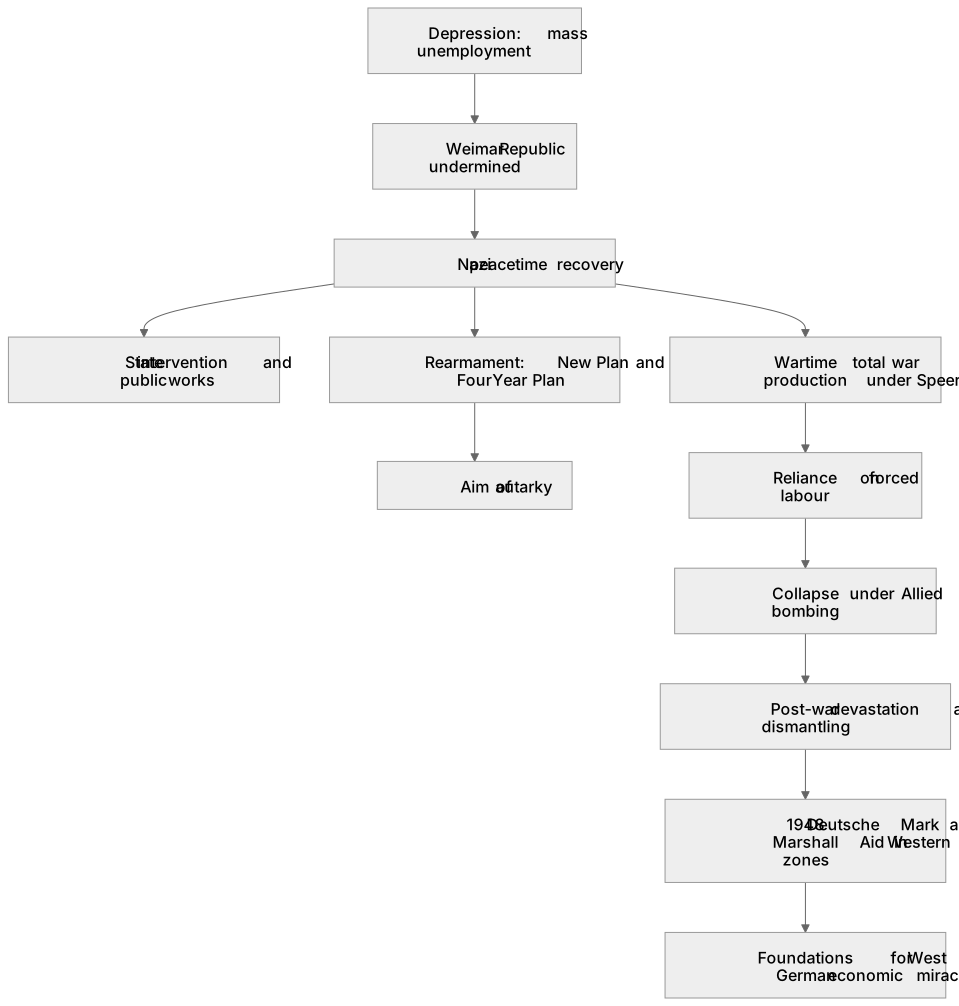
Germany's economy from 1929 to 1949 saw extreme volatility. The Depression caused mass unemployment, fatally undermining the Weimar Republic. Nazi peacetime recovery relied on state intervention, public works, and rearmament under Schacht's New Plan and Göring's Four Year Plan, aiming for autarky. In wartime, the economy shifted to total war production under Speer, depending on forced labour before collapsing under Allied bombing. The post-war economy faced devastation, shortages, and industrial dismantling by occupying powers. However, the 1948 introduction of the Deutsche Mark and Marshall Aid in the Western zones stabilised the currency and laid the crucial foundations for the subsequent West German economic miracle.
What earns the marks
- Evaluate the severity of the Great Depression's impact on German employment, industry, and political stability.
- Assess the effectiveness of Nazi economic policies, such as the New Plan and Four Year Plan, in achieving recovery and autarky.
- Analyse the transition to a total war economy and the reliance on forced labour and plundered resources during the Second World War.
- Explain the challenges of the immediate post-war economy and the significance of the 1948 currency reform in the Western zones.
Common mistakes and how to put them right
Assuming the Nazi economic recovery was entirely genuine.
Put it right by highlighting the use of statistical manipulation, such as removing women and Jews from unemployment registers.
Stating that Germany achieved autarky by 1939.
Put it right by noting that Germany still heavily relied on imported raw materials at the outbreak of war.
Confusing the post-war economic policies of the different occupation zones.
Put it right by distinguishing between Soviet dismantling for reparations and Western efforts towards economic reconstruction.
Exam tips
- Contrast the economic priorities of Schacht (trade and stability) with those of Göring (rapid rearmament and autarky) to show depth of knowledge.
- When discussing the wartime economy, evaluate the impact of Albert Speer's rationalisation policies against the destructive effects of Allied strategic bombing.
- Link post-war economic developments, particularly the introduction of the Deutsche Mark, directly to the political division of Germany.
Try the lesson
The start of the 1L The quest for political stability: Germany, 1871–1991 – only) The Nazi experiment, 1929–1949 (A-level only): Economic developments: the impact of the Depression; recovery and development under Nazis in peace and war; the post-war economy lesson, made from checked teaching notes for this specification point.
Have a go first
Which policy was central to Hjalmar Schacht’s 'New Plan' of 1934 to stimulate German economic recovery?
Listen
Germany's economy from 1929 to 1949 saw extreme volatility. The Depression caused mass unemployment, fatally undermining the Weimar Republic. Nazi peacetime recovery relied on state intervention, public works, and rearmament under Schacht's New Plan and Göring's Four Year Plan, aiming for autarky. In wartime, the economy shifted to total war production under Speer, depending on forced labour before collapsing under Allied bombing. The post-war economy faced devastation, shortages, and industrial dismantling by occupying powers. However, the 1948 introduction of the Deutsche Mark and Marshall Aid in the Western zones stabilised the currency and laid the crucial foundations for the subsequent West German economic miracle. A strong answer earns marks for these points. Evaluate the severity of the Great Depression's impact on German employment, industry, and political stability. Assess the effectiveness of Nazi economic policies, such as the New Plan and Four Year Plan, in achieving recovery and autarky. Analyse the transition to a total war economy and the reliance on forced labour and plundered resources during the Second World War. Explain the challenges of the immediate post-war economy and the significance of the 1948 currency reform in the Western zones. A common slip: Assuming the Nazi economic recovery was entirely genuine. Instead, highlighting the use of statistical manipulation, such as removing women and Jews from unemployment registers. Exam tip: Contrast the economic priorities of Schacht (trade and stability) with those of Göring (rapid rearmament and autarky) to show depth of knowledge.
See it
Key words
Say what each word means before you turn the card.
Economic crisis and recovery
Try answering aloud or in your head before turning the card.
State intervention and control
Try answering aloud or in your head before turning the card.
Autarky and rearmament
Try answering aloud or in your head before turning the card.
Post-war reconstruction
Try answering aloud or in your head before turning the card.
See every definition
- Economic crisis and recovery
- The Depression caused mass unemployment, fatally undermining the Weimar Republic, while Nazi peacetime recovery relied on state intervention, public works and rearmament.
- State intervention and control
- Nazi peacetime recovery relied on state intervention, public works and rearmament under Schacht's New Plan and Göring's Four Year Plan.
- Autarky and rearmament
- The New Plan and Four Year Plan aimed for autarky, though Germany still heavily relied on imported raw materials at the outbreak of war.
- Post-war reconstruction
- The post-war economy faced devastation, shortages and industrial dismantling by occupying powers, but the 1948 Deutsche Mark and Marshall Aid stabilised the currency in the Western zones.
Label the diagram
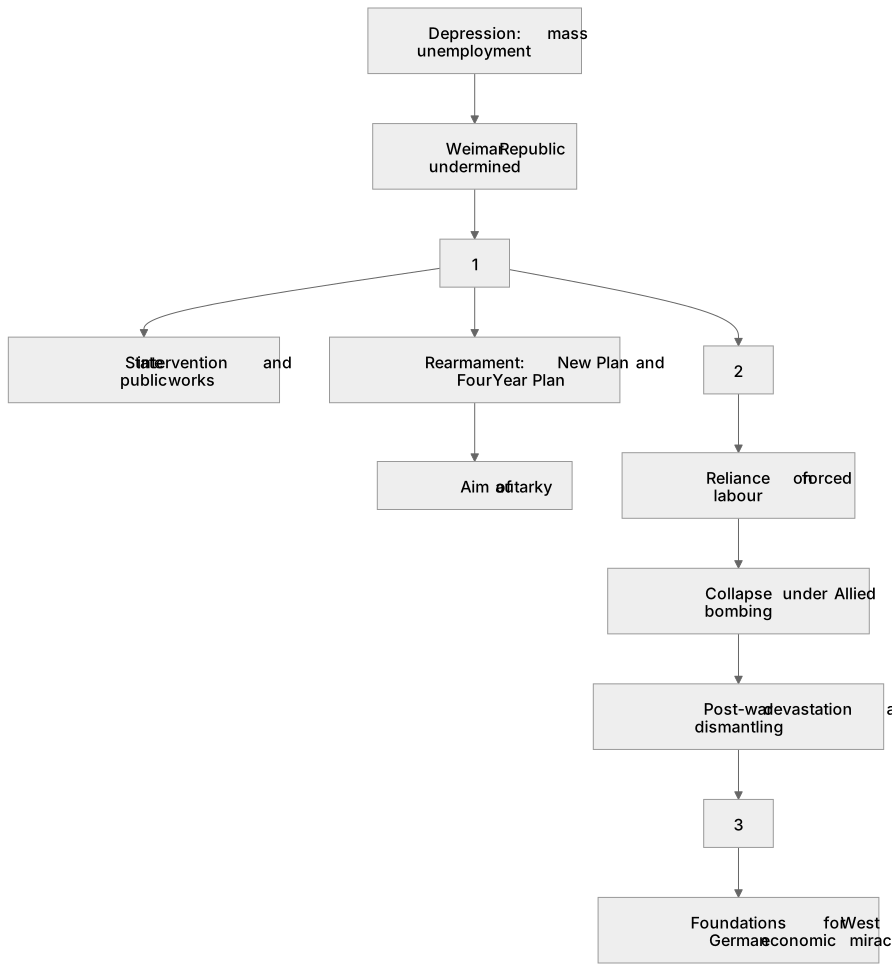
Some boxes have lost their names. Pick the right name for each number.
1Box 1
2Box 2
3Box 3
There is more to this lesson
The full lesson goes on to check your understanding and help you earn the marks. Create a free account to carry on, with your progress saved.
A week of Premium from your first lesson · Then the free plan continues · No card, no charge
Test your understanding of 1L The quest for political stability: Germany, 1871–1991 – only) The Nazi experiment, 1929–1949 (A-level only): Economic developments: the impact of the Depression; recovery and development under Nazis in peace and war; the post-war economy
Active recall beats re-reading. Take an instant quiz now to test what you’ve learned and lock it into long-term memory.
A week of Premium from your first lesson · Then the free plan continues · No card, no charge