AQA · A-Level · History
Course version: 7042 · Version from Sept 2017
Germany, 1871–1991 – only) The Nazi experiment, 1929–1949 (A-level only):…
Full specification wording
1L The quest for political stability: Germany, 1871–1991 – only) The Nazi experiment, 1929–1949 (A-level only): Social developments and tensions; Nazi social policies including volksgemeinschaft and the racial state; Nazi culture; postwar German society and the legacy of Nazism
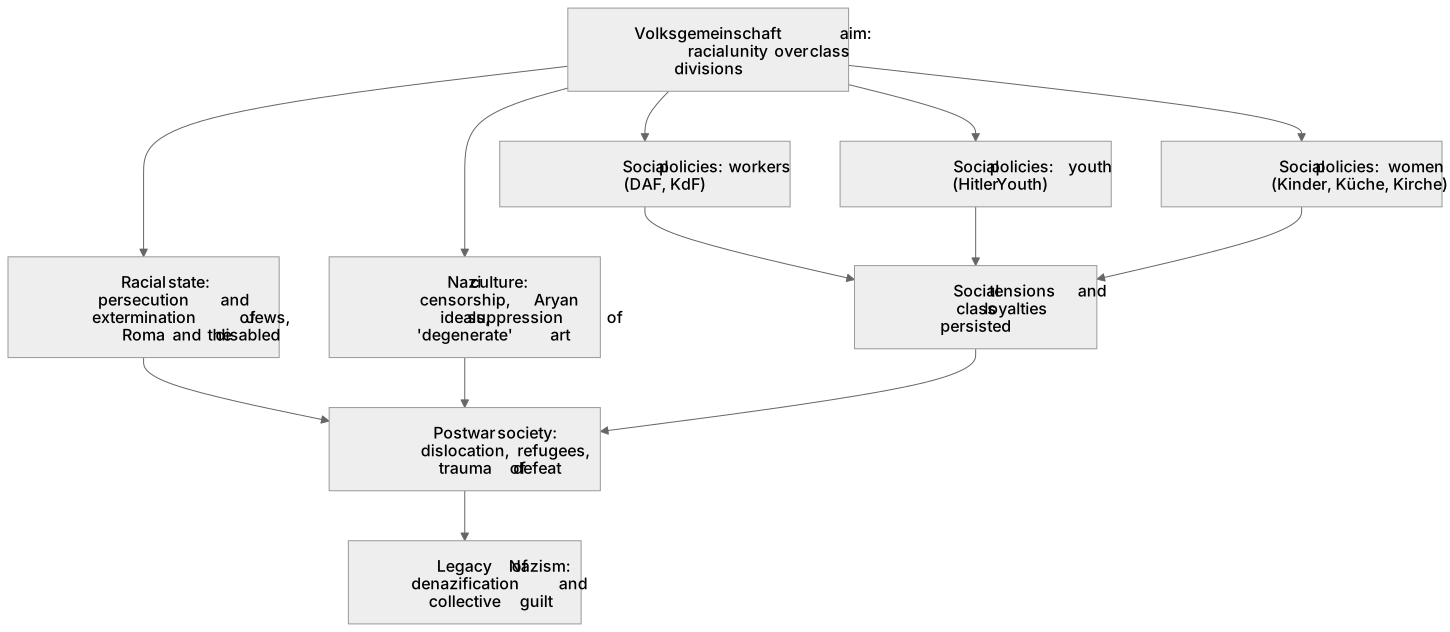
The Nazi regime sought to fundamentally restructure German society through the concept of Volksgemeinschaft (people's community), aiming to eradicate class divisions in favour of racial unity.
Checked against the AQA 7042 specification (opens in a new tab) on .
- Point 5 of 6
- 4 key terms
Study notes
From the checked teaching notes for this specification point.
The idea
The Nazi regime sought to fundamentally restructure German society through the concept of Volksgemeinschaft (people's community), aiming to eradicate class divisions in favour of racial unity. This drove social policies targeting workers (DAF, KdF), youth (Hitler Youth), and women (Kinder, Küche, Kirche), though underlying social tensions and class loyalties persisted. Simultaneously, the creation of a 'racial state' led to the systematic persecution and extermination of Jews, Roma, and the disabled. Nazi culture was heavily censored, promoting Aryan ideals through monumental architecture and propaganda while suppressing 'degenerate' art. Following 1945, postwar German society faced immense dislocation, dealing with millions of refugees, the trauma of defeat, and the complex legacy of Nazism, including denazification efforts and the psychological burden of collective guilt.
What earns the marks
- Evaluate the extent to which Volksgemeinschaft was successfully implemented versus remaining a propaganda illusion masking persistent class tensions.
- Analyse the mechanisms of the racial state, including the Nuremberg Laws (1935) and the escalation to the Final Solution.
- Assess the role of Nazi culture, such as the Reich Chamber of Culture, in enforcing ideological conformity and suppressing 'degenerate' influences.
- Examine the social dislocation in postwar Germany, including the impact of 'Year Zero' (Stunde Null), refugees (Expellees), and the varied success of Allied denazification programmes.
Common mistakes and how to put them right
Assuming Volksgemeinschaft completely eradicated class divisions.
Put it right: Acknowledge that traditional class structures and tensions largely remained despite superficial propaganda successes like the KdF.
Treating Nazi social policy as uniformly popular.
Put it right: Highlight the existence of social tensions, non-conformity, and passive resistance among groups like the Edelweiss Pirates.
Viewing postwar denazification as a complete success.
Put it right: Recognise that the legacy of Nazism persisted, with many former Nazis retaining positions in the judiciary and civil service due to pragmatic administrative needs.
Exam tips
- Use specific examples of Nazi cultural policies, such as the 1937 Degenerate Art Exhibition, to illustrate how the regime sought to control the social mindset.
- When discussing the racial state, ensure you link social policies (like the Law for the Prevention of Hereditarily Diseased Offspring) to the broader ideological goal of racial purity.
- Contrast the intended aims of Nazi social policies with their actual outcomes to build a strong evaluative argument regarding the regime's totalitarian control.
Try the lesson
The start of the 1L The quest for political stability: Germany, 1871–1991 – only) The Nazi experiment, 1929–1949 (A-level only): Social developments and tensions; Nazi social policies including volksgemeinschaft and the racial state; Nazi culture; postwar German society and the legacy of Nazism lesson, made from checked teaching notes for this specification point.
Have a go first
Which of the following best describes the core aim of the Nazi social policy of 'Volksgemeinschaft'?
Listen
The Nazi regime sought to fundamentally restructure German society through the concept of Volksgemeinschaft (people's community), aiming to eradicate class divisions in favour of racial unity. This drove social policies targeting workers (DAF, KdF), youth (Hitler Youth), and women (Kinder, Küche, Kirche), though underlying social tensions and class loyalties persisted. Simultaneously, the creation of a 'racial state' led to the systematic persecution and extermination of Jews, Roma, and the disabled. Nazi culture was heavily censored, promoting Aryan ideals through monumental architecture and propaganda while suppressing 'degenerate' art. Following 1945, postwar German society faced immense dislocation, dealing with millions of refugees, the trauma of defeat, and the complex legacy of Nazism, including denazification efforts and the psychological burden of collective guilt. A strong answer earns marks for these points. Evaluate the extent to which Volksgemeinschaft was successfully implemented versus remaining a propaganda illusion masking persistent class tensions. Analyse the mechanisms of the racial state, including the Nuremberg Laws (1935) and the escalation to the Final Solution. Assess the role of Nazi culture, such as the Reich Chamber of Culture, in enforcing ideological conformity and suppressing 'degenerate' influences. Examine the social dislocation in postwar Germany, including the impact of 'Year Zero' (Stunde Null), refugees (Expellees), and the varied success of Allied denazification programmes. A common slip: Assuming Volksgemeinschaft completely eradicated class divisions. Instead, acknowledge that traditional class structures and tensions largely remained despite superficial propaganda successes like the KdF. Exam tip: Use specific examples of Nazi cultural policies, such as the 1937 Degenerate Art Exhibition, to illustrate how the regime sought to control the social mindset.
See it
Key words
Say what each word means before you turn the card.
Volksgemeinschaft
Try answering aloud or in your head before turning the card.
Racial state
Try answering aloud or in your head before turning the card.
Nazi culture
Try answering aloud or in your head before turning the card.
Denazification
Try answering aloud or in your head before turning the card.
See every definition
- Volksgemeinschaft
- The people's community through which the Nazi regime sought to fundamentally restructure German society, aiming to eradicate class divisions in favour of racial unity.
- Racial state
- Its creation led to the systematic persecution and extermination of Jews, Roma, and the disabled.
- Nazi culture
- Heavily censored, it promoted Aryan ideals through monumental architecture and propaganda while suppressing 'degenerate' art.
- Denazification
- Efforts following 1945 that formed part of the complex legacy of Nazism in postwar German society.
Label the diagram
Some boxes have lost their names. Pick the right name for each number.
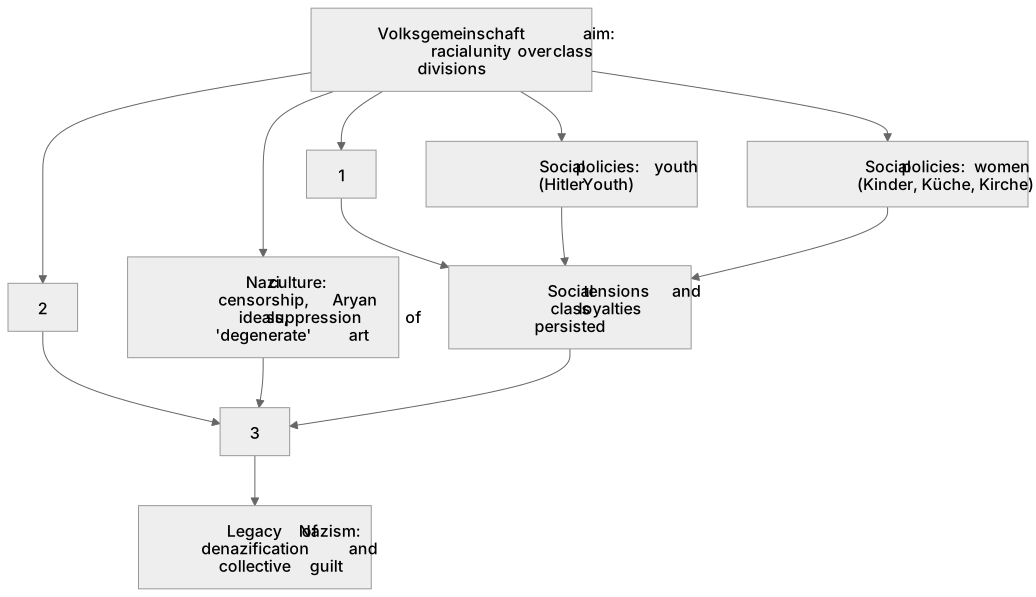
1Box 1
2Box 2
3Box 3
There is more to this lesson
The full lesson goes on to check your understanding and help you earn the marks. Create a free account to carry on, with your progress saved.
A week of Premium from your first lesson · Then the free plan continues · No card, no charge
Test your understanding of 1L The quest for political stability: Germany, 1871–1991 – only) The Nazi experiment, 1929–1949 (A-level only): Social developments and tensions; Nazi social policies including volksgemeinschaft and the racial state; Nazi culture; postwar German society and the legacy of Nazism
Active recall beats re-reading. Take an instant quiz now to test what you’ve learned and lock it into long-term memory.
A week of Premium from your first lesson · Then the free plan continues · No card, no charge