AQA · A-Level · History
Course version: 7042 · Version from Sept 2017
Germany, 1871–1991 – The Kaiserreich, 1871–1914: Political authority: the…
Full specification wording
1L The quest for political stability: Germany, 1871–1991 – The Kaiserreich, 1871–1914: Political authority: the extent and make-up of the German Empire in 1871; the 1871 constitution; the role of Emperor and Chancellor; political groupings and parties and their ideologies
The 1871 German Empire was a federal state comprising 25 distinct states, dominated by Prussia which held 60% of the population and territory.
Checked against the AQA 7042 specification (opens in a new tab) on .
- Point 1 of 6
- 4 key terms
Study notes
From the checked teaching notes for this specification point.
The idea
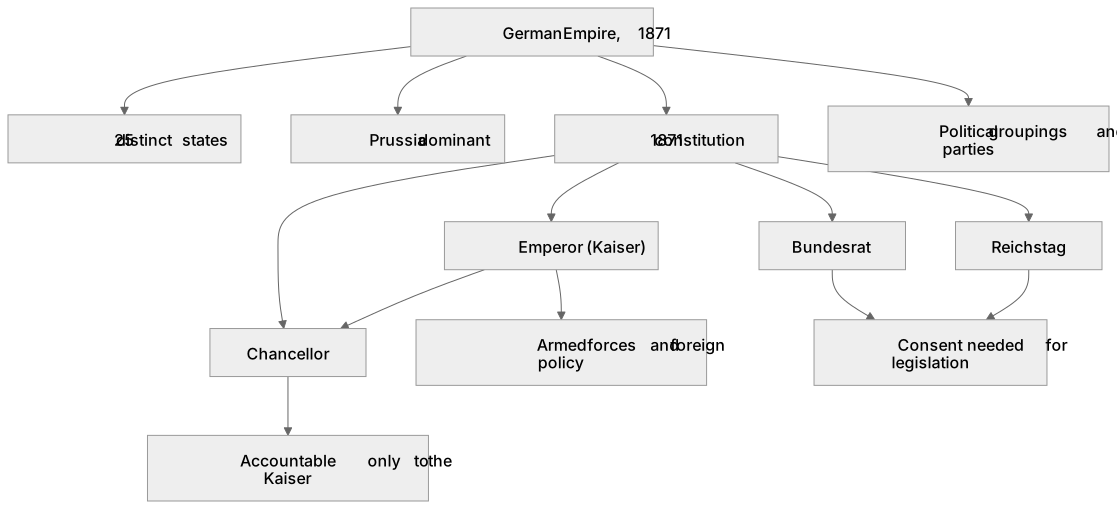
The 1871 German Empire was a federal state comprising 25 distinct states, dominated by Prussia which held 60% of the population and territory. The 1871 constitution established a complex balance of power. The Emperor (Kaiser) commanded the armed forces, controlled foreign policy, and appointed the Chancellor. The Chancellor, notably Bismarck, was accountable only to the Kaiser, not the Reichstag, giving the executive immense authority. However, legislation required the consent of the Bundesrat (federal council) and the Reichstag (national parliament elected by universal male suffrage). Key political groupings emerged with distinct ideologies: National Liberals championed unity and free trade; the Centre Party defended Catholic interests; Conservatives backed Prussian autocracy; and the SPD advocated for socialist reforms.
What earns the marks
- Identify the federal nature of the 1871 Empire, noting Prussia's dominance in the Bundesrat where it held 17 of 58 votes, sufficient for a veto.
- Explain the constitutional powers of the Emperor, including absolute control over the military and the sole right to appoint or dismiss the Chancellor.
- Analyse the Chancellor's role as the chief minister who drafted legislation and remained independent of Reichstag majorities.
- Evaluate the ideologies of major parties, such as the National Liberals' focus on centralisation and the Centre Party's defence of minority Catholic rights.
Common mistakes and how to put them right
Claiming the Chancellor was elected by or accountable to the Reichstag.
Put it right: State that the Chancellor was appointed by and solely responsible to the Emperor.
Assuming the 1871 Empire was a fully unified, centralised state.
Put it right: Emphasise that it was a federal structure where 25 individual states retained control over local matters like education and policing.
Confusing the Bundesrat and the Reichstag.
Put it right: Distinguish the Bundesrat as the appointed federal council of state representatives and the Reichstag as the elected national parliament.
Exam tips
- Use Prussia's veto power in the Bundesrat as a concrete example of how the constitution entrenched conservative, authoritarian control.
- When discussing political parties, link their ideologies directly to the demographic they represented, such as the SPD and the growing industrial working class.
- Evaluate the tension between the democratic element of universal male suffrage for the Reichstag and the autocratic reality of the Kaiser's powers.
Try the lesson
The start of the 1L The quest for political stability: Germany, 1871–1991 – The Kaiserreich, 1871–1914: Political authority: the extent and make-up of the German Empire in 1871; the 1871 constitution; the role of Emperor and Chancellor; political groupings and parties and their ideologies lesson, made from checked teaching notes for this specification point.
Have a go first
Under the 1871 constitution of the German Empire, which state held the most political and military power, including the right to veto constitutional changes in the Bundesrat?
Listen
The 1871 German Empire was a federal state comprising 25 distinct states, dominated by Prussia which held 60% of the population and territory. The 1871 constitution established a complex balance of power. The Emperor (Kaiser) commanded the armed forces, controlled foreign policy, and appointed the Chancellor. The Chancellor, notably Bismarck, was accountable only to the Kaiser, not the Reichstag, giving the executive immense authority. However, legislation required the consent of the Bundesrat (federal council) and the Reichstag (national parliament elected by universal male suffrage). Key political groupings emerged with distinct ideologies: National Liberals championed unity and free trade; the Centre Party defended Catholic interests; Conservatives backed Prussian autocracy; and the SPD advocated for socialist reforms. A strong answer earns marks for these points. Identify the federal nature of the 1871 Empire, noting Prussia's dominance in the Bundesrat where it held 17 of 58 votes, sufficient for a veto. Explain the constitutional powers of the Emperor, including absolute control over the military and the sole right to appoint or dismiss the Chancellor. Analyse the Chancellor's role as the chief minister who drafted legislation and remained independent of Reichstag majorities. Evaluate the ideologies of major parties, such as the National Liberals' focus on centralisation and the Centre Party's defence of minority Catholic rights. A common slip: Claiming the Chancellor was elected by or accountable to the Reichstag. Instead, State that the Chancellor was appointed by and solely responsible to the Emperor. Exam tip: Use Prussia's veto power in the Bundesrat as a concrete example of how the constitution entrenched conservative, authoritarian control.
See it
Key words
Say what each word means before you turn the card.
Federalism versus Centralisation
Try answering aloud or in your head before turning the card.
Autocracy versus Democracy
Try answering aloud or in your head before turning the card.
Constitutional power structures
Try answering aloud or in your head before turning the card.
Political ideologies and class interests
Try answering aloud or in your head before turning the card.
See every definition
- Federalism versus Centralisation
- The 1871 Empire was a federal state of 25 distinct states, dominated by Prussia, rather than a fully unified, centralised state.
- Autocracy versus Democracy
- The constitution set the democratic element of universal male suffrage for the Reichstag against the autocratic reality of the Kaiser's powers.
- Constitutional power structures
- The 1871 constitution established a complex balance of power between the Emperor, Chancellor, Bundesrat and Reichstag.
- Political ideologies and class interests
- Key political groupings emerged with distinct ideologies, their beliefs linked to the demographic they represented.
Label the diagram
Some boxes have lost their names. Pick the right name for each number.
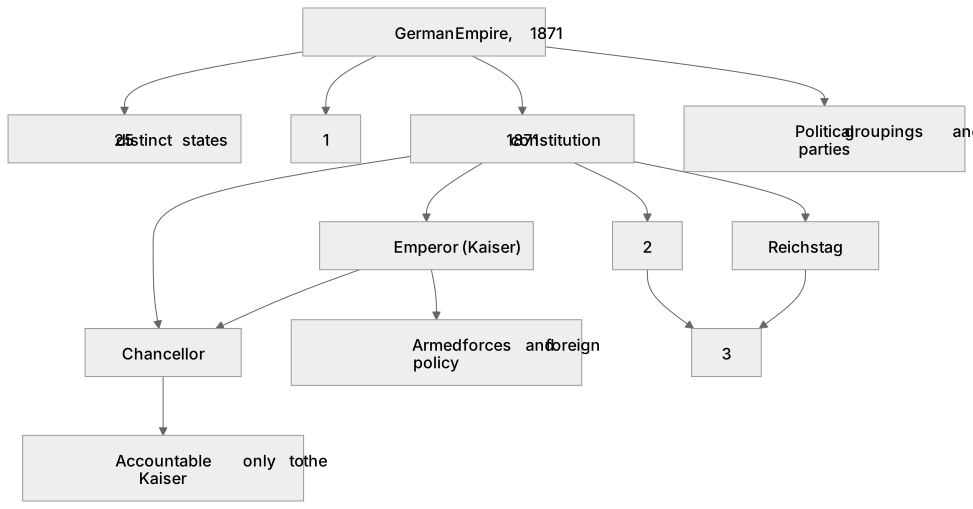
1Box 1
2Box 2
3Box 3
There is more to this lesson
The full lesson goes on to check your understanding and help you earn the marks. Create a free account to carry on, with your progress saved.
A week of Premium from your first lesson · Then the free plan continues · No card, no charge
Test your understanding of 1L The quest for political stability: Germany, 1871–1991 – The Kaiserreich, 1871–1914: Political authority: the extent and make-up of the German Empire in 1871; the 1871 constitution; the role of Emperor and Chancellor; political groupings and parties and their ideologies
Active recall beats re-reading. Take an instant quiz now to test what you’ve learned and lock it into long-term memory.
A week of Premium from your first lesson · Then the free plan continues · No card, no charge