AQA · A-Level · History
Course version: 7042 · Version from Sept 2017
Germany, 1871–1991 – The Kaiserreich, 1871–1914: Government and…
Full specification wording
1L The quest for political stability: Germany, 1871–1991 – The Kaiserreich, 1871–1914: Government and opposition: Kaiser Wilhelm I and government under Bismarck; their personalities and policies; the role of the Reichstag; the struggle between autocracy and democracy; the development of parties and political opposition
Government under Bismarck was defined by his pragmatic, authoritarian personality and his complex relationship with the conservative Kaiser Wilhelm I, who largely deferred to his Chancellor.
Checked against the AQA 7042 specification (opens in a new tab) on .
- Point 2 of 6
- 4 key terms
Study notes
From the checked teaching notes for this specification point.
The idea
Government under Bismarck was defined by his pragmatic, authoritarian personality and his complex relationship with the conservative Kaiser Wilhelm I, who largely deferred to his Chancellor. Bismarck’s policies, such as the Kulturkampf against Catholics and the Anti-Socialist Laws, aimed to crush political opposition and consolidate state power. The Reichstag played a crucial role; although Bismarck despised parliamentary democracy, he needed its approval for budgets and legislation. This created a continuous struggle between autocracy and democracy. As industrialisation accelerated, political opposition developed rapidly. The Centre Party and the SPD grew in strength despite Bismarck's repressive policies, forcing him to forge shifting alliances, such as abandoning the National Liberals for conservative protectionism in 1879.
What earns the marks
- Assess the dynamic between Wilhelm I and Bismarck, noting the Kaiser's traditional Prussian militarism and Bismarck's dominant, manipulative political strategy.
- Analyse Bismarck's domestic policies, specifically the Kulturkampf and Anti-Socialist Laws, as methods to suppress perceived internal enemies.
- Evaluate the Reichstag's role as a platform for political opposition that, despite limited executive power, could block legislation and military budgets.
- Trace the development of political opposition, highlighting how the Centre Party and SPD expanded their electoral support in response to state persecution.
Common mistakes and how to put them right
Stating that Bismarck ruled as an absolute dictator without needing parliament.
Put it right: Clarify that Bismarck required the Reichstag to pass laws and budgets, forcing him to manage political majorities.
Treating Wilhelm I and Wilhelm II as having the same governing style.
Put it right: Specify that Wilhelm I generally allowed Bismarck to dictate policy, whereas Wilhelm II insisted on personal rule.
Arguing that the Anti-Socialist Laws completely destroyed the SPD.
Put it right: Explain that while the laws banned socialist organisations, SPD candidates could still stand for election, and their support actually grew.
Exam tips
- Contrast Bismarck's initial alliance with the National Liberals (1871-1878) with his later conservative pivot to demonstrate his pragmatic approach to managing the Reichstag.
- Use the Kulturkampf as a primary example of how Bismarck's attempts to crush opposition often backfired, ultimately strengthening the Centre Party.
- Discuss the struggle between autocracy and democracy by contrasting the executive power of the Chancellor with the democratic mandate of the Reichstag deputies.
Try the lesson
The start of the 1L The quest for political stability: Germany, 1871–1991 – The Kaiserreich, 1871–1914: Government and opposition: Kaiser Wilhelm I and government under Bismarck; their personalities and policies; the role of the Reichstag; the struggle between autocracy and democracy; the development of parties and political opposition lesson, made from checked teaching notes for this specification point.
Have a go first
What was the name given to Chancellor Otto von Bismarck's policy in the 1870s that aimed to reduce the political and social influence of the Catholic Church in Germany?
Listen
Government under Bismarck was defined by his pragmatic, authoritarian personality and his complex relationship with the conservative Kaiser Wilhelm I, who largely deferred to his Chancellor. Bismarck’s policies, such as the Kulturkampf against Catholics and the Anti-Socialist Laws, aimed to crush political opposition and consolidate state power. The Reichstag played a crucial role; although Bismarck despised parliamentary democracy, he needed its approval for budgets and legislation. This created a continuous struggle between autocracy and democracy. As industrialisation accelerated, political opposition developed rapidly. The Centre Party and the SPD grew in strength despite Bismarck's repressive policies, forcing him to forge shifting alliances, such as abandoning the National Liberals for conservative protectionism in 1879. A strong answer earns marks for these points. Assess the dynamic between Wilhelm I and Bismarck, noting the Kaiser's traditional Prussian militarism and Bismarck's dominant, manipulative political strategy. Analyse Bismarck's domestic policies, specifically the Kulturkampf and Anti-Socialist Laws, as methods to suppress perceived internal enemies. Evaluate the Reichstag's role as a platform for political opposition that, despite limited executive power, could block legislation and military budgets. Trace the development of political opposition, highlighting how the Centre Party and SPD expanded their electoral support in response to state persecution. A common slip: Stating that Bismarck ruled as an absolute dictator without needing parliament. Instead, Clarify that Bismarck required the Reichstag to pass laws and budgets, forcing him to manage political majorities. Exam tip: Contrast Bismarck's initial alliance with the National Liberals (1871-1878) with his later conservative pivot to demonstrate his pragmatic approach to managing the Reichstag.
See it
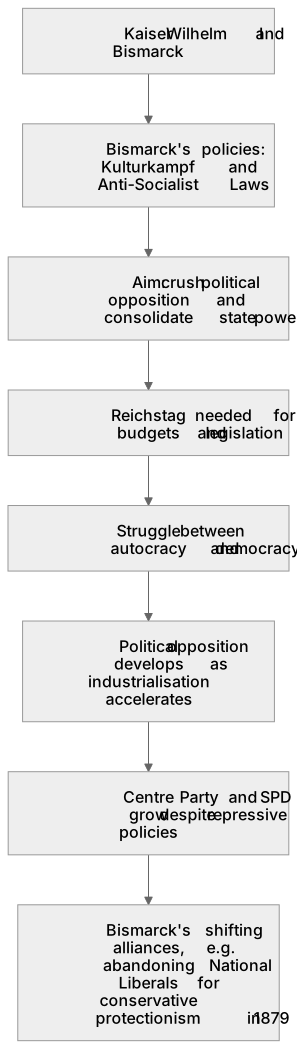
Put it in order
Put these steps in the order they happen.
- 1. Struggle between autocracy and democracy
- 2. Bismarck's shifting alliances, e.g. abandoning National Liberals for conservative protectionism in 1879
- 3. Political opposition develops as industrialisation accelerates
- 4. Kaiser Wilhelm I and Bismarck
- 5. Bismarck's policies: Kulturkampf and Anti-Socialist Laws
- 6. Centre Party and SPD grow despite repressive policies
- 7. Aim: crush political opposition and consolidate state power
- 8. Reichstag needed for budgets and legislation
Key words
Say what each word means before you turn the card.
Authoritarianism and state repression
Try answering aloud or in your head before turning the card.
The evolution of parliamentary opposition
Try answering aloud or in your head before turning the card.
Pragmatism and political alliances
Try answering aloud or in your head before turning the card.
The tension between traditional elites and mass politics
Try answering aloud or in your head before turning the card.
See every definition
- Authoritarianism and state repression
- Bismarck's policies aimed to crush political opposition and consolidate state power, reflecting his pragmatic, authoritarian personality.
- The evolution of parliamentary opposition
- As industrialisation accelerated, political opposition developed rapidly, with the Centre Party and the SPD growing in strength despite Bismarck's repressive policies.
- Pragmatism and political alliances
- Bismarck forged shifting alliances, such as abandoning the National Liberals for conservative protectionism in 1879.
- The tension between traditional elites and mass politics
- A continuous struggle between autocracy and democracy arose, as the Reichstag, though despised by Bismarck, was needed for budgets and legislation.
Label the diagram
Some boxes have lost their names. Pick the right name for each number.
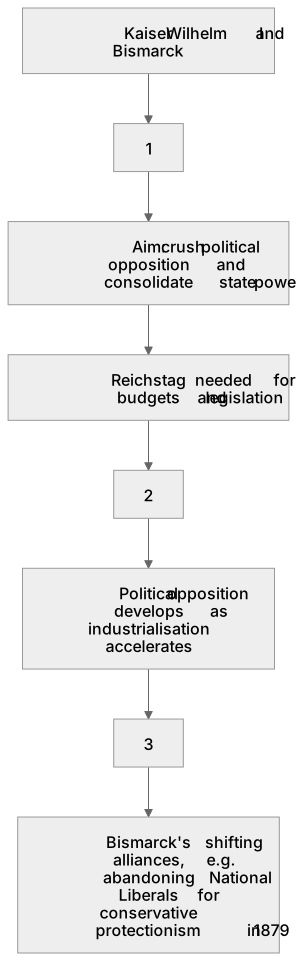
1Box 1
2Box 2
3Box 3
There is more to this lesson
The full lesson goes on to check your understanding and help you earn the marks. Create a free account to carry on, with your progress saved.
A week of Premium from your first lesson · Then the free plan continues · No card, no charge
Test your understanding of 1L The quest for political stability: Germany, 1871–1991 – The Kaiserreich, 1871–1914: Government and opposition: Kaiser Wilhelm I and government under Bismarck; their personalities and policies; the role of the Reichstag; the struggle between autocracy and democracy; the development of parties and political opposition
Active recall beats re-reading. Take an instant quiz now to test what you’ve learned and lock it into long-term memory.
A week of Premium from your first lesson · Then the free plan continues · No card, no charge