AQA · A-Level · History
Course version: 7042 · Version from Sept 2017
Germany, 1871–1991 – The Kaiserreich, 1871–1914: Social developments: the…
Full specification wording
1L The quest for political stability: Germany, 1871–1991 – The Kaiserreich, 1871–1914: Social developments: the class hierarchy; elitism and the culture of militarism; the condition of the working people
During the Kaiserreich, Germany's rapid industrialisation transformed its class hierarchy, yet traditional elites like the Prussian Junkers maintained dominance over the upper echelons of…
Checked against the AQA 7042 specification (opens in a new tab) on .
- Point 5 of 6
- 4 key terms
Study notes
From the checked teaching notes for this specification point.
The idea
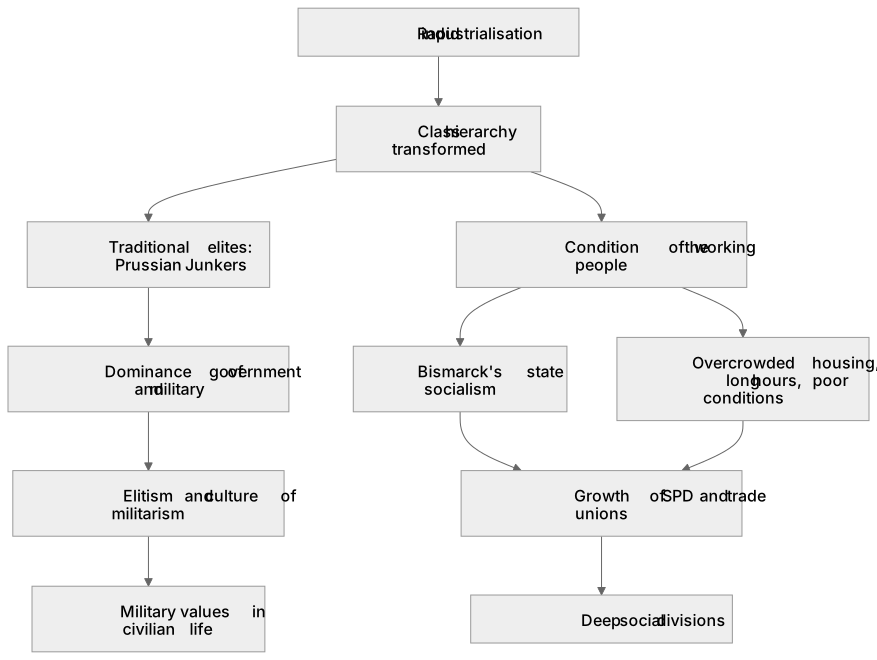
During the Kaiserreich, Germany's rapid industrialisation transformed its class hierarchy, yet traditional elites like the Prussian Junkers maintained dominance over the upper echelons of government and the military. This elitism fostered a pervasive culture of militarism, where military values permeated civilian life, exemplified by the high social status of army officers and the popularity of veterans' associations (Kriegervereine). Meanwhile, the condition of the working people was a paradox. Despite the introduction of Bismarck's pioneering state socialism, which provided health and old-age insurance, urban workers endured overcrowded housing, long hours, and poor working conditions. This fuelled the rapid growth of the SPD and trade unions, highlighting the deep social divisions within the newly unified German state.
What earns the marks
- Identify the continued dominance of the Prussian Junker class in political and military leadership despite rapid industrialisation.
- Explain how militarism influenced civilian society, such as the prestige of the officer corps and the role of the Zabern Affair in highlighting military impunity.
- Evaluate the living and working conditions of the industrial working class, noting issues like urban overcrowding and long working hours.
- Assess the impact of state welfare reforms versus the reality of working-class life, leading to the rise of the SPD and trade unionism.
Common mistakes and how to put them right
Assuming the working class saw no improvements.
Put it right by acknowledging Bismarck's welfare state and rising real wages by 1914, despite ongoing hardships.
Equating the middle class (Bürgertum) with the ruling elite.
Put it right by distinguishing between the traditional Junker aristocracy who held power and the wealthy industrialists who sought to emulate them.
Treating militarism as purely a government policy.
Put it right by explaining it as a cultural phenomenon embraced by the middle classes through organisations like the Navy League.
Exam tips
- Use the Zabern Affair (1913) as a concrete example to demonstrate the supremacy of the military over civilian authorities.
- Contrast the progressive nature of Germany's social welfare system with the restrictive political rights of the working class to build a nuanced argument.
- Analyse the concept of Sammlungspolitik when discussing how elites attempted to unite the middle and upper classes against the socialist threat.
Try the lesson
The start of the 1L The quest for political stability: Germany, 1871–1991 – The Kaiserreich, 1871–1914: Social developments: the class hierarchy; elitism and the culture of militarism; the condition of the working people lesson, made from checked teaching notes for this specification point.
Have a go first
Which of the following best describes the role of the military in the social hierarchy of the German Kaiserreich between 1871 and 1914?
Listen
During the Kaiserreich, Germany's rapid industrialisation transformed its class hierarchy, yet traditional elites like the Prussian Junkers maintained dominance over the upper echelons of government and the military. This elitism fostered a pervasive culture of militarism, where military values permeated civilian life, exemplified by the high social status of army officers and the popularity of veterans' associations (Kriegervereine). Meanwhile, the condition of the working people was a paradox. Despite the introduction of Bismarck's pioneering state socialism, which provided health and old-age insurance, urban workers endured overcrowded housing, long hours, and poor working conditions. This fuelled the rapid growth of the SPD and trade unions, highlighting the deep social divisions within the newly unified German state. A strong answer earns marks for these points. Identify the continued dominance of the Prussian Junker class in political and military leadership despite rapid industrialisation. Explain how militarism influenced civilian society, such as the prestige of the officer corps and the role of the Zabern Affair in highlighting military impunity. Evaluate the living and working conditions of the industrial working class, noting issues like urban overcrowding and long working hours. Assess the impact of state welfare reforms versus the reality of working-class life, leading to the rise of the SPD and trade unionism. A common slip: Assuming the working class saw no improvements. Instead, acknowledging Bismarck's welfare state and rising real wages by 1914, despite ongoing hardships. Exam tip: Use the Zabern Affair (1913) as a concrete example to demonstrate the supremacy of the military over civilian authorities.
See it
Key words
Say what each word means before you turn the card.
Social stratification
Try answering aloud or in your head before turning the card.
Militarism
Try answering aloud or in your head before turning the card.
Industrialisation
Try answering aloud or in your head before turning the card.
Working-class movements
Try answering aloud or in your head before turning the card.
See every definition
- Social stratification
- The class hierarchy of the Kaiserreich, in which traditional elites like the Prussian Junkers maintained dominance over the upper echelons of government and the military despite rapid industrialisation.
- Militarism
- A pervasive culture in which military values permeated civilian life, exemplified by the high social status of army officers and the popularity of veterans' associations.
- Industrialisation
- Rapid transformation that changed Germany's class hierarchy during the Kaiserreich, while traditional elites retained dominance over government and the military.
- Working-class movements
- The rapid growth of the SPD and trade unions, fuelled by overcrowded housing, long hours and poor working conditions among urban workers.
Label the diagram
Some boxes have lost their names. Pick the right name for each number.
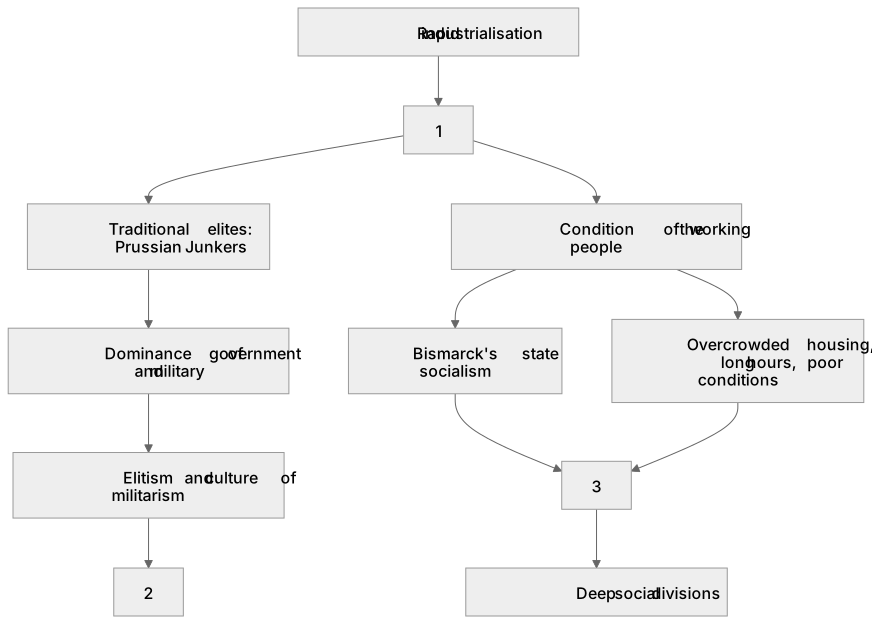
1Box 1
2Box 2
3Box 3
There is more to this lesson
The full lesson goes on to check your understanding and help you earn the marks. Create a free account to carry on, with your progress saved.
A week of Premium from your first lesson · Then the free plan continues · No card, no charge
Test your understanding of 1L The quest for political stability: Germany, 1871–1991 – The Kaiserreich, 1871–1914: Social developments: the class hierarchy; elitism and the culture of militarism; the condition of the working people
Active recall beats re-reading. Take an instant quiz now to test what you’ve learned and lock it into long-term memory.
A week of Premium from your first lesson · Then the free plan continues · No card, no charge