AQA · A-Level · History
Course version: 7042 · Version from Sept 2017
Germany, 1871–1991 – The Kaiserreich, 1871–1914: Economic developments:…
Full specification wording
1L The quest for political stability: Germany, 1871–1991 – The Kaiserreich, 1871–1914: Economic developments: industrial expansion; old and new industries; trade and wealth
Between 1871 and 1914, Germany experienced unprecedented industrial expansion, transforming into Europe's leading industrial power.
Checked against the AQA 7042 specification (opens in a new tab) on .
- Point 4 of 6
- 4 key terms
Study notes
From the checked teaching notes for this specification point.
The idea
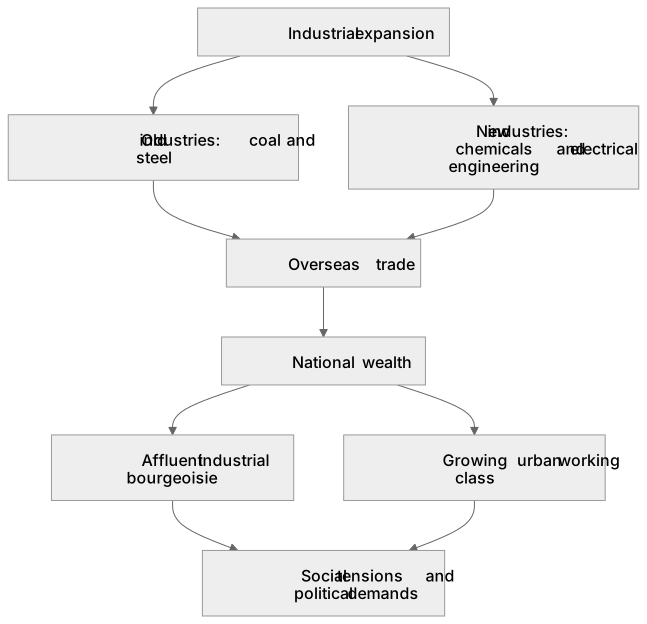
Between 1871 and 1914, Germany experienced unprecedented industrial expansion, transforming into Europe's leading industrial power. This growth was driven by the rapid expansion of 'old' industries, such as coal and steel production in the Ruhr, alongside pioneering developments in 'new' industries like chemicals and electrical engineering. Companies like Krupp, Bayer, and Siemens became global giants. This industrial boom fuelled a massive increase in overseas trade, supported by a growing merchant navy, and generated immense national wealth. However, this wealth was unevenly distributed, creating a stark divide between the affluent industrial bourgeoisie and the growing urban working class, which in turn fuelled social tensions and political demands.
What earns the marks
- Identify the key factors driving Germany's rapid industrial expansion before 1914.
- Compare the growth and significance of traditional heavy industries with new technological sectors.
- Analyse the impact of industrialisation on Germany's share of global trade.
- Evaluate the social consequences of the wealth generated by economic development.
- Explain the role of cartels and state support in fostering industrial growth.
Common mistakes and how to put them right
Stating that Germany only focused on heavy industry like coal and steel.
Put it right: Emphasise Germany's global dominance in new industries, particularly chemicals and electricals, by the early 20th century.
Assuming the economic boom benefited all Germans equally.
Put it right: Highlight the growing wealth inequality between the industrial elite and the working classes, which exacerbated social tensions.
Ignoring the role of agriculture.
Put it right: Note that while industry expanded rapidly, agriculture remained a significant, albeit declining, sector of the economy protected by tariffs.
Exam tips
- Memorise key statistics, such as the increase in coal production or Germany's share of the global chemical market, to substantiate arguments about economic growth.
- Link economic developments to political changes, showing how the growth of the industrial working class strengthened the SPD.
- Discuss the formation of cartels as a unique feature of German industrial expansion that reduced competition and increased efficiency.
Try the lesson
The start of the 1L The quest for political stability: Germany, 1871–1991 – The Kaiserreich, 1871–1914: Economic developments: industrial expansion; old and new industries; trade and wealth lesson, made from checked teaching notes for this specification point.
Have a go first
In which 'new' industries did Germany experience the most significant expansion and achieve global dominance by 1914?
Listen
Between 1871 and 1914, Germany experienced unprecedented industrial expansion, transforming into Europe's leading industrial power. This growth was driven by the rapid expansion of 'old' industries, such as coal and steel production in the Ruhr, alongside pioneering developments in 'new' industries like chemicals and electrical engineering. Companies like Krupp, Bayer, and Siemens became global giants. This industrial boom fuelled a massive increase in overseas trade, supported by a growing merchant navy, and generated immense national wealth. However, this wealth was unevenly distributed, creating a stark divide between the affluent industrial bourgeoisie and the growing urban working class, which in turn fuelled social tensions and political demands. A strong answer earns marks for these points. Identify the key factors driving Germany's rapid industrial expansion before 1914. Compare the growth and significance of traditional heavy industries with new technological sectors. Analyse the impact of industrialisation on Germany's share of global trade. Evaluate the social consequences of the wealth generated by economic development. A common slip: Stating that Germany only focused on heavy industry like coal and steel. Instead, Emphasise Germany's global dominance in new industries, particularly chemicals and electricals, by the early 20th century. Exam tip: Memorise key statistics, such as the increase in coal production or Germany's share of the global chemical market, to substantiate arguments about economic growth.
See it
Key words
Say what each word means before you turn the card.
Industrialisation
Try answering aloud or in your head before turning the card.
Economic Inequality
Try answering aloud or in your head before turning the card.
Technological Innovation
Try answering aloud or in your head before turning the card.
Global Trade
Try answering aloud or in your head before turning the card.
See every definition
- Industrialisation
- Unprecedented industrial expansion that transformed Germany into Europe's leading industrial power between 1871 and 1914.
- Economic Inequality
- Wealth was unevenly distributed, creating a stark divide between the affluent industrial bourgeoisie and the growing urban working class.
- Technological Innovation
- Pioneering developments in new industries like chemicals and electrical engineering, alongside old industries such as coal and steel.
- Global Trade
- A massive increase in overseas trade, supported by a growing merchant navy, fuelled by the industrial boom.
Label the diagram
Some boxes have lost their names. Pick the right name for each number.
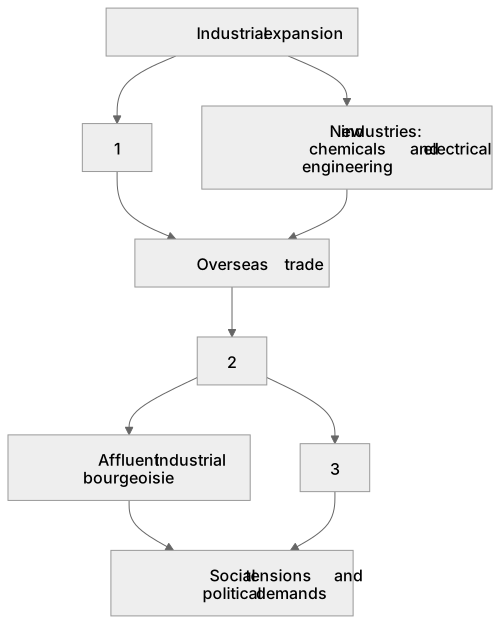
1Box 1
2Box 2
3Box 3
There is more to this lesson
The full lesson goes on to check your understanding and help you earn the marks. Create a free account to carry on, with your progress saved.
A week of Premium from your first lesson · Then the free plan continues · No card, no charge
Test your understanding of 1L The quest for political stability: Germany, 1871–1991 – The Kaiserreich, 1871–1914: Economic developments: industrial expansion; old and new industries; trade and wealth
Active recall beats re-reading. Take an instant quiz now to test what you’ve learned and lock it into long-term memory.
A week of Premium from your first lesson · Then the free plan continues · No card, no charge