AQA · A-Level · History
Course version: 7042 · Version from Sept 2017
Relations with the Church: Hubert Walter as Archbishop of Canterbury; the…
Full specification wording
2A Royal Authority and the Angevin Kings, 1154–1216 – King John, 1199–1214 (A-level only): Relations with the Church: Hubert Walter as Archbishop of Canterbury; the dispute with the Papacy; the interdict of 1208
King John’s early relations with the Church were stabilised by Hubert Walter, Archbishop of Canterbury and Chancellor, whose diplomatic skill bridged the gap between royal authority and…
Checked against the AQA 7042 specification (opens in a new tab) on .
- Point 2 of 4
- 4 key terms
Study notes
From the checked teaching notes for this specification point.
The idea
King John’s early relations with the Church were stabilised by Hubert Walter, Archbishop of Canterbury and Chancellor, whose diplomatic skill bridged the gap between royal authority and ecclesiastical independence. Walter’s death in 1205 triggered a monumental dispute with the Papacy over his successor. John demanded John de Gray, while Pope Innocent III consecrated Stephen Langton. John’s refusal to accept Langton led Innocent III to impose the Interdict of 1208, suspending most church services across England. Rather than capitulating, John exploited the Interdict financially, confiscating the revenues of clergy who obeyed the Pope. This standoff demonstrated John’s determination to maintain royal prerogative over church appointments.
What earns the marks
- Evaluate the role of Hubert Walter in maintaining a harmonious relationship between the Crown and the Church until 1205.
- Analyse the origins of the papal dispute, focusing on the conflicting claims of the King, the Canterbury monks, and Pope Innocent III regarding the election of the Archbishop.
- Assess the impact of the 1208 Interdict on the English population and the daily functioning of the Church.
- Explain how King John turned the Interdict to his financial advantage by seizing the lands and revenues of the exiled or compliant clergy.
Common mistakes and how to put them right
Assuming the Interdict meant all religious life stopped completely.
Put it right: Clarify that while mass and marriages were suspended, baptisms of infants and last rites for the dying were still permitted.
Claiming the Interdict immediately weakened King John's power.
Put it right: Note that John actually benefited financially in the short term by confiscating church properties and revenues.
Confusing the Interdict of 1208 with John's personal excommunication.
Put it right: Distinguish between the Interdict, which was a strike on the country's religious services in 1208, and John's personal excommunication which followed later in 1209.
Exam tips
- Contrast the period of Hubert Walter's leadership with the subsequent crisis to highlight Walter's importance to John's government.
- Use the dispute over Stephen Langton to illustrate the broader European struggle between emerging papal supremacy and traditional royal prerogative.
- Discuss the financial windfall John gained from the Interdict to explain why he was able to withstand papal pressure for so long.
Try the lesson
The start of the 2A Royal Authority and the Angevin Kings, 1154–1216 – King John, 1199–1214 (A-level only): Relations with the Church: Hubert Walter as Archbishop of Canterbury; the dispute with the Papacy; the interdict of 1208 lesson, made from checked teaching notes for this specification point.
Have a go first
What was the primary cause of the dispute between King John and Pope Innocent III that resulted in the papal interdict of 1208?
Listen
King John’s early relations with the Church were stabilised by Hubert Walter, Archbishop of Canterbury and Chancellor, whose diplomatic skill bridged the gap between royal authority and ecclesiastical independence. Walter’s death in 1205 triggered a monumental dispute with the Papacy over his successor. John demanded John de Gray, while Pope Innocent III consecrated Stephen Langton. John’s refusal to accept Langton led Innocent III to impose the Interdict of 1208, suspending most church services across England. Rather than capitulating, John exploited the Interdict financially, confiscating the revenues of clergy who obeyed the Pope. This standoff demonstrated John’s determination to maintain royal prerogative over church appointments. A strong answer earns marks for these points. Evaluate the role of Hubert Walter in maintaining a harmonious relationship between the Crown and the Church until 1205. Analyse the origins of the papal dispute, focusing on the conflicting claims of the King, the Canterbury monks, and Pope Innocent III regarding the election of the Archbishop. Assess the impact of the 1208 Interdict on the English population and the daily functioning of the Church. Explain how King John turned the Interdict to his financial advantage by seizing the lands and revenues of the exiled or compliant clergy. A common slip: Assuming the Interdict meant all religious life stopped completely. Instead, Clarify that while mass and marriages were suspended, baptisms of infants and last rites for the dying were still permitted. Exam tip: Contrast the period of Hubert Walter's leadership with the subsequent crisis to highlight Walter's importance to John's government.
See it
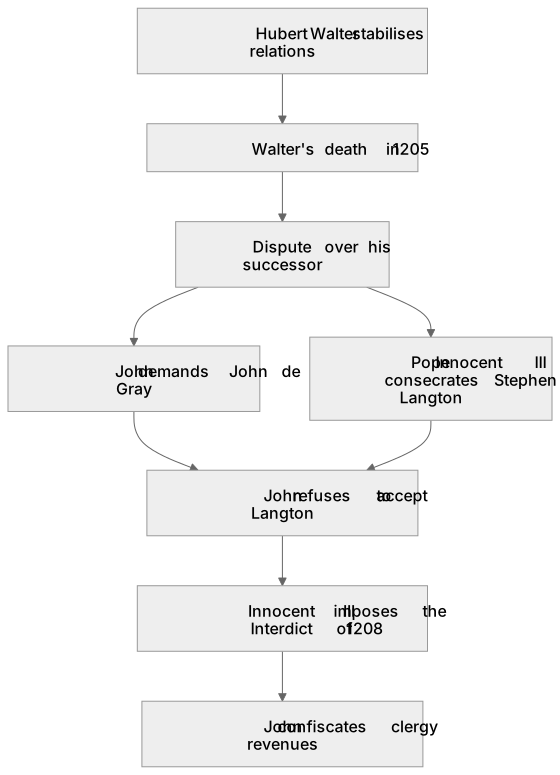
Key words
Say what each word means before you turn the card.
Church-State conflict
Try answering aloud or in your head before turning the card.
Papal authority versus royal prerogative
Try answering aloud or in your head before turning the card.
Ecclesiastical administration
Try answering aloud or in your head before turning the card.
Financial opportunism
Try answering aloud or in your head before turning the card.
See every definition
- Church-State conflict
- A monumental dispute with the Papacy over the successor to Hubert Walter, in which John demanded John de Gray while Pope Innocent III consecrated Stephen Langton.
- Papal authority versus royal prerogative
- John's refusal to accept Langton demonstrated his determination to maintain royal prerogative over church appointments against the Papacy.
- Ecclesiastical administration
- Hubert Walter, Archbishop of Canterbury and Chancellor, bridged the gap between royal authority and ecclesiastical independence through diplomatic skill.
- Financial opportunism
- Rather than capitulating, John exploited the Interdict financially by confiscating the revenues of clergy who obeyed the Pope.
Label the diagram
Some boxes have lost their names. Pick the right name for each number.
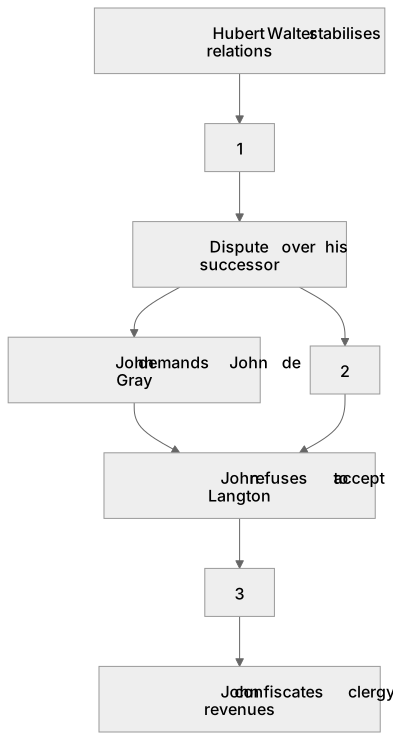
1Box 1
2Box 2
3Box 3
There is more to this lesson
The full lesson goes on to check your understanding and help you earn the marks. Create a free account to carry on, with your progress saved.
A week of Premium from your first lesson · Then the free plan continues · No card, no charge
Test your understanding of 2A Royal Authority and the Angevin Kings, 1154–1216 – King John, 1199–1214 (A-level only): Relations with the Church: Hubert Walter as Archbishop of Canterbury; the dispute with the Papacy; the interdict of 1208
Active recall beats re-reading. Take an instant quiz now to test what you’ve learned and lock it into long-term memory.
A week of Premium from your first lesson · Then the free plan continues · No card, no charge