AQA · A-Level · History
Course version: 7042 · Version from Sept 2017
Royal government under King John: the character and aims of the King; his…
Full specification wording
2A Royal Authority and the Angevin Kings, 1154–1216 – King John, 1199–1214 (A-level only): Royal government under King John: the character and aims of the King; his relations with the barons; the royal finances; justice and the law
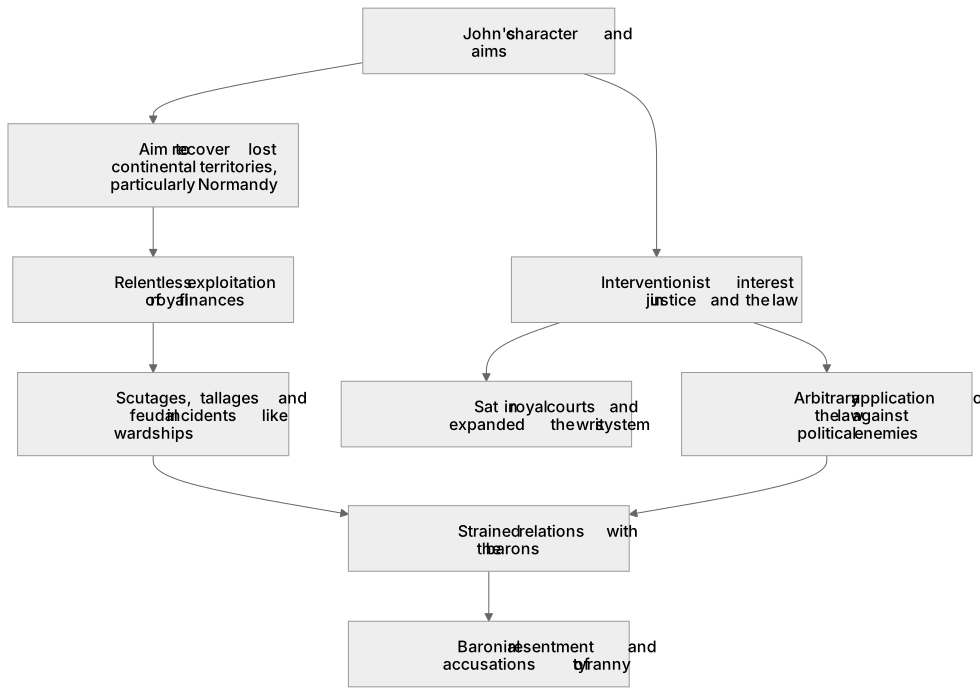
King John’s royal government was defined by his suspicious character and his overarching aim to recover lost continental territories, particularly Normandy.
Checked against the AQA 7042 specification (opens in a new tab) on .
- Point 1 of 4
- 4 key terms
Study notes
From the checked teaching notes for this specification point.
The idea
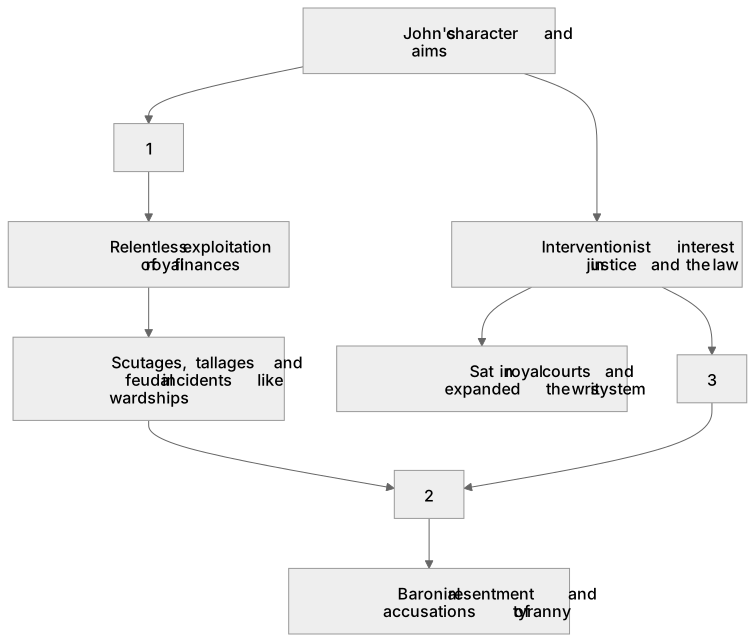
King John’s royal government was defined by his suspicious character and his overarching aim to recover lost continental territories, particularly Normandy. This ambition drove his relentless exploitation of royal finances, levying exorbitant scutages, tallages, and feudal incidents like wardships which severely strained relations with the barons. Unlike his absentee brother Richard, John was a highly interventionist monarch who took a keen, personal interest in justice and the law. He frequently sat in the royal courts, expanding the use of the writ system and making royal justice more accessible, yet his arbitrary application of the law against political enemies, such as the de Braose family, fuelled baronial resentment and accusations of tyranny.
What earns the marks
- Assess how John's personality, particularly his paranoia and micromanagement, influenced his style of governance.
- Evaluate the methods John used to maximize royal revenue, including the unprecedented frequency and rate of scutage demands.
- Analyse the dual nature of John's legal reforms: his genuine improvements to the efficiency of royal courts versus his use of the law to punish personal enemies.
- Explain the deterioration of baronial relations, linking financial extortion and arbitrary justice to the eventual rebellion.
Common mistakes and how to put them right
Claiming John was entirely incompetent in government.
Put it right: Acknowledge his administrative capability and genuine interest in justice, contrasting this with his political misjudgements.
Stating the barons rebelled solely because of military defeats.
Put it right: Emphasise that financial extortion and arbitrary justice at home were equally significant catalysts for baronial discontent.
Confusing John's financial policies with Richard's.
Put it right: Specify that while Richard also taxed heavily, John's demands were more frequent, arbitrary, and applied during periods of peace in England.
Exam tips
- Use specific examples of financial exploitation, such as the exorbitant fine levied on William de Braose, to illustrate baronial grievances.
- When evaluating John's character, balance contemporary chroniclers' hostile accounts with administrative records that show his diligence.
- Link John's domestic policies directly to his foreign policy aims; his need to fund the recovery of Normandy drove his financial and legal actions.
Try the lesson
The start of the 2A Royal Authority and the Angevin Kings, 1154–1216 – King John, 1199–1214 (A-level only): Royal government under King John: the character and aims of the King; his relations with the barons; the royal finances; justice and the law lesson, made from checked teaching notes for this specification point.
Have a go first
Which financial mechanism did King John exploit most heavily to fund his military campaigns, causing significant resentment among the English barons?
Listen
King John’s royal government was defined by his suspicious character and his overarching aim to recover lost continental territories, particularly Normandy. This ambition drove his relentless exploitation of royal finances, levying exorbitant scutages, tallages, and feudal incidents like wardships which severely strained relations with the barons. Unlike his absentee brother Richard, John was a highly interventionist monarch who took a keen, personal interest in justice and the law. He frequently sat in the royal courts, expanding the use of the writ system and making royal justice more accessible, yet his arbitrary application of the law against political enemies, such as the de Braose family, fuelled baronial resentment and accusations of tyranny. A strong answer earns marks for these points. Assess how John's personality, particularly his paranoia and micromanagement, influenced his style of governance. Evaluate the methods John used to maximize royal revenue, including the unprecedented frequency and rate of scutage demands. Analyse the dual nature of John's legal reforms: his genuine improvements to the efficiency of royal courts versus his use of the law to punish personal enemies. Explain the deterioration of baronial relations, linking financial extortion and arbitrary justice to the eventual rebellion. A common slip: Claiming John was entirely incompetent in government. Instead, Acknowledge his administrative capability and genuine interest in justice, contrasting this with his political misjudgements. Exam tip: Use specific examples of financial exploitation, such as the exorbitant fine levied on William de Braose, to illustrate baronial grievances.
See it
Key words
Say what each word means before you turn the card.
Royal authority and tyranny
Try answering aloud or in your head before turning the card.
Financial administration and taxation
Try answering aloud or in your head before turning the card.
The development of English law
Try answering aloud or in your head before turning the card.
Crown-baron relations
Try answering aloud or in your head before turning the card.
See every definition
- Royal authority and tyranny
- John's arbitrary application of the law against political enemies fuelled baronial resentment and accusations of tyranny.
- Financial administration and taxation
- His ambition drove relentless exploitation of royal finances, levying exorbitant scutages, tallages and feudal incidents like wardships which severely strained relations with the barons.
- The development of English law
- He frequently sat in the royal courts, expanding the use of the writ system and making royal justice more accessible.
- Crown-baron relations
- Financial extortion and arbitrary justice at home were equally significant catalysts for baronial discontent.
Label the diagram
Some boxes have lost their names. Pick the right name for each number.
1Box 1
2Box 2
3Box 3
There is more to this lesson
The full lesson goes on to check your understanding and help you earn the marks. Create a free account to carry on, with your progress saved.
A week of Premium from your first lesson · Then the free plan continues · No card, no charge
Test your understanding of 2A Royal Authority and the Angevin Kings, 1154–1216 – King John, 1199–1214 (A-level only): Royal government under King John: the character and aims of the King; his relations with the barons; the royal finances; justice and the law
Active recall beats re-reading. Take an instant quiz now to test what you’ve learned and lock it into long-term memory.
A week of Premium from your first lesson · Then the free plan continues · No card, no charge