AQA · A-Level · History
Course version: 7042 · Version from Sept 2017
The character and aims of King Richard: attitudes towards religion and the…
Full specification wording
2A Royal Authority and the Angevin Kings, 1154–1216 – only) Richard I, 1189–1199 (A-level only): The character and aims of King Richard: attitudes towards religion and the Church; his involvement in the Third Crusade
Richard I ('the Lionheart') is characterised as a warrior-king whose primary aim was military glory, defending his Angevin lands and reclaiming Jerusalem.
Checked against the AQA 7042 specification (opens in a new tab) on .
- Point 1 of 4
- 4 key terms
Study notes
From the checked teaching notes for this specification point.
The idea
Richard I ('the Lionheart') is characterised as a warrior-king whose primary aim was military glory, defending his Angevin lands and reclaiming Jerusalem. His attitude towards religion was conventional yet zealous, viewing his kingship as a divine mandate to lead the Third Crusade. To fund this holy war, he heavily taxed England and sold offices, building upon the financial precedent of the 1188 'Saladin Tithe' levied by his father, Henry II. This showed that faith was central to his political strategies. His involvement in the Crusade (1190–1192) showcased his tactical brilliance at Arsuf and Acre, but also his diplomatic shortcomings, alienating allies like Philip II of France and Leopold of Austria, which ultimately led to his capture.
What earns the marks
- Evaluate Richard's primary aims, focusing on his prioritisation of the Third Crusade and the defence of the Angevin Empire over domestic English governance.
- Assess how Richard's conventional but fervent religious beliefs shaped his kingship, including his willingness to exploit Church resources and sell offices to fund his campaigns.
- Analyse Richard's military leadership and tactical successes during the Third Crusade, such as the sieges of Acre and the Battle of Arsuf.
- Examine the political consequences of his crusading involvement, particularly the breakdown of alliances with Philip II and Leopold of Austria, leading to his imprisonment.
Common mistakes and how to put them right
Claiming Richard had no interest in religion and only used the Crusade for personal glory.
Put it right: Acknowledge that while he sought glory, his commitment to the Crusade was driven by genuine, conventional medieval piety and a belief in his divine duty.
Stating Richard completely ignored the English Church or sold the Bishopric of Ely to William Longchamp.
Put it right: Recognise that he actively engaged with the Church to extract wealth, and while Longchamp was Bishop of Ely, Richard actually sold him the secular office of Chancellor for £3,000.
Assuming the Third Crusade was a complete failure because Jerusalem was not taken.
Put it right: Highlight his significant military victories and the negotiation of the Treaty of Jaffa, which secured Christian access to Jerusalem.
Attributing the creation of the Saladin Tithe to Richard I.
Put it right: Note that the Saladin Tithe was actually levied by his father, Henry II, in 1188, though Richard utilised the wealth and precedent for his own crusading funds.
Exam tips
- When evaluating Richard's character, contrast the romanticised 'Lionheart' myth with contemporary evidence of his pragmatism and ruthlessness in funding his campaigns.
- Link Richard's religious attitudes directly to his financial policies, showing how his piety justified the heavy taxation of his English subjects.
- Use specific examples from the Third Crusade, such as the Treaty of Jaffa, to evaluate the extent to which he achieved his aims.
Try the lesson
The start of the 2A Royal Authority and the Angevin Kings, 1154–1216 – only) Richard I, 1189–1199 (A-level only): The character and aims of King Richard: attitudes towards religion and the Church; his involvement in the Third Crusade lesson, made from checked teaching notes for this specification point.
Have a go first
What was King Richard I's primary motivation for his extensive involvement in the Third Crusade?
Listen
Richard I ('the Lionheart') is characterised as a warrior-king whose primary aim was military glory, defending his Angevin lands and reclaiming Jerusalem. His attitude towards religion was conventional yet zealous, viewing his kingship as a divine mandate to lead the Third Crusade. To fund this holy war, he heavily taxed England and sold offices, building upon the financial precedent of the 1188 'Saladin Tithe' levied by his father, Henry II. This showed that faith was central to his political strategies. His involvement in the Crusade (1190–1192) showcased his tactical brilliance at Arsuf and Acre, but also his diplomatic shortcomings, alienating allies like Philip II of France and Leopold of Austria, which ultimately led to his capture. A strong answer earns marks for these points. Evaluate Richard's primary aims, focusing on his prioritisation of the Third Crusade and the defence of the Angevin Empire over domestic English governance. Assess how Richard's conventional but fervent religious beliefs shaped his kingship, including his willingness to exploit Church resources and sell offices to fund his campaigns. Analyse Richard's military leadership and tactical successes during the Third Crusade, such as the sieges of Acre and the Battle of Arsuf. Examine the political consequences of his crusading involvement, particularly the breakdown of alliances with Philip II and Leopold of Austria, leading to his imprisonment. A common slip: Claiming Richard had no interest in religion and only used the Crusade for personal glory. Instead, Acknowledge that while he sought glory, his commitment to the Crusade was driven by genuine, conventional medieval piety and a belief in his divine duty. Exam tip: When evaluating Richard's character, contrast the romanticised 'Lionheart' myth with contemporary evidence of his pragmatism and ruthlessness in funding his campaigns.
See it
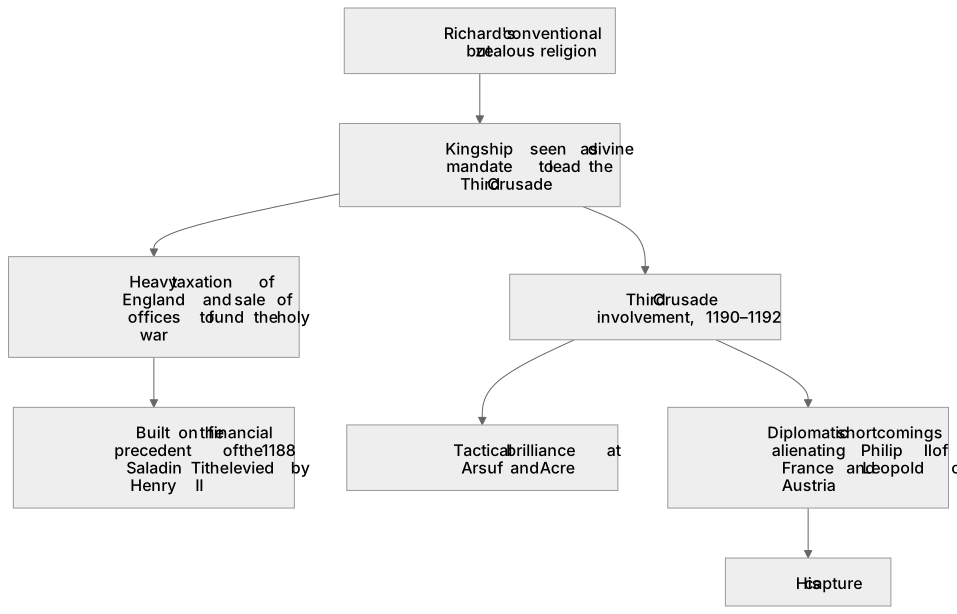
Put the events in order
Put these events in the order they happened, earliest first.
- 1. Richard's involvement in the Third Crusade ended
- 2. Henry II levied the Saladin Tithe
- 3. Richard's involvement in the Third Crusade began
- 4. Richard I became king
Key words
Say what each word means before you turn the card.
Kingship and royal authority
Try answering aloud or in your head before turning the card.
Religion and the Church
Try answering aloud or in your head before turning the card.
Military leadership and warfare
Try answering aloud or in your head before turning the card.
International relations and diplomacy
Try answering aloud or in your head before turning the card.
See every definition
- Kingship and royal authority
- Richard viewed his kingship as a divine mandate to lead the Third Crusade, with faith central to his political strategies.
- Religion and the Church
- His attitude was conventional yet zealous, and he was willing to exploit Church resources and sell offices to fund his campaigns.
- Military leadership and warfare
- His tactical brilliance was showcased at Arsuf and Acre during the Third Crusade, though his diplomatic shortcomings alienated allies.
- International relations and diplomacy
- His diplomatic shortcomings alienated allies like Philip II of France and Leopold of Austria, which ultimately led to his capture.
Label the diagram
Some boxes have lost their names. Pick the right name for each number.
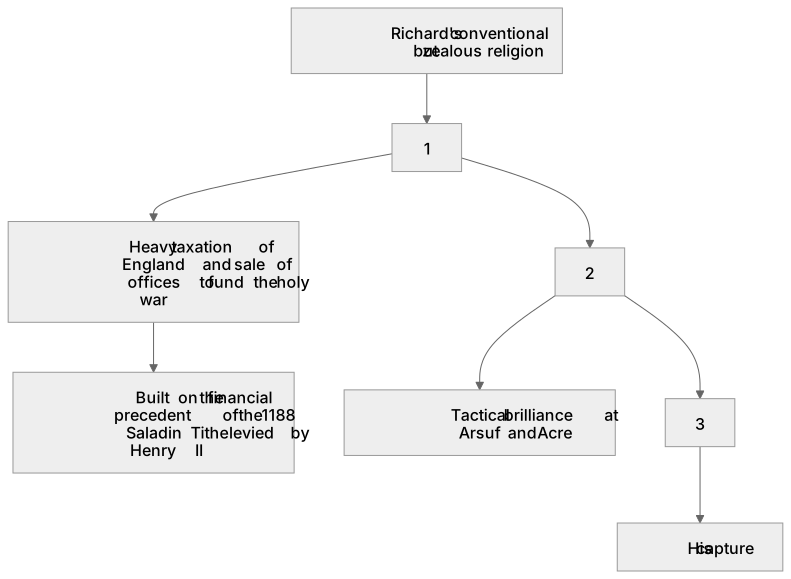
1Box 1
2Box 2
3Box 3
There is more to this lesson
The full lesson goes on to check your understanding and help you earn the marks. Create a free account to carry on, with your progress saved.
A week of Premium from your first lesson · Then the free plan continues · No card, no charge
Test your understanding of 2A Royal Authority and the Angevin Kings, 1154–1216 – only) Richard I, 1189–1199 (A-level only): The character and aims of King Richard: attitudes towards religion and the Church; his involvement in the Third Crusade
Active recall beats re-reading. Take an instant quiz now to test what you’ve learned and lock it into long-term memory.
A week of Premium from your first lesson · Then the free plan continues · No card, no charge