AQA · A-Level · History
Course version: 7042 · Version from Sept 2017
England without Richard: the absentee king; royal authority under the rule…
Full specification wording
2A Royal Authority and the Angevin Kings, 1154–1216 – only) Richard I, 1189–1199 (A-level only): England without Richard: the absentee king; royal authority under the rule of William Longchamp, Hugh de Puiset and Walter de Coutances; the ambitions of Prince John and the later government under Hubert Walter
Richard I spent barely six months of his reign in England, necessitating robust delegated royal authority.
Checked against the AQA 7042 specification (opens in a new tab) on .
- Point 2 of 4
- 4 key terms
Study notes
From the checked teaching notes for this specification point.
The idea
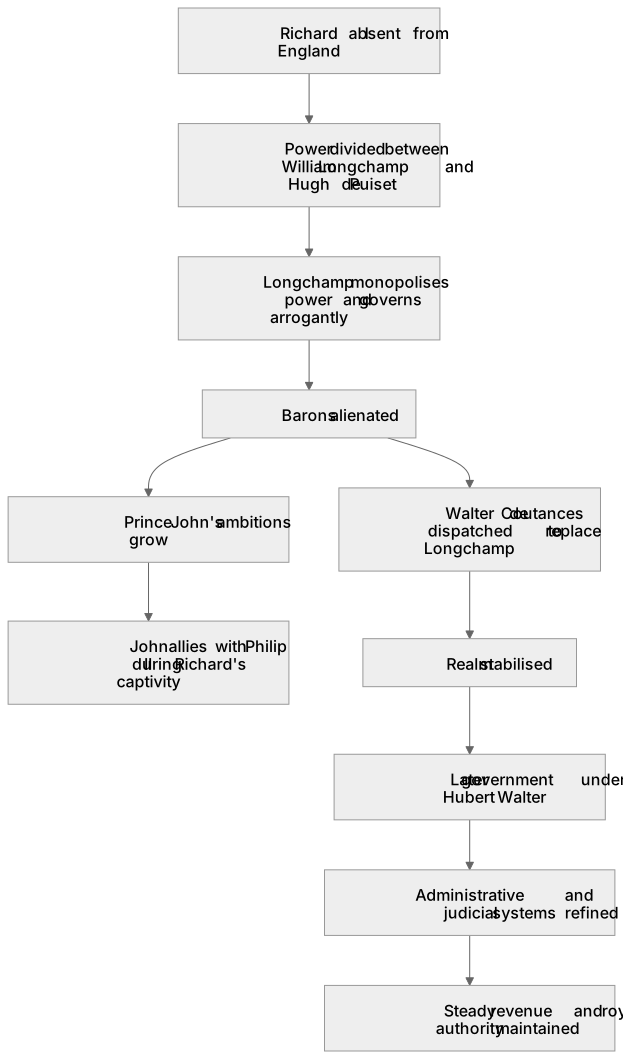
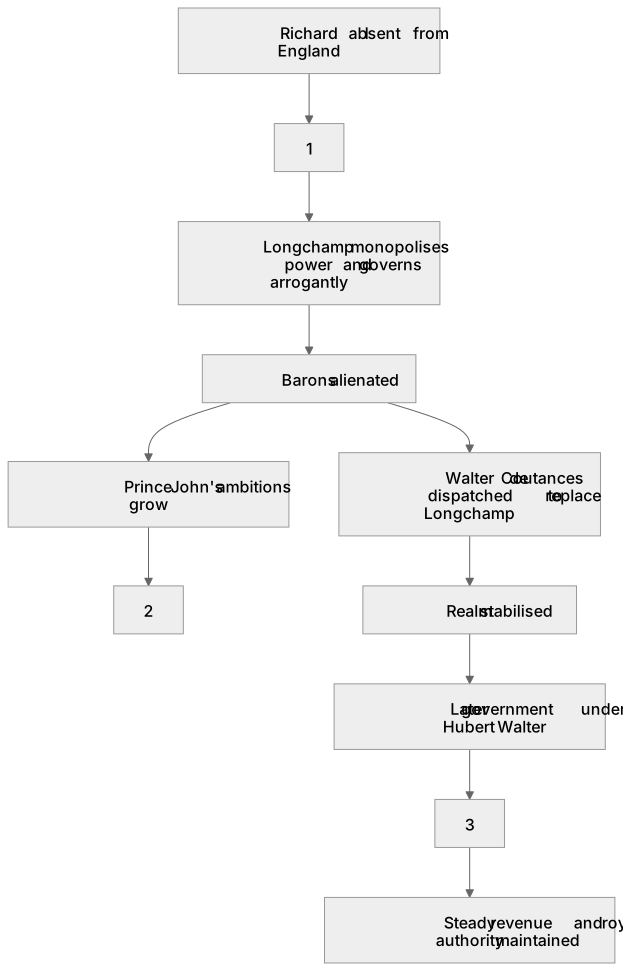
Richard I spent barely six months of his reign in England, necessitating robust delegated royal authority. Initially, power was divided between William Longchamp and Hugh de Puiset, but Longchamp's rapid monopolisation of power and arrogant governance alienated the barons. This instability fuelled the ambitions of Prince John, who attempted to seize control during Richard's captivity by allying with Philip II. To restore order, Walter de Coutances was dispatched to replace Longchamp, stabilising the realm. Subsequently, the later government under Hubert Walter proved highly effective. As Justiciar, Walter refined the administrative and judicial systems, ensuring steady revenue and maintaining royal authority despite the absentee king.
What earns the marks
- Evaluate the effectiveness of Richard's initial arrangements for governing England, contrasting the roles and rivalry of William Longchamp and Hugh de Puiset.
- Analyse the threat posed by Prince John's ambitions, particularly his exploitation of Richard's captivity and his treasonous alliance with Philip II of France.
- Assess the role of Walter de Coutances in resolving the crisis caused by Longchamp's unpopularity and John's rebellion.
- Examine the administrative and judicial reforms implemented by Hubert Walter, demonstrating how his government successfully sustained royal authority and revenue for the absentee king.
Common mistakes and how to put them right
Assuming England descended into complete anarchy during Richard's absence.
Put it right: Emphasise that despite political crises at the top, the underlying Angevin administrative system continued to function effectively, especially under Hubert Walter.
Confusing the roles of the different justiciars.
Put it right: Clearly distinguish between Longchamp's unpopular, autocratic style, Coutances' role as a stabilising peacemaker, and Walter's highly efficient administrative governance.
Stating Prince John successfully usurped the throne during Richard's captivity.
Put it right: Clarify that John's rebellion was ultimately thwarted by the loyalist barons and the defensive measures of the regency government.
Exam tips
- Compare the effectiveness of Longchamp and Hubert Walter to evaluate how successfully royal authority was maintained in Richard's absence.
- Use the rebellion of Prince John to discuss the vulnerabilities of absentee kingship and the importance of loyal administrators.
- Highlight Hubert Walter's 1194 Articles of the Eyre as concrete evidence of the sophisticated development of English government during this period.
Try the lesson
The start of the 2A Royal Authority and the Angevin Kings, 1154–1216 – only) Richard I, 1189–1199 (A-level only): England without Richard: the absentee king; royal authority under the rule of William Longchamp, Hugh de Puiset and Walter de Coutances; the ambitions of Prince John and the later government under Hubert Walter lesson, made from checked teaching notes for this specification point.
Have a go first
Who did King Richard I initially appoint to share the governance of England as Chief Justiciars during his absence on the Third Crusade?
Listen
Richard I spent barely six months of his reign in England, necessitating robust delegated royal authority. Initially, power was divided between William Longchamp and Hugh de Puiset, but Longchamp's rapid monopolisation of power and arrogant governance alienated the barons. This instability fuelled the ambitions of Prince John, who attempted to seize control during Richard's captivity by allying with Philip II. To restore order, Walter de Coutances was dispatched to replace Longchamp, stabilising the realm. Subsequently, the later government under Hubert Walter proved highly effective. As Justiciar, Walter refined the administrative and judicial systems, ensuring steady revenue and maintaining royal authority despite the absentee king. A strong answer earns marks for these points. Evaluate the effectiveness of Richard's initial arrangements for governing England, contrasting the roles and rivalry of William Longchamp and Hugh de Puiset. Analyse the threat posed by Prince John's ambitions, particularly his exploitation of Richard's captivity and his treasonous alliance with Philip II of France. Assess the role of Walter de Coutances in resolving the crisis caused by Longchamp's unpopularity and John's rebellion. Examine the administrative and judicial reforms implemented by Hubert Walter, demonstrating how his government successfully sustained royal authority and revenue for the absentee king. A common slip: Assuming England descended into complete anarchy during Richard's absence. Instead, Emphasise that despite political crises at the top, the underlying Angevin administrative system continued to function effectively, especially under Hubert Walter. Exam tip: Compare the effectiveness of Longchamp and Hubert Walter to evaluate how successfully royal authority was maintained in Richard's absence.
See it
Key words
Say what each word means before you turn the card.
Absentee kingship and delegated authority
Try answering aloud or in your head before turning the card.
Rebellion and dynastic ambition
Try answering aloud or in your head before turning the card.
Administrative and judicial development
Try answering aloud or in your head before turning the card.
The role of the Justiciar
Try answering aloud or in your head before turning the card.
See every definition
- Absentee kingship and delegated authority
- Richard I spent barely six months of his reign in England, necessitating robust delegated royal authority.
- Rebellion and dynastic ambition
- Prince John attempted to seize control during Richard's captivity by allying with Philip II.
- Administrative and judicial development
- As Justiciar, Hubert Walter refined the administrative and judicial systems, ensuring steady revenue and maintaining royal authority.
- The role of the Justiciar
- Power was initially divided between William Longchamp and Hugh de Puiset, and later the government under Hubert Walter proved highly effective.
Label the diagram
Some boxes have lost their names. Pick the right name for each number.
1Box 1
2Box 2
3Box 3
There is more to this lesson
The full lesson goes on to check your understanding and help you earn the marks. Create a free account to carry on, with your progress saved.
A week of Premium from your first lesson · Then the free plan continues · No card, no charge
Test your understanding of 2A Royal Authority and the Angevin Kings, 1154–1216 – only) Richard I, 1189–1199 (A-level only): England without Richard: the absentee king; royal authority under the rule of William Longchamp, Hugh de Puiset and Walter de Coutances; the ambitions of Prince John and the later government under Hubert Walter
Active recall beats re-reading. Take an instant quiz now to test what you’ve learned and lock it into long-term memory.
A week of Premium from your first lesson · Then the free plan continues · No card, no charge