AQA · A-Level · History
Course version: 7042 · Version from Sept 2017
The conflict between Church and State: Thomas Becket and the crisis of…
Full specification wording
2A Royal Authority and the Angevin Kings, 1154–1216 – The crisis of Royal Authority, 1166–1174: The conflict between Church and State: Thomas Becket and the crisis of 1170; the clash between Henry II and the Papacy
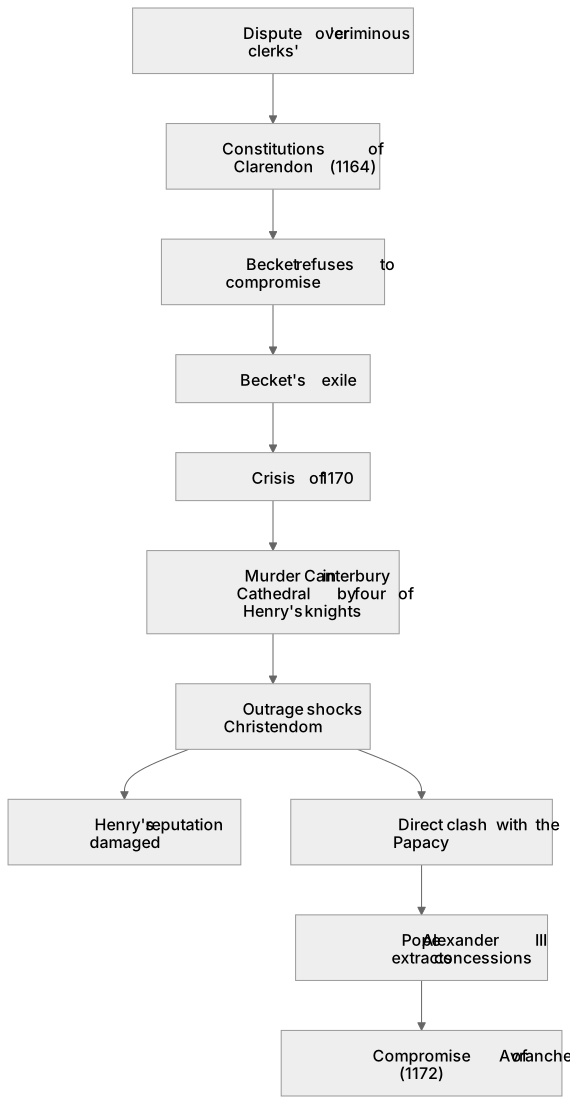
The conflict between Church and State during Henry II's reign centred on the jurisdiction over 'criminous clerks', culminating in the Constitutions of Clarendon (1164).
Checked against the AQA 7042 specification (opens in a new tab) on .
- Point 1 of 4
Study notes
From the checked teaching notes for this specification point.
The idea
The conflict between Church and State during Henry II's reign centred on the jurisdiction over 'criminous clerks', culminating in the Constitutions of Clarendon (1164). Thomas Becket’s refusal to compromise led to his exile and the dramatic crisis of 1170, when his murder in Canterbury Cathedral by four of Henry's knights shocked Christendom. This crisis severely damaged Henry's reputation and forced a direct clash with the Papacy. Pope Alexander III leveraged the outrage to extract concessions from Henry, resulting in the Compromise of Avranches (1172), where Henry agreed to abolish 'evil customs' and allow appeals to Rome, fundamentally altering the balance of power between the English Crown and the Papacy.
What earns the marks
- Explain the origins of the conflict, specifically the debate over 'criminous clerks' and the Constitutions of Clarendon.
- Analyse the escalation of the crisis in 1170, including the coronation of the Young King and Becket's subsequent murder.
- Evaluate the immediate and long-term impact of Becket's death on Henry II's authority and public image.
- Assess the resolution of the clash with the Papacy through the Compromise of Avranches and its implications for royal jurisdiction.
Common mistakes and how to put them right
Assuming Becket was always a pious churchman.
Put it right: Becket was a worldly chancellor before his appointment as Archbishop, which makes his sudden transformation a key point of historical debate.
Stating that Henry II directly ordered Becket's murder.
Put it right: Henry uttered a rash outburst which four knights interpreted as a royal command, rather than issuing a formal execution order.
Claiming the Papacy completely defeated Henry II.
Put it right: While Henry made concessions at Avranches, he retained significant practical control over the English Church and episcopal appointments.
Exam tips
- Use the Constitutions of Clarendon as concrete evidence when discussing the structural causes of the Church-State conflict.
- Evaluate how far the crisis of 1170 was a result of personality clashes versus fundamental jurisdictional disputes.
- Link the aftermath of Becket's murder to Henry's wider political difficulties, such as the Great Rebellion of 1173-1174.
Try the lesson
The start of the 2A Royal Authority and the Angevin Kings, 1154–1216 – The crisis of Royal Authority, 1166–1174: The conflict between Church and State: Thomas Becket and the crisis of 1170; the clash between Henry II and the Papacy lesson, made from checked teaching notes for this specification point.
Have a go first
What was the culminating event of the crisis of 1170 that severely damaged Henry II's relationship with the Church?
Listen
The conflict between Church and State during Henry II's reign centred on the jurisdiction over 'criminous clerks', culminating in the Constitutions of Clarendon (1164). Thomas Becket’s refusal to compromise led to his exile and the dramatic crisis of 1170, when his murder in Canterbury Cathedral by four of Henry's knights shocked Christendom. This crisis severely damaged Henry's reputation and forced a direct clash with the Papacy. Pope Alexander III leveraged the outrage to extract concessions from Henry, resulting in the Compromise of Avranches (1172), where Henry agreed to abolish 'evil customs' and allow appeals to Rome, fundamentally altering the balance of power between the English Crown and the Papacy. A strong answer earns marks for these points. Explain the origins of the conflict, specifically the debate over 'criminous clerks' and the Constitutions of Clarendon. Analyse the escalation of the crisis in 1170, including the coronation of the Young King and Becket's subsequent murder. Evaluate the immediate and long-term impact of Becket's death on Henry II's authority and public image. Assess the resolution of the clash with the Papacy through the Compromise of Avranches and its implications for royal jurisdiction. A common slip: Assuming Becket was always a pious churchman. Instead, Becket was a worldly chancellor before his appointment as Archbishop, which makes his sudden transformation a key point of historical debate. Exam tip: Use the Constitutions of Clarendon as concrete evidence when discussing the structural causes of the Church-State conflict.
See it
Put the events in order
Put these events in the order they happened, earliest first.
- 1. Outbreak of the Great Rebellion
- 2. Constitutions of Clarendon issued
- 3. Compromise of Avranches agreed with the Papacy
- 4. Murder of Becket in Canterbury Cathedral
Label the diagram
Some boxes have lost their names. Pick the right name for each number.
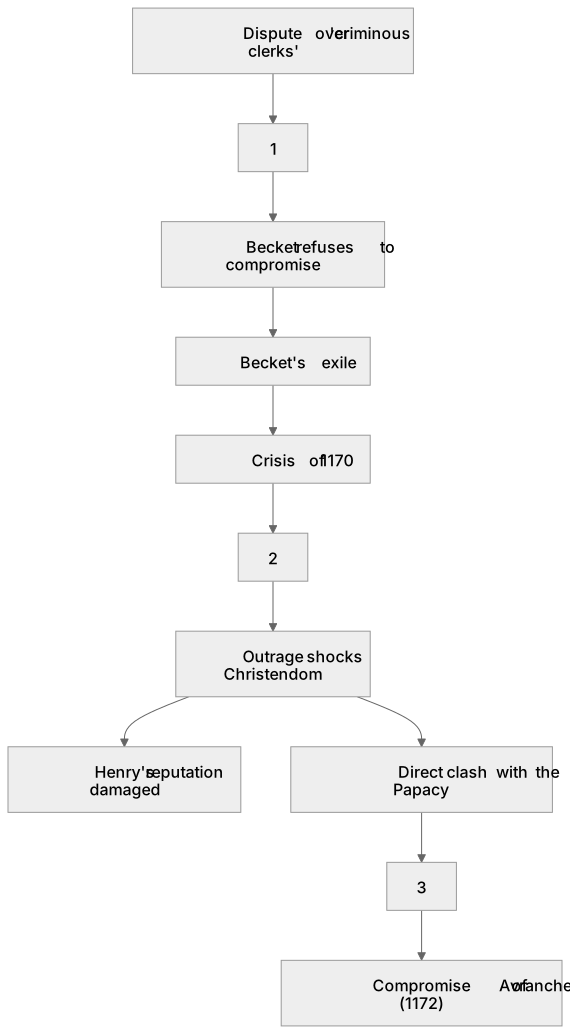
1Box 1
2Box 2
3Box 3
There is more to this lesson
The full lesson goes on to check your understanding and help you earn the marks. Create a free account to carry on, with your progress saved.
A week of Premium from your first lesson · Then the free plan continues · No card, no charge
Test your understanding of 2A Royal Authority and the Angevin Kings, 1154–1216 – The crisis of Royal Authority, 1166–1174: The conflict between Church and State: Thomas Becket and the crisis of 1170; the clash between Henry II and the Papacy
Active recall beats re-reading. Take an instant quiz now to test what you’ve learned and lock it into long-term memory.
A week of Premium from your first lesson · Then the free plan continues · No card, no charge