AQA · A-Level · History
Course version: 7042 · Version from Sept 2017
Henry II and Ireland: the invasions of 1169 and 1171; relations with the…
Full specification wording
2A Royal Authority and the Angevin Kings, 1154–1216 – The crisis of Royal Authority, 1166–1174: Henry II and Ireland: the invasions of 1169 and 1171; relations with the Irish nobility
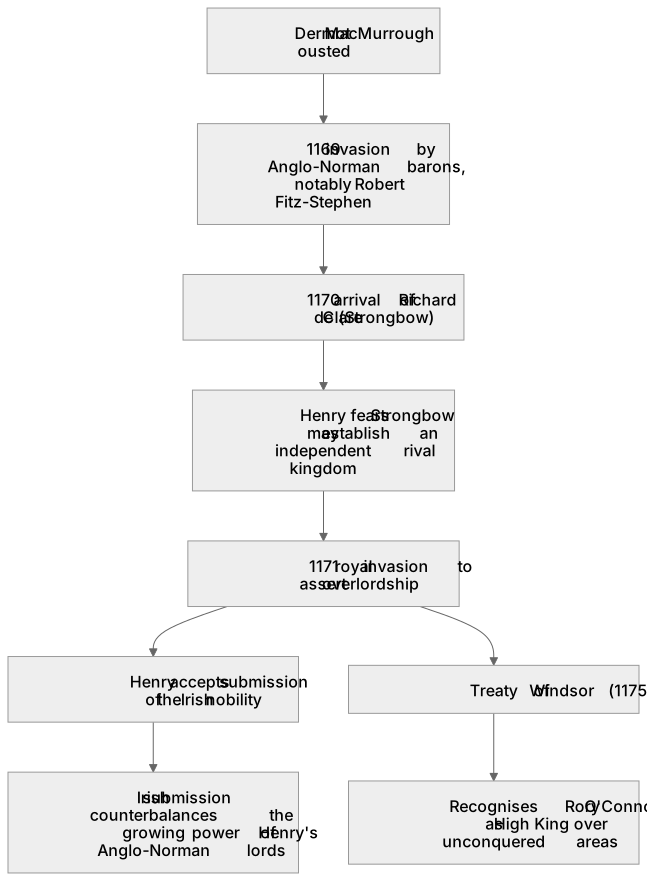
Henry II’s involvement in Ireland began indirectly with the 1169 invasion by Anglo-Norman barons, notably Robert Fitz-Stephen, aiding the ousted Irish king Dermot MacMurrough.
Checked against the AQA 7042 specification (opens in a new tab) on .
- Point 2 of 4
Study notes
From the checked teaching notes for this specification point.
The idea
Henry II’s involvement in Ireland began indirectly with the 1169 invasion by Anglo-Norman barons, notably Robert Fitz-Stephen, aiding the ousted Irish king Dermot MacMurrough. This was followed by the arrival of Richard de Clare (Strongbow) in 1170. Fearing Strongbow might establish an independent rival kingdom, Henry launched his own royal invasion in 1171 to assert his overlordship. Henry's relations with the Irish nobility were complex; he accepted their submission to counterbalance the growing power of his Anglo-Norman lords. The Treaty of Windsor (1175) attempted to formalise this by recognising Rory O'Connor as High King over unconquered areas, illustrating Henry's pragmatic approach to managing native and settler aristocracies.
What earns the marks
- Explain the catalyst for the 1169 invasion, focusing on Dermot MacMurrough's appeal and the initial role of Anglo-Norman mercenaries like Robert Fitz-Stephen.
- Analyse Henry II's motivations for the 1171 royal invasion, particularly his fear of independent Norman power bases developing following Strongbow's arrival in 1170.
- Evaluate Henry's strategy for managing relations with the native Irish nobility, including accepting their fealty to check the ambitions of his own barons.
- Assess the significance of the Treaty of Windsor (1175) as an attempt to establish a workable political settlement between the Crown, Norman settlers, and Irish kings.
Common mistakes and how to put them right
Placing Strongbow in the initial 1169 invasion.
Put it right: Note that the 1169 landings were led by figures like Fitz-Stephen, while Strongbow arrived a year later in 1170.
Using the term 'English Pale' to describe the area of Norman control in 1175.
Put it right: Avoid this anachronism, as the Pale developed later; refer instead to the lands directly held by the English Crown and Norman settlers.
Assuming Henry II conquered the entirety of Ireland.
Put it right: Henry only established direct control over a small area and relied on the submission of native kings for the rest.
Exam tips
- Contrast Henry's reactive policy to the 1169 and 1170 baronial expeditions with his proactive intervention in 1171 to demonstrate his focus on preserving royal authority.
- Use the Treaty of Windsor to illustrate the limitations of Henry's power and his reliance on native rulers like Rory O'Connor to govern unconquered territories.
- Connect Henry's actions in Ireland to his broader need to assert dominance following the reputational damage of the Becket crisis in 1170.
Try the lesson
The start of the 2A Royal Authority and the Angevin Kings, 1154–1216 – The crisis of Royal Authority, 1166–1174: Henry II and Ireland: the invasions of 1169 and 1171; relations with the Irish nobility lesson, made from checked teaching notes for this specification point.
Have a go first
Who led the initial Anglo-Norman invasion force that landed in Ireland in May 1169?
Listen
Henry II’s involvement in Ireland began indirectly with the 1169 invasion by Anglo-Norman barons, notably Robert Fitz-Stephen, aiding the ousted Irish king Dermot MacMurrough. This was followed by the arrival of Richard de Clare (Strongbow) in 1170. Fearing Strongbow might establish an independent rival kingdom, Henry launched his own royal invasion in 1171 to assert his overlordship. Henry's relations with the Irish nobility were complex; he accepted their submission to counterbalance the growing power of his Anglo-Norman lords. The Treaty of Windsor (1175) attempted to formalise this by recognising Rory O'Connor as High King over unconquered areas, illustrating Henry's pragmatic approach to managing native and settler aristocracies. A strong answer earns marks for these points. Explain the catalyst for the 1169 invasion, focusing on Dermot MacMurrough's appeal and the initial role of Anglo-Norman mercenaries like Robert Fitz-Stephen. Analyse Henry II's motivations for the 1171 royal invasion, particularly his fear of independent Norman power bases developing following Strongbow's arrival in 1170. Evaluate Henry's strategy for managing relations with the native Irish nobility, including accepting their fealty to check the ambitions of his own barons. Assess the significance of the Treaty of Windsor (1175) as an attempt to establish a workable political settlement between the Crown, Norman settlers, and Irish kings. A common slip: Placing Strongbow in the initial 1169 invasion. Instead, Note that the 1169 landings were led by figures like Fitz-Stephen, while Strongbow arrived a year later in 1170. Exam tip: Contrast Henry's reactive policy to the 1169 and 1170 baronial expeditions with his proactive intervention in 1171 to demonstrate his focus on preserving royal authority.
See it
Put the events in order
Put these events in the order they happened, earliest first.
- 1. Treaty of Windsor recognises Rory O'Connor as High King
- 2. Anglo-Norman barons invade Ireland, aiding Dermot MacMurrough
- 3. Henry II launches his own royal invasion of Ireland
- 4. Richard de Clare, Strongbow, arrives in Ireland
Label the diagram
Some boxes have lost their names. Pick the right name for each number.
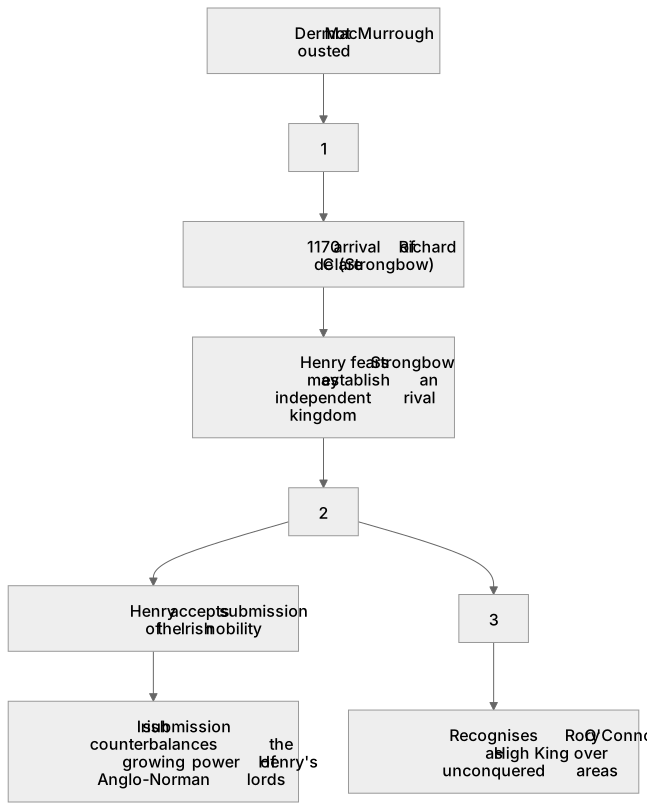
1Box 1
2Box 2
3Box 3
There is more to this lesson
The full lesson goes on to check your understanding and help you earn the marks. Create a free account to carry on, with your progress saved.
A week of Premium from your first lesson · Then the free plan continues · No card, no charge
Test your understanding of 2A Royal Authority and the Angevin Kings, 1154–1216 – The crisis of Royal Authority, 1166–1174: Henry II and Ireland: the invasions of 1169 and 1171; relations with the Irish nobility
Active recall beats re-reading. Take an instant quiz now to test what you’ve learned and lock it into long-term memory.
A week of Premium from your first lesson · Then the free plan continues · No card, no charge