AQA · A-Level · History
Course version: 7042 · Version from Sept 2017
King John’s legacy: the problem of the succession and role of William…
Full specification wording
2A Royal Authority and the Angevin Kings, 1154–1216 – The end of John's reign, 1214–1216 (A-level only): King John’s legacy: the problem of the succession and role of William Marshal as Protector; the political, economic and social condition of England by 1216
King John's legacy in 1216 was defined by a fractured kingdom and a precarious succession.
Checked against the AQA 7042 specification (opens in a new tab) on .
- Point 4 of 4
- 4 key terms
Study notes
From the checked teaching notes for this specification point.
The idea
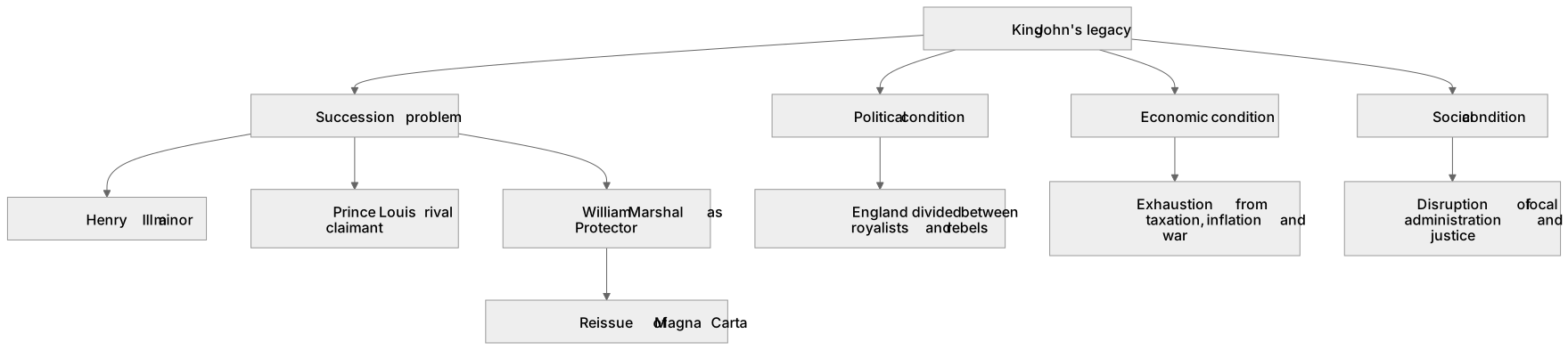
King John's legacy in 1216 was defined by a fractured kingdom and a precarious succession. The succession problem centred on his heir, Henry III, being only nine years old amidst a civil war with a rival French claimant, Prince Louis. William Marshal's appointment as Protector was pivotal; his immense prestige united the royalists, and his reissue of Magna Carta in 1216 shrewdly undermined rebel grievances. By 1216, England's political condition was chaotic, divided between royalist and rebel control. Economically, the realm was exhausted by John's heavy taxation, inflation, and the devastation of war. Socially, the conflict disrupted local administration and justice, leaving a legacy of instability that Marshal had to urgently address.
What earns the marks
- Explain the succession crisis caused by Henry III's minority and the presence of Prince Louis in England.
- Evaluate William Marshal's strategies as Protector, including the tactical reissue of Magna Carta to win over moderate rebels.
- Assess the political division of England in 1216 between royalist and rebel factions.
- Analyse the economic impact of John's reign, focusing on taxation, inflation, and wartime destruction.
- Describe the social disruption caused by the breakdown of local government and the justice system.
Common mistakes and how to put them right
Stating that Henry III immediately took full control of the kingdom.
Put it right: Emphasise that Henry was a minor and William Marshal acted as Protector to govern and fight the war.
Ignoring the economic damage of John's reign.
Put it right: Explicitly discuss the financial exhaustion caused by John's scutages, inflation, and the ravages of the civil war.
Assuming Magna Carta was forgotten after John's death.
Put it right: Highlight that William Marshal reissued Magna Carta in 1216 to win over moderate rebels and establish royal legitimacy.
Exam tips
- Use William Marshal's reissue of Magna Carta as evidence of astute political leadership during a severe crisis.
- When discussing England's condition in 1216, ensure you explicitly separate political, economic, and social factors to provide a structured analysis.
- Contrast the vulnerability of a nine-year-old king with the strength and reputation of William Marshal to explain the survival of the dynasty.
Try the lesson
The start of the 2A Royal Authority and the Angevin Kings, 1154–1216 – The end of John's reign, 1214–1216 (A-level only): King John’s legacy: the problem of the succession and role of William Marshal as Protector; the political, economic and social condition of England by 1216 lesson, made from checked teaching notes for this specification point.
Have a go first
What specific title was given to William Marshal in 1216 to manage the succession of the nine-year-old Henry III?
Listen
King John's legacy in 1216 was defined by a fractured kingdom and a precarious succession. The succession problem centred on his heir, Henry III, being only nine years old amidst a civil war with a rival French claimant, Prince Louis. William Marshal's appointment as Protector was pivotal; his immense prestige united the royalists, and his reissue of Magna Carta in 1216 shrewdly undermined rebel grievances. By 1216, England's political condition was chaotic, divided between royalist and rebel control. Economically, the realm was exhausted by John's heavy taxation, inflation, and the devastation of war. Socially, the conflict disrupted local administration and justice, leaving a legacy of instability that Marshal had to urgently address. A strong answer earns marks for these points. Explain the succession crisis caused by Henry III's minority and the presence of Prince Louis in England. Evaluate William Marshal's strategies as Protector, including the tactical reissue of Magna Carta to win over moderate rebels. Assess the political division of England in 1216 between royalist and rebel factions. Analyse the economic impact of John's reign, focusing on taxation, inflation, and wartime destruction. A common slip: Stating that Henry III immediately took full control of the kingdom. Instead, Emphasise that Henry was a minor and William Marshal acted as Protector to govern and fight the war. Exam tip: Use William Marshal's reissue of Magna Carta as evidence of astute political leadership during a severe crisis.
See it
Key words
Say what each word means before you turn the card.
Succession and inheritance
Try answering aloud or in your head before turning the card.
Regency and protectorate
Try answering aloud or in your head before turning the card.
Economic and social impact of war
Try answering aloud or in your head before turning the card.
Political stability
Try answering aloud or in your head before turning the card.
See every definition
- Succession and inheritance
- The problem centred on John's heir, Henry III, being only nine years old amidst a civil war with a rival French claimant, Prince Louis.
- Regency and protectorate
- William Marshal's appointment as Protector was pivotal, as his immense prestige united the royalists during the minority of Henry III.
- Economic and social impact of war
- The realm was exhausted by John's heavy taxation, inflation and the devastation of war, while the conflict disrupted local administration and justice.
- Political stability
- England's political condition was chaotic, divided between royalist and rebel control, leaving a legacy of instability that Marshal had to urgently address.
Label the diagram
Some boxes have lost their names. Pick the right name for each number.
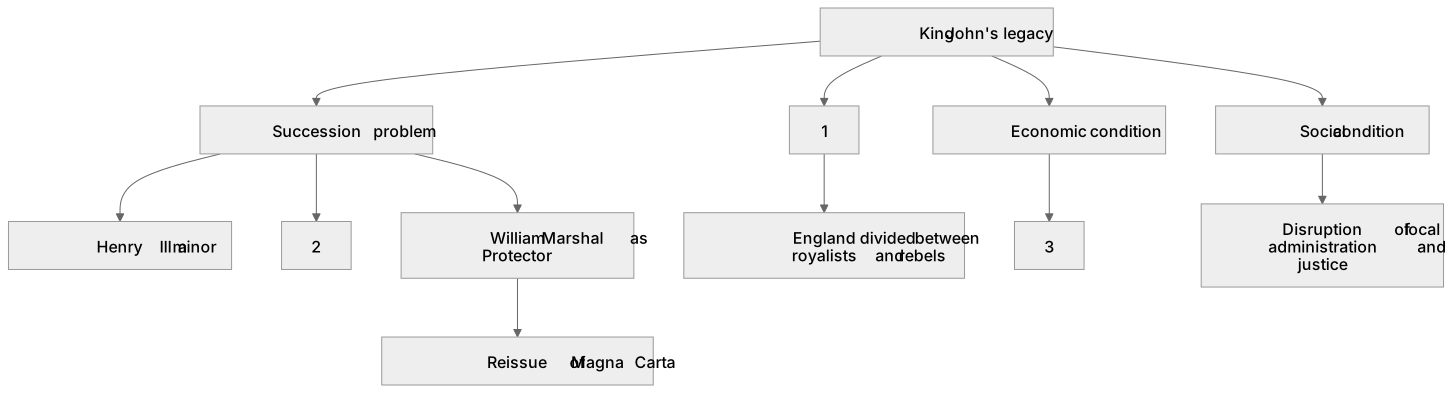
1Box 1
2Box 2
3Box 3
There is more to this lesson
The full lesson goes on to check your understanding and help you earn the marks. Create a free account to carry on, with your progress saved.
A week of Premium from your first lesson · Then the free plan continues · No card, no charge
Test your understanding of 2A Royal Authority and the Angevin Kings, 1154–1216 – The end of John's reign, 1214–1216 (A-level only): King John’s legacy: the problem of the succession and role of William Marshal as Protector; the political, economic and social condition of England by 1216
Active recall beats re-reading. Take an instant quiz now to test what you’ve learned and lock it into long-term memory.
A week of Premium from your first lesson · Then the free plan continues · No card, no charge