AQA · A-Level · History
Course version: 7042 · Version from Sept 2017
The First Barons War: baronial unrest and the outbreak of the war; John’s…
Full specification wording
2A Royal Authority and the Angevin Kings, 1154–1216 – The end of John's reign, 1214–1216 (A-level only): The First Barons War: baronial unrest and the outbreak of the war; John’s military campaigns; the death of the King
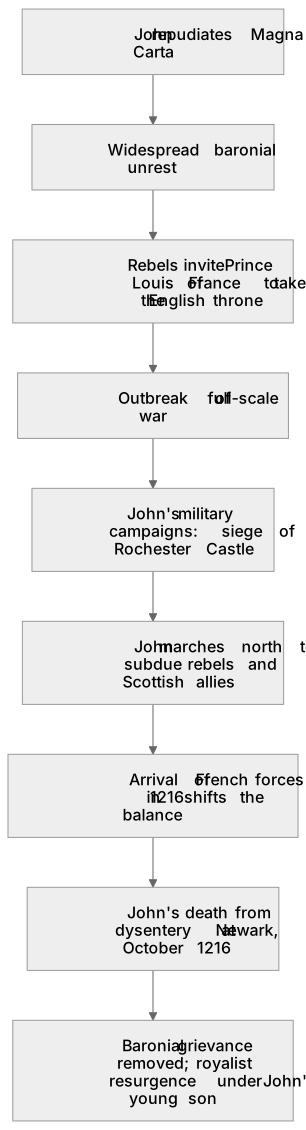
The First Barons' War erupted following King John's repudiation of Magna Carta in 1215, triggering widespread baronial unrest.
Checked against the AQA 7042 specification (opens in a new tab) on .
- Point 3 of 4
- 4 key terms
Study notes
From the checked teaching notes for this specification point.
The idea
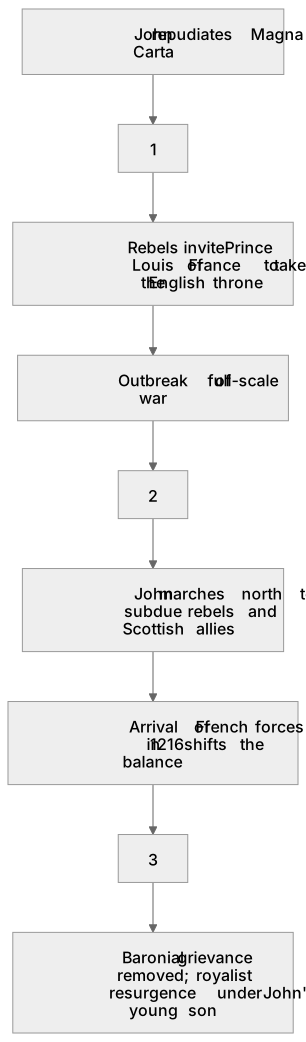
The First Barons' War erupted following King John's repudiation of Magna Carta in 1215, triggering widespread baronial unrest. The rebels, seeking to depose John, invited Prince Louis of France to take the English throne, marking the outbreak of full-scale war. John's military campaigns initially showed strategic competence; he successfully besieged Rochester Castle in late 1215, a crucial stronghold, and subsequently marched north to subdue rebel forces and their Scottish allies. However, the arrival of French forces in 1216 shifted the balance. John's sudden death from dysentery at Newark in October 1216 dramatically altered the political landscape, removing the primary source of baronial grievance and paving the way for a royalist resurgence under his young son.
What earns the marks
- Explain the causes of baronial unrest, specifically John's rejection of Magna Carta and the subsequent papal annulment.
- Detail the outbreak of war, including the rebels' invitation to Prince Louis of France to assume the English throne.
- Evaluate John's military strategy, such as the successful siege of Rochester Castle and his northern campaign against the rebels.
- Assess the impact of John's death in October 1216 on the momentum of the rebel cause and the survival of the Angevin dynasty.
Common mistakes and how to put them right
Claiming the war started solely because of Magna Carta.
Put it right: The war broke out because John obtained a papal bull annulling Magna Carta, leading the barons to seek his deposition.
Confusing the First Barons' War with the Second.
Put it right: Ensure details relate to King John and Prince Louis, not Henry III and Simon de Montfort.
Assuming John was entirely militarily incompetent.
Put it right: Acknowledge John's tactical successes during the war, such as the capture of Rochester Castle.
Exam tips
- Use the siege of Rochester Castle as a concrete example of John's military capabilities and ruthlessness during the conflict.
- Link the outbreak of the war directly to the failure of Magna Carta as a peace treaty.
- Consider how John's death paradoxically saved the Angevin dynasty by removing the barons' main target of hatred.
Try the lesson
The start of the 2A Royal Authority and the Angevin Kings, 1154–1216 – The end of John's reign, 1214–1216 (A-level only): The First Barons War: baronial unrest and the outbreak of the war; John’s military campaigns; the death of the King lesson, made from checked teaching notes for this specification point.
Have a go first
Where did King John die in October 1216 during his military campaign against the rebel barons and Prince Louis?
Listen
The First Barons' War erupted following King John's repudiation of Magna Carta in 1215, triggering widespread baronial unrest. The rebels, seeking to depose John, invited Prince Louis of France to take the English throne, marking the outbreak of full-scale war. John's military campaigns initially showed strategic competence; he successfully besieged Rochester Castle in late 1215, a crucial stronghold, and subsequently marched north to subdue rebel forces and their Scottish allies. However, the arrival of French forces in 1216 shifted the balance. John's sudden death from dysentery at Newark in October 1216 dramatically altered the political landscape, removing the primary source of baronial grievance and paving the way for a royalist resurgence under his young son. A strong answer earns marks for these points. Explain the causes of baronial unrest, specifically John's rejection of Magna Carta and the subsequent papal annulment. Detail the outbreak of war, including the rebels' invitation to Prince Louis of France to assume the English throne. Evaluate John's military strategy, such as the successful siege of Rochester Castle and his northern campaign against the rebels. Assess the impact of John's death in October 1216 on the momentum of the rebel cause and the survival of the Angevin dynasty. A common slip: Claiming the war started solely because of Magna Carta. Instead, The war broke out because John obtained a papal bull annulling Magna Carta, leading the barons to seek his deposition. Exam tip: Use the siege of Rochester Castle as a concrete example of John's military capabilities and ruthlessness during the conflict.
See it
Key words
Say what each word means before you turn the card.
Conflict and rebellion
Try answering aloud or in your head before turning the card.
Military strategy and leadership
Try answering aloud or in your head before turning the card.
Royal authority
Try answering aloud or in your head before turning the card.
Foreign intervention
Try answering aloud or in your head before turning the card.
See every definition
- Conflict and rebellion
- Widespread baronial unrest followed John's repudiation of Magna Carta in 1215, with rebels seeking to depose him and inviting Prince Louis of France to take the English throne.
- Military strategy and leadership
- John's campaigns initially showed strategic competence, including the successful siege of Rochester Castle in late 1215 and a march north to subdue rebel forces and their Scottish allies.
- Royal authority
- John obtained a papal bull annulling Magna Carta, and his rejection of it triggered the baronial unrest that led to war.
- Foreign intervention
- The rebels invited Prince Louis of France to take the English throne, and the arrival of French forces in 1216 shifted the balance.
Label the diagram
Some boxes have lost their names. Pick the right name for each number.
1Box 1
2Box 2
3Box 3
There is more to this lesson
The full lesson goes on to check your understanding and help you earn the marks. Create a free account to carry on, with your progress saved.
A week of Premium from your first lesson · Then the free plan continues · No card, no charge
Test your understanding of 2A Royal Authority and the Angevin Kings, 1154–1216 – The end of John's reign, 1214–1216 (A-level only): The First Barons War: baronial unrest and the outbreak of the war; John’s military campaigns; the death of the King
Active recall beats re-reading. Take an instant quiz now to test what you’ve learned and lock it into long-term memory.
A week of Premium from your first lesson · Then the free plan continues · No card, no charge