AQA · A-Level · History
Course version: 7042 · Version from Sept 2017
Attempts to consolidate royal authority after the Great Rebellion: court…
Full specification wording
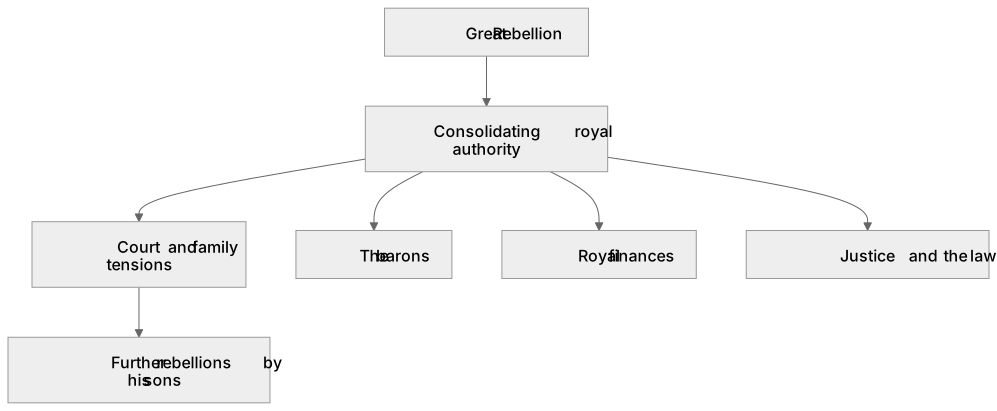
2A Royal Authority and the Angevin Kings, 1154–1216 – The struggle for Royal Authority, 1174–1189: Attempts to consolidate royal authority after the Great Rebellion: court and family tensions; the barons; the royal finances; justice and the law
Following the Great Rebellion (1173–1174), Henry II systematically consolidated royal authority to prevent future uprisings.
Checked against the AQA 7042 specification (opens in a new tab) on .
- Point 1 of 4
- 4 key terms
Study notes
From the checked teaching notes for this specification point.
The idea
Following the Great Rebellion (1173–1174), Henry II systematically consolidated royal authority to prevent future uprisings. He addressed baronial threats by dismantling adulterine castles and replacing rebellious sheriffs with loyal administrators. To secure royal finances, he enforced strict forest laws and exacted heavy feudal dues, maximising crown revenue. Justice and the law were central to his strategy; the 1176 Assize of Northampton tightened criminal justice, while the possessory assizes (like Novel Disseisin) bypassed baronial courts, drawing free men directly into royal jurisdiction. Despite these successes, court and family tensions persisted, culminating in further rebellions by his sons, fuelled by Eleanor of Aquitaine's imprisonment and Philip II's intrigues.
What earns the marks
- Explain how the Assize of Northampton (1176) expanded royal jurisdiction over criminal and civil law, undermining baronial courts.
- Analyse Henry II's financial strategies, such as the exploitation of feudal incidents, wardships, and the forest laws to rebuild the treasury.
- Evaluate the methods used to control the barons, including the destruction of unlicensed castles and the restructuring of local government.
- Assess the impact of ongoing family tensions, specifically the rivalries between Henry's sons and the influence of the French crown.
Common mistakes and how to put them right
Assuming the Great Rebellion permanently ended baronial opposition.
Put it right: In reality, Henry had to continuously enforce legal and financial controls to maintain dominance.
Confusing the Assize of Clarendon (1166) with the Assize of Northampton (1176).
Put it right: Ensure you specify Northampton when discussing post-rebellion legal consolidation.
Overlooking the role of royal finances in political control.
Put it right by linking the collection of scutage and feudal dues directly to Henry's ability to suppress baronial power.
Exam tips
- Link Henry's legal reforms directly to his political need to bypass baronial courts and centralise power after 1174.
- Use specific examples of financial extraction, such as the Saladin Tithe (1188), to demonstrate the growing sophistication of the royal exchequer.
- When discussing family tensions, explicitly mention the role of Philip II of France in exploiting the divisions between Henry II and his sons.
Try the lesson
The start of the 2A Royal Authority and the Angevin Kings, 1154–1216 – The struggle for Royal Authority, 1174–1189: Attempts to consolidate royal authority after the Great Rebellion: court and family tensions; the barons; the royal finances; justice and the law lesson, made from checked teaching notes for this specification point.
Have a go first
What action did Henry II take regarding baronial castles immediately following the Great Rebellion of 1173–1174 to consolidate his authority?
Listen
Following the Great Rebellion (1173–1174), Henry II systematically consolidated royal authority to prevent future uprisings. He addressed baronial threats by dismantling adulterine castles and replacing rebellious sheriffs with loyal administrators. To secure royal finances, he enforced strict forest laws and exacted heavy feudal dues, maximising crown revenue. Justice and the law were central to his strategy; the 1176 Assize of Northampton tightened criminal justice, while the possessory assizes (like Novel Disseisin) bypassed baronial courts, drawing free men directly into royal jurisdiction. Despite these successes, court and family tensions persisted, culminating in further rebellions by his sons, fuelled by Eleanor of Aquitaine's imprisonment and Philip II's intrigues. A strong answer earns marks for these points. Explain how the Assize of Northampton (1176) expanded royal jurisdiction over criminal and civil law, undermining baronial courts. Analyse Henry II's financial strategies, such as the exploitation of feudal incidents, wardships, and the forest laws to rebuild the treasury. Evaluate the methods used to control the barons, including the destruction of unlicensed castles and the restructuring of local government. Assess the impact of ongoing family tensions, specifically the rivalries between Henry's sons and the influence of the French crown. A common slip: Overlooking the role of royal finances in political control. Instead, linking the collection of scutage and feudal dues directly to Henry's ability to suppress baronial power. Exam tip: Link Henry's legal reforms directly to his political need to bypass baronial courts and centralise power after 1174.
See it
Put the events in order
Put these events in the order they happened, earliest first.
- 1. Assize of Clarendon issued
- 2. Saladin Tithe demonstrated growing royal exchequer sophistication
- 3. Assize of Northampton tightened criminal justice
Key words
Say what each word means before you turn the card.
Centralisation of power
Try answering aloud or in your head before turning the card.
Legal and administrative reform
Try answering aloud or in your head before turning the card.
Dynastic conflict
Try answering aloud or in your head before turning the card.
Crown-baron relations
Try answering aloud or in your head before turning the card.
See every definition
- Centralisation of power
- Henry II systematically consolidated royal authority after the Great Rebellion to prevent future uprisings.
- Legal and administrative reform
- The 1176 Assize of Northampton tightened criminal justice, while the possessory assizes bypassed baronial courts, drawing free men directly into royal jurisdiction.
- Dynastic conflict
- Court and family tensions persisted, culminating in further rebellions by his sons, fuelled by Eleanor of Aquitaine's imprisonment and Philip II's intrigues.
- Crown-baron relations
- Baronial threats were addressed by dismantling adulterine castles and replacing rebellious sheriffs with loyal administrators.
Label the diagram
Some boxes have lost their names. Pick the right name for each number.
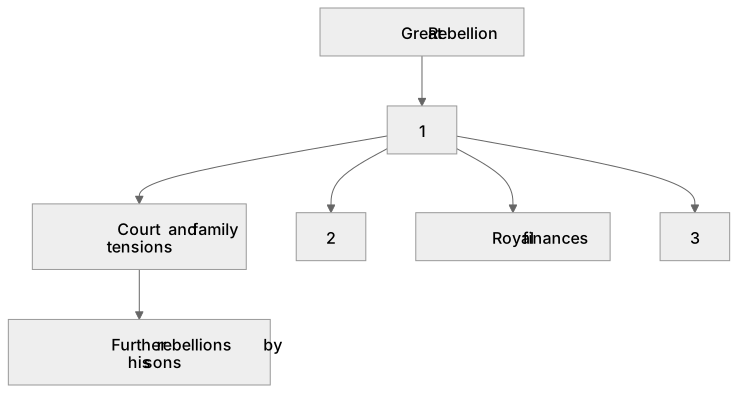
1Box 1
2Box 2
3Box 3
There is more to this lesson
The full lesson goes on to check your understanding and help you earn the marks. Create a free account to carry on, with your progress saved.
A week of Premium from your first lesson · Then the free plan continues · No card, no charge
Test your understanding of 2A Royal Authority and the Angevin Kings, 1154–1216 – The struggle for Royal Authority, 1174–1189: Attempts to consolidate royal authority after the Great Rebellion: court and family tensions; the barons; the royal finances; justice and the law
Active recall beats re-reading. Take an instant quiz now to test what you’ve learned and lock it into long-term memory.
A week of Premium from your first lesson · Then the free plan continues · No card, no charge