AQA · A-Level · History
Course version: 7042 · Version from Sept 2017
Relations between Church and State: Henry II and his bishops;…
Full specification wording
2A Royal Authority and the Angevin Kings, 1154–1216 – The struggle for Royal Authority, 1174–1189: Relations between Church and State: Henry II and his bishops; reconciliation with the Papacy
Following the disastrous murder of Thomas Becket, Henry II had to carefully rebuild relations between Church and State.
Checked against the AQA 7042 specification (opens in a new tab) on .
- Point 2 of 4
- 4 key terms
Study notes
From the checked teaching notes for this specification point.
The idea
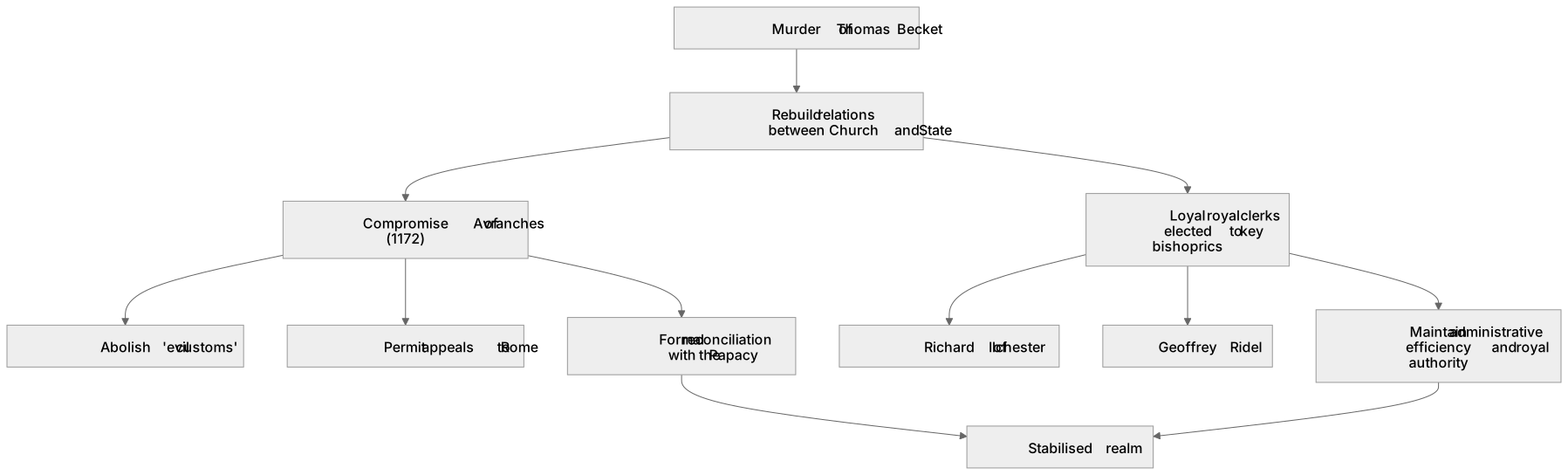
Following the disastrous murder of Thomas Becket, Henry II had to carefully rebuild relations between Church and State. His reconciliation with the Papacy was formalised at the Compromise of Avranches (1172), where he agreed to abolish 'evil customs' and permit appeals to Rome, though in practice he retained significant control over the English Church. Henry successfully managed his bishops by ensuring loyal royal clerks, such as Richard of Ilchester and Geoffrey Ridel, were elected to key bishoprics. This allowed him to maintain administrative efficiency and royal authority without provoking further papal interdicts. By balancing outward submission to Pope Alexander III with practical dominance over episcopal appointments, Henry stabilised his realm.
What earns the marks
- Analyse the terms of the Compromise of Avranches (1172) and how it facilitated Henry II's formal reconciliation with the Papacy.
- Evaluate the extent to which Henry II actually surrendered royal authority over the Church, noting his continued influence over episcopal elections.
- Explain the role of loyal bishops, often former royal clerks, in supporting Henry's administrative and legal reforms after the Becket crisis.
- Assess the diplomatic strategies Henry used to maintain a working relationship with Pope Alexander III while protecting Angevin interests.
Common mistakes and how to put them right
Claiming that the Compromise of Avranches ended all royal control over the Church.
Put it right: In reality, Henry continued to heavily influence the election of bishops and abbots.
Assuming all bishops opposed Henry after Becket's death.
Put it right by noting that many bishops were pragmatic royal administrators who supported the crown.
Stating that appeals to Rome completely undermined royal justice.
Put it right by explaining that Henry still managed to restrict appeals that directly threatened the crown.
Exam tips
- Contrast the theoretical concessions Henry made at Avranches with the practical reality of his continued dominance over the English episcopate.
- Use specific examples of loyal bishops, such as Richard of Ilchester, to demonstrate how Henry integrated the Church into his royal administration.
- Discuss how the broader European political context, including the Papal schism, influenced Pope Alexander III's willingness to reconcile with Henry.
Try the lesson
The start of the 2A Royal Authority and the Angevin Kings, 1154–1216 – The struggle for Royal Authority, 1174–1189: Relations between Church and State: Henry II and his bishops; reconciliation with the Papacy lesson, made from checked teaching notes for this specification point.
Have a go first
What significant public act did Henry II perform in 1174 that aided his reconciliation with the Church and the Papacy?
Listen
Following the disastrous murder of Thomas Becket, Henry II had to carefully rebuild relations between Church and State. His reconciliation with the Papacy was formalised at the Compromise of Avranches (1172), where he agreed to abolish 'evil customs' and permit appeals to Rome, though in practice he retained significant control over the English Church. Henry successfully managed his bishops by ensuring loyal royal clerks, such as Richard of Ilchester and Geoffrey Ridel, were elected to key bishoprics. This allowed him to maintain administrative efficiency and royal authority without provoking further papal interdicts. By balancing outward submission to Pope Alexander III with practical dominance over episcopal appointments, Henry stabilised his realm. A strong answer earns marks for these points. Analyse the terms of the Compromise of Avranches (1172) and how it facilitated Henry II's formal reconciliation with the Papacy. Evaluate the extent to which Henry II actually surrendered royal authority over the Church, noting his continued influence over episcopal elections. Explain the role of loyal bishops, often former royal clerks, in supporting Henry's administrative and legal reforms after the Becket crisis. Assess the diplomatic strategies Henry used to maintain a working relationship with Pope Alexander III while protecting Angevin interests. A common slip: Assuming all bishops opposed Henry after Becket's death. Instead, noting that many bishops were pragmatic royal administrators who supported the crown. Exam tip: Contrast the theoretical concessions Henry made at Avranches with the practical reality of his continued dominance over the English episcopate.
See it
Key words
Say what each word means before you turn the card.
Compromise of Avranches (1172)
Try answering aloud or in your head before turning the card.
Papal authority
Try answering aloud or in your head before turning the card.
Royal administration
Try answering aloud or in your head before turning the card.
Diplomacy and compromise
Try answering aloud or in your head before turning the card.
See every definition
- Compromise of Avranches (1172)
- The formal reconciliation with the Papacy where Henry II agreed to abolish 'evil customs' and permit appeals to Rome.
- Papal authority
- The power of the Pope, to which Henry II balanced outward submission with practical dominance over episcopal appointments.
- Royal administration
- Administrative efficiency and royal authority, maintained by ensuring loyal royal clerks were elected to key bishoprics.
- Diplomacy and compromise
- The diplomatic strategies Henry used to maintain a working relationship with Pope Alexander III while protecting Angevin interests.
Label the diagram
Some boxes have lost their names. Pick the right name for each number.
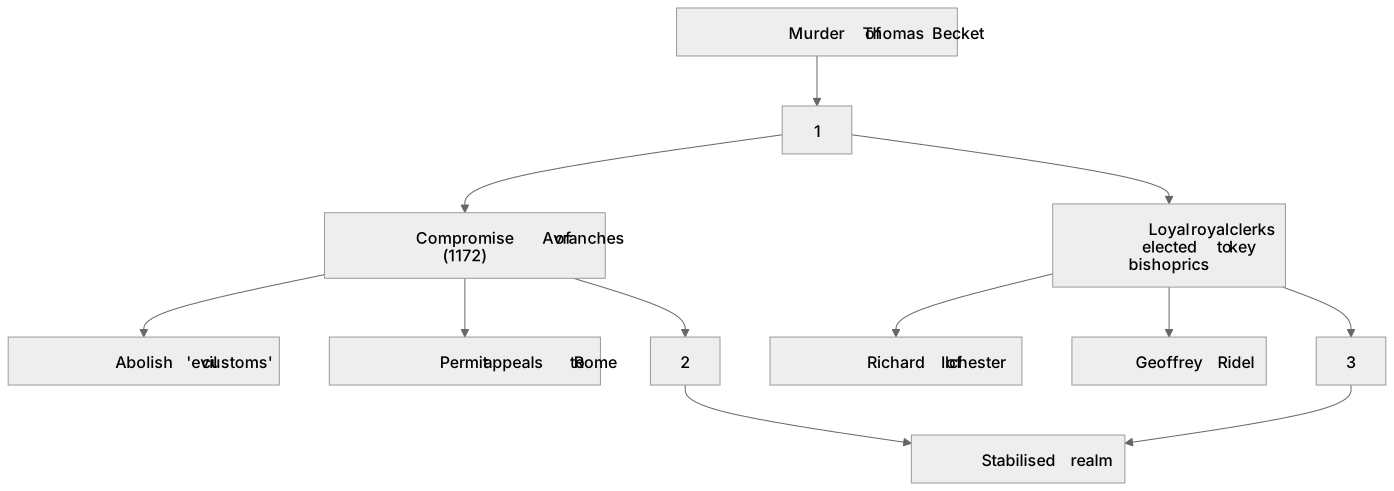
1Box 1
2Box 2
3Box 3
There is more to this lesson
The full lesson goes on to check your understanding and help you earn the marks. Create a free account to carry on, with your progress saved.
A week of Premium from your first lesson · Then the free plan continues · No card, no charge
Test your understanding of 2A Royal Authority and the Angevin Kings, 1154–1216 – The struggle for Royal Authority, 1174–1189: Relations between Church and State: Henry II and his bishops; reconciliation with the Papacy
Active recall beats re-reading. Take an instant quiz now to test what you’ve learned and lock it into long-term memory.
A week of Premium from your first lesson · Then the free plan continues · No card, no charge