AQA · A-Level · History
Course version: 7042 · Version from Sept 2017
The coup d’état by Richard of Gloucester: the issue of the Princes in the…
Full specification wording
2B The Wars of the Roses, 1450–1499 – The downfall of the Yorkist Monarchy, 1483–1486 (A-level only): The coup d’état by Richard of Gloucester: the issue of the Princes in the Tower and Richard III’s position as a usurper
Richard of Gloucester’s 1483 coup d’état transformed him from Lord Protector to King Richard III, fundamentally destabilising the Yorkist regime.
Checked against the AQA 7042 specification (opens in a new tab) on .
- Point 1 of 4
- 4 key terms
Study notes
From the checked teaching notes for this specification point.
The idea
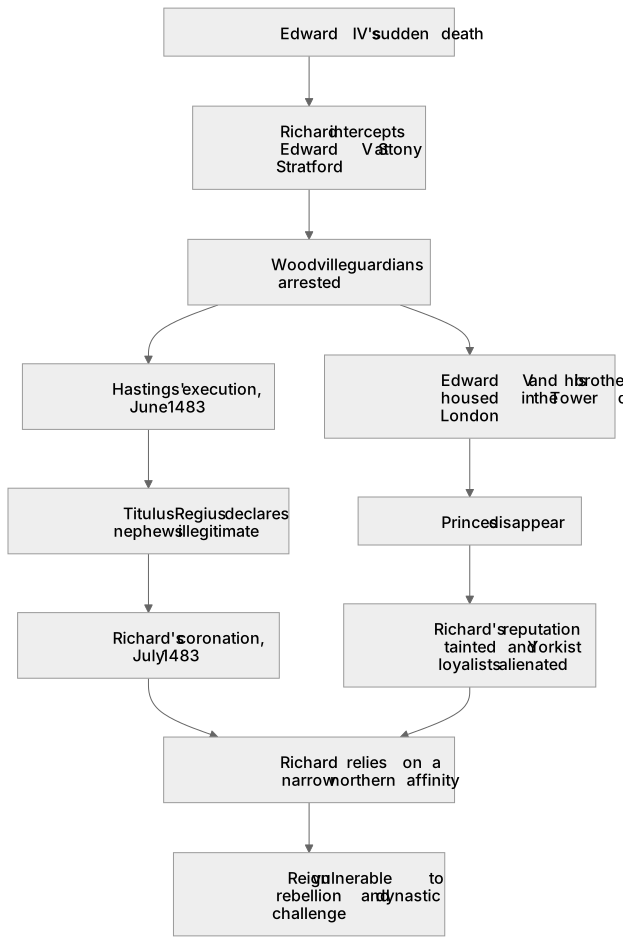
Richard of Gloucester’s 1483 coup d’état transformed him from Lord Protector to King Richard III, fundamentally destabilising the Yorkist regime. Following Edward IV's sudden death, Richard intercepted the young Edward V at Stony Stratford, arresting his Woodville guardians. He subsequently housed Edward V and his brother in the Tower of London, where they disappeared. The unresolved issue of the Princes in the Tower permanently tainted Richard’s reputation and alienated crucial Yorkist loyalists. By declaring his nephews illegitimate via Titulus Regius, Richard cemented his position as a usurper. This usurpation shattered the political consensus Edward IV had built, forcing Richard to rely on a narrow northern affinity and leaving his reign vulnerable to rebellion and dynastic challenge.
What earns the marks
- Assess the sequence of events from Edward IV's death in April 1483 to Richard's coronation in July, focusing on the marginalisation of the Woodvilles.
- Evaluate the impact of the disappearance of the Princes in the Tower on Richard III's political support, particularly among southern Yorkists.
- Analyse the legal and political mechanisms Richard used to justify his usurpation, such as the claims of precontract in Titulus Regius.
- Examine how Richard's status as a usurper forced him to rely heavily on his northern affinity, creating resentment among the southern nobility.
Common mistakes and how to put them right
Assuming Richard III had a long-standing masterplan to seize the throne.
Put it right: Recognise that his initial actions may have been defensive against the Woodville faction before escalating into a full coup.
Stating as absolute historical fact that Richard III murdered the Princes.
Put it right: Acknowledge that while he is the prime suspect and their disappearance fatally damaged his reign, their exact fate remains a historical mystery.
Confusing the timeline of the coup.
Put it right: Ensure the sequence is clear, noting that Hastings' execution in June 1483 was the pivotal moment transitioning from protectorship to usurpation.
Exam tips
- When evaluating Richard's usurpation, contrast the stability of Edward IV's later years with the immediate crisis caused by Richard's seizure of power.
- Use the execution of Lord Hastings as a key turning point to demonstrate when Richard's actions shifted from controlling the young king to replacing him.
- Discuss the 'issue' of the Princes not just as a moral crime, but as a profound political liability that destroyed Yorkist unity.
Try the lesson
The start of the 2B The Wars of the Roses, 1450–1499 – The downfall of the Yorkist Monarchy, 1483–1486 (A-level only): The coup d’état by Richard of Gloucester: the issue of the Princes in the Tower and Richard III’s position as a usurper lesson, made from checked teaching notes for this specification point.
Have a go first
What was the primary legal justification used by Richard of Gloucester in 1483 to claim the throne and depose his nephew, Edward V?
Listen
Richard of Gloucester’s 1483 coup d’état transformed him from Lord Protector to King Richard III, fundamentally destabilising the Yorkist regime. Following Edward IV's sudden death, Richard intercepted the young Edward V at Stony Stratford, arresting his Woodville guardians. He subsequently housed Edward V and his brother in the Tower of London, where they disappeared. The unresolved issue of the Princes in the Tower permanently tainted Richard’s reputation and alienated crucial Yorkist loyalists. By declaring his nephews illegitimate via Titulus Regius, Richard cemented his position as a usurper. This usurpation shattered the political consensus Edward IV had built, forcing Richard to rely on a narrow northern affinity and leaving his reign vulnerable to rebellion and dynastic challenge. A strong answer earns marks for these points. Assess the sequence of events from Edward IV's death in April 1483 to Richard's coronation in July, focusing on the marginalisation of the Woodvilles. Evaluate the impact of the disappearance of the Princes in the Tower on Richard III's political support, particularly among southern Yorkists. Analyse the legal and political mechanisms Richard used to justify his usurpation, such as the claims of precontract in Titulus Regius. Examine how Richard's status as a usurper forced him to rely heavily on his northern affinity, creating resentment among the southern nobility. A common slip: Assuming Richard III had a long-standing masterplan to seize the throne. Instead, recognise that his initial actions may have been defensive against the Woodville faction before escalating into a full coup. Exam tip: When evaluating Richard's usurpation, contrast the stability of Edward IV's later years with the immediate crisis caused by Richard's seizure of power.
See it
Key words
Say what each word means before you turn the card.
Usurpation and dynastic instability
Try answering aloud or in your head before turning the card.
The role of the nobility and affinity
Try answering aloud or in your head before turning the card.
Propaganda and legitimation of power
Try answering aloud or in your head before turning the card.
The breakdown of political consensus
Try answering aloud or in your head before turning the card.
See every definition
- Usurpation and dynastic instability
- Richard cemented his position as a usurper by declaring his nephews illegitimate via Titulus Regius, leaving his reign vulnerable to rebellion and dynastic challenge.
- The role of the nobility and affinity
- The usurpation shattered the political consensus Edward IV had built, forcing Richard to rely on a narrow northern affinity and creating resentment among the southern nobility.
- Propaganda and legitimation of power
- Richard used the legal and political mechanism of Titulus Regius, with its claims of precontract, to justify his usurpation.
- The breakdown of political consensus
- The usurpation shattered the political consensus Edward IV had built, alienating crucial Yorkist loyalists, particularly among southern Yorkists.
Label the diagram
Some boxes have lost their names. Pick the right name for each number.
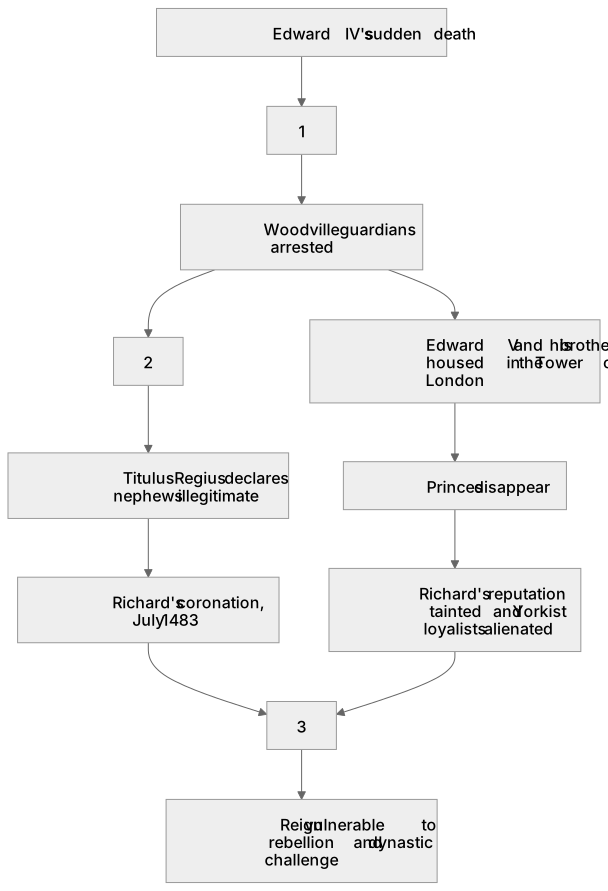
1Box 1
2Box 2
3Box 3
There is more to this lesson
The full lesson goes on to check your understanding and help you earn the marks. Create a free account to carry on, with your progress saved.
A week of Premium from your first lesson · Then the free plan continues · No card, no charge
Test your understanding of 2B The Wars of the Roses, 1450–1499 – The downfall of the Yorkist Monarchy, 1483–1486 (A-level only): The coup d’état by Richard of Gloucester: the issue of the Princes in the Tower and Richard III’s position as a usurper
Active recall beats re-reading. Take an instant quiz now to test what you’ve learned and lock it into long-term memory.
A week of Premium from your first lesson · Then the free plan continues · No card, no charge