AQA · A-Level · History
Course version: 7042 · Version from Sept 2017
Factional rivalries; the emergence of Henry Tudor, dissensions among the…
Full specification wording
2B The Wars of the Roses, 1450–1499 – The downfall of the Yorkist Monarchy, 1483–1486 (A-level only): Factional rivalries; the emergence of Henry Tudor, dissensions among the Yorkist nobility, Buckingham’s rebellion
Richard III’s usurpation ignited intense factional rivalries, fatally fracturing the Yorkist establishment.
Checked against the AQA 7042 specification (opens in a new tab) on .
- Point 2 of 4
- 3 key terms
Study notes
From the checked teaching notes for this specification point.
The idea
Richard III’s usurpation ignited intense factional rivalries, fatally fracturing the Yorkist establishment. Dissensions among the Yorkist nobility grew as Richard planted his northern loyalists in southern estates, alienating the local gentry. This discontent culminated in the October 1483 Buckingham’s rebellion, led by his former ally, the Duke of Buckingham. Although the rebellion failed and Buckingham was executed, it highlighted the severe lack of support for Richard's regime. Crucially, the uprising facilitated the emergence of Henry Tudor as a viable Lancastrian claimant. By pledging to marry Elizabeth of York, Tudor united disgruntled Yorkists and Lancastrian exiles, transforming from an obscure exile in Brittany into the focal point of opposition against Richard III.
What earns the marks
- Analyse the causes of Buckingham's rebellion, focusing on the Duke's personal ambitions and the widespread southern outrage over the Princes in the Tower.
- Evaluate how Richard III's policy of planting northern lords in southern counties exacerbated dissensions among the traditional Yorkist nobility.
- Assess the strategic importance of Henry Tudor's pledge in Rennes Cathedral to marry Elizabeth of York in uniting rival factions.
- Examine the consequences of the failed 1483 rebellion, specifically how the flight of defeated rebels to Brittany strengthened Henry Tudor's court in exile.
Common mistakes and how to put them right
Treating Buckingham's rebellion as a purely Lancastrian uprising.
Put it right: Identify that it was primarily driven by disaffected Yorkists who had previously supported Edward IV.
Overstating Henry Tudor's power before 1483.
Put it right: Explain that Tudor was an obscure exile with a weak claim until the factional rivalries of Richard's reign made him a unifying figurehead.
Assuming Buckingham rebelled solely to put Henry Tudor on the throne.
Put it right: Recognise that Buckingham's motives were complex and likely included personal ambition or self-preservation, with Tudor emerging as the beneficiary.
Exam tips
- Link the failure of Buckingham's rebellion directly to the strengthening of Henry Tudor, as the influx of Yorkist exiles provided Tudor with crucial administrative and military expertise.
- Highlight the marriage proposal to Elizabeth of York as a masterstroke of factional politics that bridged the Lancastrian-Yorkist divide.
- Use the term 'northern plantations' to describe Richard's redistribution of southern lands, demonstrating precise knowledge of why the Yorkist nobility dissented.
Try the lesson
The start of the 2B The Wars of the Roses, 1450–1499 – The downfall of the Yorkist Monarchy, 1483–1486 (A-level only): Factional rivalries; the emergence of Henry Tudor, dissensions among the Yorkist nobility, Buckingham’s rebellion lesson, made from checked teaching notes for this specification point.
Have a go first
During Buckingham's rebellion in October 1483, who did the rebels ultimately aim to place on the English throne?
Listen
Richard III’s usurpation ignited intense factional rivalries, fatally fracturing the Yorkist establishment. Dissensions among the Yorkist nobility grew as Richard planted his northern loyalists in southern estates, alienating the local gentry. This discontent culminated in the October 1483 Buckingham’s rebellion, led by his former ally, the Duke of Buckingham. Although the rebellion failed and Buckingham was executed, it highlighted the severe lack of support for Richard's regime. Crucially, the uprising facilitated the emergence of Henry Tudor as a viable Lancastrian claimant. By pledging to marry Elizabeth of York, Tudor united disgruntled Yorkists and Lancastrian exiles, transforming from an obscure exile in Brittany into the focal point of opposition against Richard III. A strong answer earns marks for these points. Analyse the causes of Buckingham's rebellion, focusing on the Duke's personal ambitions and the widespread southern outrage over the Princes in the Tower. Evaluate how Richard III's policy of planting northern lords in southern counties exacerbated dissensions among the traditional Yorkist nobility. Assess the strategic importance of Henry Tudor's pledge in Rennes Cathedral to marry Elizabeth of York in uniting rival factions. Examine the consequences of the failed 1483 rebellion, specifically how the flight of defeated rebels to Brittany strengthened Henry Tudor's court in exile. A common slip: Treating Buckingham's rebellion as a purely Lancastrian uprising. Instead, identify that it was primarily driven by disaffected Yorkists who had previously supported Edward IV. Exam tip: Link the failure of Buckingham's rebellion directly to the strengthening of Henry Tudor, as the influx of Yorkist exiles provided Tudor with crucial administrative and military expertise.
See it
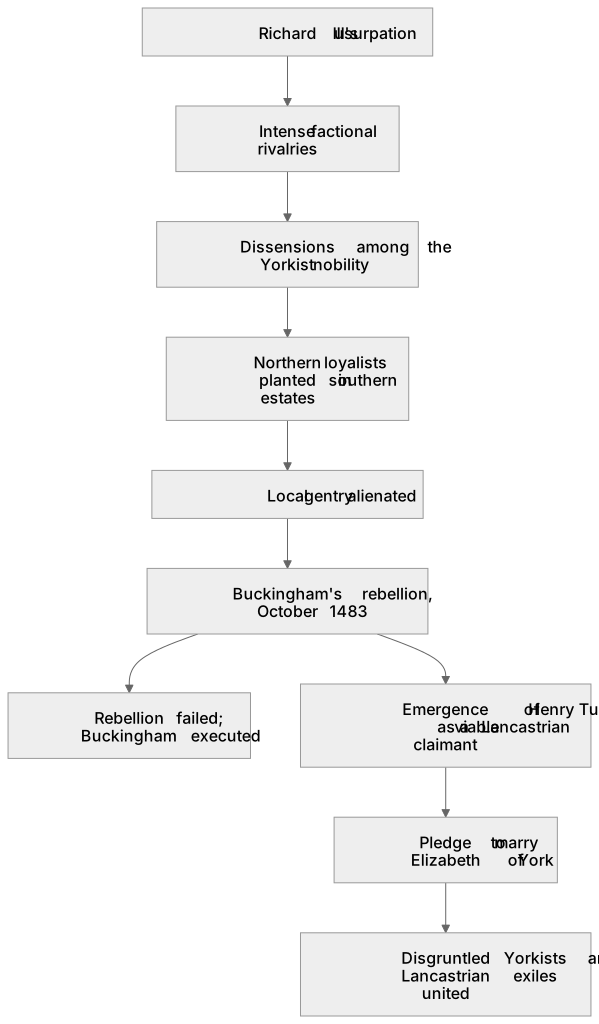
Key words
Say what each word means before you turn the card.
Factional rivalries
Try answering aloud or in your head before turning the card.
Dissensions among the Yorkist nobility
Try answering aloud or in your head before turning the card.
Buckingham's rebellion
Try answering aloud or in your head before turning the card.
See every definition
- Factional rivalries
- Intense rivalries that ignited under Richard III's usurpation and fatally fractured the Yorkist establishment.
- Dissensions among the Yorkist nobility
- Growing disagreements among the Yorkist nobility as Richard planted his northern loyalists in southern estates, alienating the local gentry.
- Buckingham's rebellion
- The October 1483 uprising led by Richard's former ally, the Duke of Buckingham, which failed and ended in his execution.
Label the diagram
Some boxes have lost their names. Pick the right name for each number.
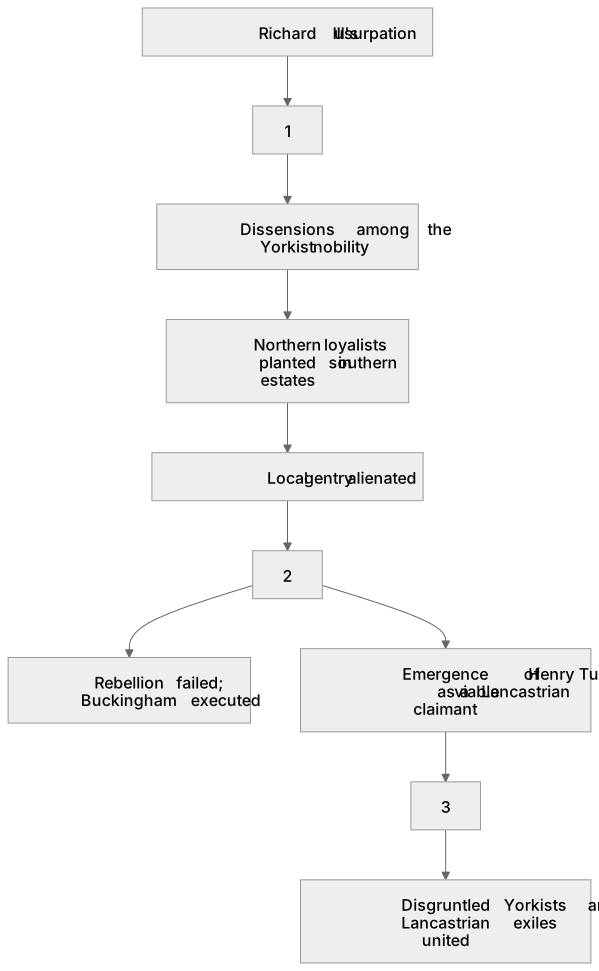
1Box 1
2Box 2
3Box 3
There is more to this lesson
The full lesson goes on to check your understanding and help you earn the marks. Create a free account to carry on, with your progress saved.
A week of Premium from your first lesson · Then the free plan continues · No card, no charge
Test your understanding of 2B The Wars of the Roses, 1450–1499 – The downfall of the Yorkist Monarchy, 1483–1486 (A-level only): Factional rivalries; the emergence of Henry Tudor, dissensions among the Yorkist nobility, Buckingham’s rebellion
Active recall beats re-reading. Take an instant quiz now to test what you’ve learned and lock it into long-term memory.
A week of Premium from your first lesson · Then the free plan continues · No card, no charge