AQA · A-Level · History
Course version: 7042 · Version from Sept 2017
The downfall of Richard III: Bosworth, the proclamation of a new Tudor…
Full specification wording
2B The Wars of the Roses, 1450–1499 – The downfall of the Yorkist Monarchy, 1483–1486 (A-level only): The downfall of Richard III: Bosworth, the proclamation of a new Tudor dynasty under Henry VII and his marriage to Elizabeth of York
Richard III’s downfall culminated at the Battle of Bosworth in August 1485, where his royal army was defeated by Henry Tudor.
Checked against the AQA 7042 specification (opens in a new tab) on .
- Point 4 of 4
- 3 key terms
Study notes
From the checked teaching notes for this specification point.
The idea
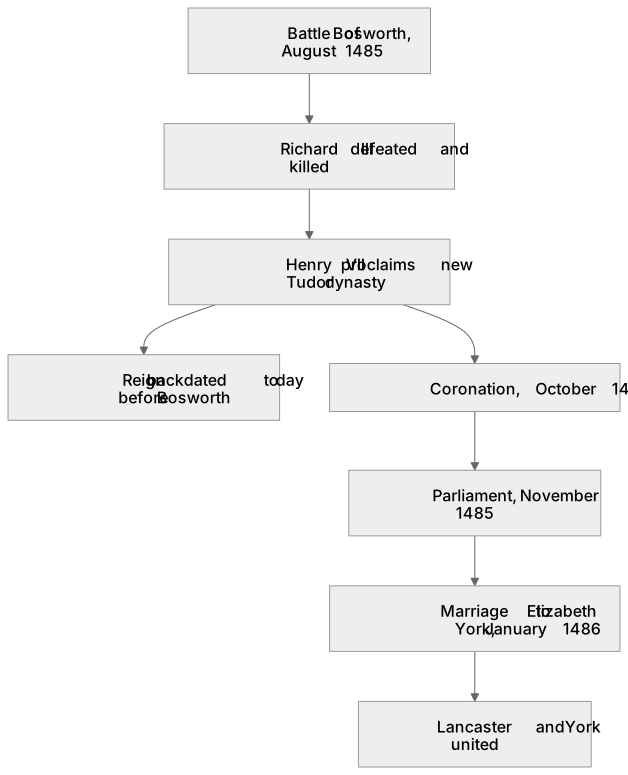
Richard III’s downfall culminated at the Battle of Bosworth in August 1485, where his royal army was defeated by Henry Tudor. Richard's demise was sealed by the betrayal of key nobles, notably the Stanleys and the inaction of Northumberland, highlighting his failure to secure broad aristocratic loyalty. Following Richard's death, Henry VII proclaimed a new Tudor dynasty, shrewdly backdating his reign to the day before Bosworth to declare Richard's supporters as traitors. To consolidate his tenuous claim and unite the warring houses of Lancaster and York, Henry fulfilled his pledge by marrying Elizabeth of York in January 1486. This strategic union neutralised rival Yorkist claims and symbolised the end of the dynastic conflict.
What earns the marks
- Analyse the tactical and political factors at the Battle of Bosworth, specifically the decisive interventions and betrayals by the Stanley family and the Earl of Northumberland.
- Evaluate Henry VII's immediate actions to secure the throne, including backdating his reign to 21 August 1485 to attaint Richard's supporters.
- Explain the significance of the proclamation of the new Tudor dynasty and Henry's coronation before his marriage, establishing his claim by right of conquest rather than solely through his wife.
- Assess the political importance of Henry VII's marriage to Elizabeth of York in January 1486 in uniting the rival houses and neutralising alternative Yorkist claimants.
Common mistakes and how to put them right
Stating that Henry VII claimed the throne entirely through his marriage to Elizabeth of York.
Put it right: Emphasise that Henry claimed the throne by right of conquest and was crowned before marrying Elizabeth to ensure his authority was independent of her Yorkist claim.
Claiming Richard III lost at Bosworth simply because he had a smaller army.
Put it right: Note that Richard actually had a larger force, but lost due to the betrayal of the Stanleys and the failure of his vanguard and reserves to engage effectively.
Confusing the timeline of Henry's consolidation of power.
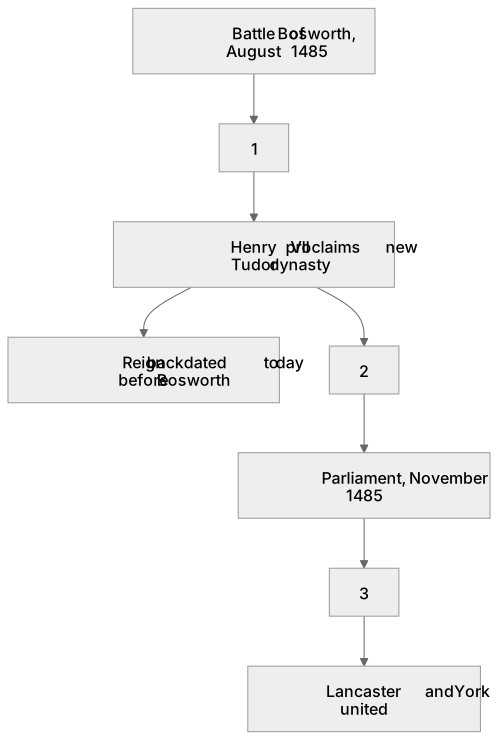
Put it right: Ensure the sequence is clear: Bosworth (August 1485), coronation (October 1485), parliament (November 1485), and finally marriage to Elizabeth (January 1486).
Exam tips
- When discussing Richard's downfall, balance his personal mistakes at Bosworth (like his reckless cavalry charge) with the broader structural weakness of his narrow support base.
- Use Henry VII's backdating of his reign as a key example of his political astuteness in dealing with the immediate aftermath of Bosworth.
- Highlight the marriage to Elizabeth of York not just as a romantic union, but as a calculated political strategy to absorb the Yorkist faction into the new Tudor regime.
Try the lesson
The start of the 2B The Wars of the Roses, 1450–1499 – The downfall of the Yorkist Monarchy, 1483–1486 (A-level only): The downfall of Richard III: Bosworth, the proclamation of a new Tudor dynasty under Henry VII and his marriage to Elizabeth of York lesson, made from checked teaching notes for this specification point.
Have a go first
At which battle in August 1485 was Richard III defeated and killed, leading to the proclamation of Henry VII as king?
Listen
Richard III’s downfall culminated at the Battle of Bosworth in August 1485, where his royal army was defeated by Henry Tudor. Richard's demise was sealed by the betrayal of key nobles, notably the Stanleys and the inaction of Northumberland, highlighting his failure to secure broad aristocratic loyalty. Following Richard's death, Henry VII proclaimed a new Tudor dynasty, shrewdly backdating his reign to the day before Bosworth to declare Richard's supporters as traitors. To consolidate his tenuous claim and unite the warring houses of Lancaster and York, Henry fulfilled his pledge by marrying Elizabeth of York in January 1486. This strategic union neutralised rival Yorkist claims and symbolised the end of the dynastic conflict. A strong answer earns marks for these points. Analyse the tactical and political factors at the Battle of Bosworth, specifically the decisive interventions and betrayals by the Stanley family and the Earl of Northumberland. Evaluate Henry VII's immediate actions to secure the throne, including backdating his reign to 21 August 1485 to attaint Richard's supporters. Explain the significance of the proclamation of the new Tudor dynasty and Henry's coronation before his marriage, establishing his claim by right of conquest rather than solely through his wife. Assess the political importance of Henry VII's marriage to Elizabeth of York in January 1486 in uniting the rival houses and neutralising alternative Yorkist claimants. A common slip: Stating that Henry VII claimed the throne entirely through his marriage to Elizabeth of York. Instead, Emphasise that Henry claimed the throne by right of conquest and was crowned before marrying Elizabeth to ensure his authority was independent of her Yorkist claim. Exam tip: When discussing Richard's downfall, balance his personal mistakes at Bosworth (like his reckless cavalry charge) with the broader structural weakness of his narrow support base.
See it
Key words
Say what each word means before you turn the card.
Right of conquest
Try answering aloud or in your head before turning the card.
Noble betrayal
Try answering aloud or in your head before turning the card.
Dynastic consolidation
Try answering aloud or in your head before turning the card.
See every definition
- Right of conquest
- The basis on which Henry VII established his claim to the throne, rather than solely through his wife, being crowned before marrying Elizabeth.
- Noble betrayal
- The betrayal of key nobles, notably the Stanleys, and the inaction of Northumberland, which sealed Richard's demise at Bosworth.
- Dynastic consolidation
- Securing a tenuous claim and uniting the warring houses of Lancaster and York by marrying Elizabeth of York in January 1486.
Label the diagram
Some boxes have lost their names. Pick the right name for each number.
1Box 1
2Box 2
3Box 3
There is more to this lesson
The full lesson goes on to check your understanding and help you earn the marks. Create a free account to carry on, with your progress saved.
A week of Premium from your first lesson · Then the free plan continues · No card, no charge
Test your understanding of 2B The Wars of the Roses, 1450–1499 – The downfall of the Yorkist Monarchy, 1483–1486 (A-level only): The downfall of Richard III: Bosworth, the proclamation of a new Tudor dynasty under Henry VII and his marriage to Elizabeth of York
Active recall beats re-reading. Take an instant quiz now to test what you’ve learned and lock it into long-term memory.
A week of Premium from your first lesson · Then the free plan continues · No card, no charge