AQA · A-Level · History
Course version: 7042 · Version from Sept 2017
The strengths and weaknesses of Richard III’s position in 1484: the death…
Full specification wording
2B The Wars of the Roses, 1450–1499 – The downfall of the Yorkist Monarchy, 1483–1486 (A-level only): The strengths and weaknesses of Richard III’s position in 1484: the death of his wife and heir; the problem of the succession
In 1484, Richard III balanced administrative strengths against severe dynastic weaknesses.
Checked against the AQA 7042 specification (opens in a new tab) on .
- Point 3 of 4
- 2 key terms
Study notes
From the checked teaching notes for this specification point.
The idea
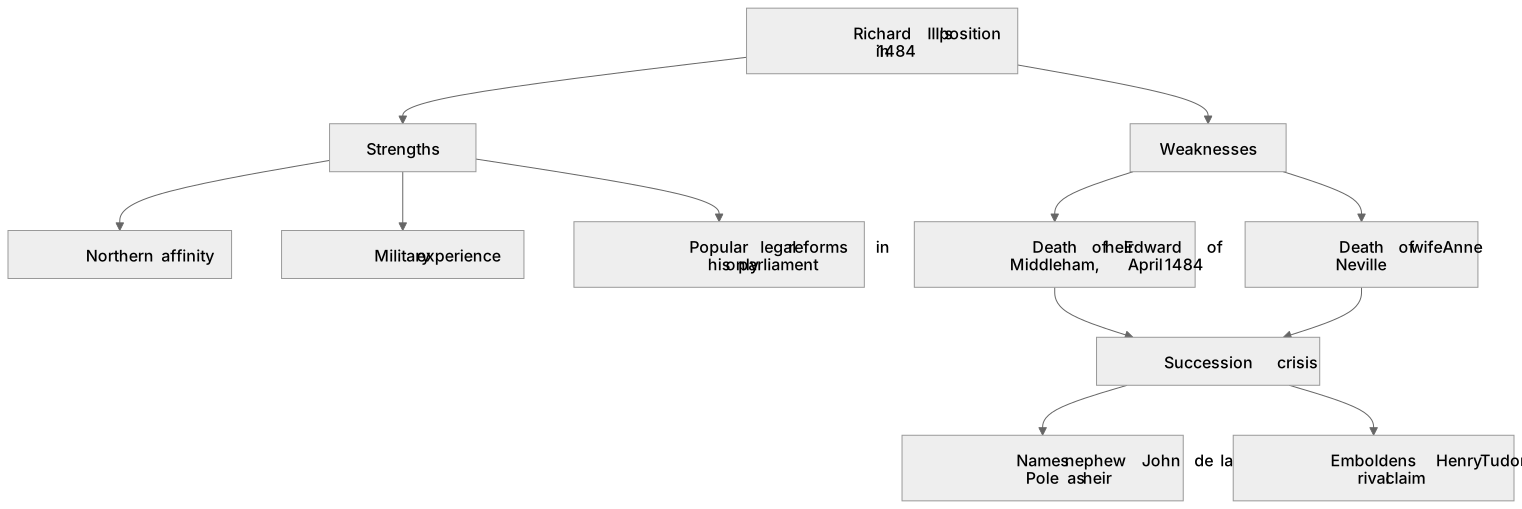
In 1484, Richard III balanced administrative strengths against severe dynastic weaknesses. While he showed capability through legal reforms and a loyal northern affinity, his regime lacked broad southern support. The sudden death of his only legitimate heir, Edward of Middleham, in April 1484 created a critical succession problem, leaving the Yorkist dynasty vulnerable. This crisis deepened with the death of his wife, Anne Neville, which severed crucial Neville connections and sparked damaging rumours that he poisoned her to marry his niece, Elizabeth of York. Consequently, Richard had to name his nephew, John de la Pole, as heir, highlighting the fragility of his royal authority and emboldening Henry Tudor's rival claim.
What earns the marks
- Identify Richard's strengths in 1484, such as his established northern affinity, military experience, and the implementation of popular legal reforms in his only parliament.
- Explain the impact of Edward of Middleham's death in April 1484, which destroyed Richard's direct dynastic line and created an immediate succession crisis.
- Analyse the political fallout from the death of Anne Neville, including the loss of Neville loyalty and the disastrous rumours regarding Richard's marital intentions towards Elizabeth of York.
- Evaluate how the succession problem forced Richard to rely on nephews like John de la Pole, Earl of Lincoln, failing to provide the stability needed to deter Henry Tudor's challenge.
Common mistakes and how to put them right
Claiming Anne Neville died in 1484 alongside her son.
Put it right: Note that while Edward died in April 1484, Anne's health declined throughout the year before her death in March 1485, compounding the succession crisis.
Assuming Richard had no strengths or support by 1484.
Put it right: Acknowledge his strong northern power base, his control of the state apparatus, and his successful 1484 parliament.
Stating Richard officially named Henry Tudor as his heir.
Put it right: Recognise that Richard named his nephew, John de la Pole, Earl of Lincoln, as his heir presumptive to counter Tudor's claim.
Exam tips
- When evaluating Richard's position, contrast his administrative competence in the 1484 parliament with his insurmountable dynastic vulnerabilities.
- Use the deaths of his wife and heir to explain why Richard's regime failed to achieve long-term stability, despite surviving Buckingham's rebellion.
- Link the succession problem directly to the growing support for Henry Tudor, showing how Yorkist fragility created Lancastrian opportunity.
Try the lesson
The start of the 2B The Wars of the Roses, 1450–1499 – The downfall of the Yorkist Monarchy, 1483–1486 (A-level only): The strengths and weaknesses of Richard III’s position in 1484: the death of his wife and heir; the problem of the succession lesson, made from checked teaching notes for this specification point.
Have a go first
Which significant event in April 1484 severely weakened Richard III's dynastic position by creating a crisis regarding the succession?
Listen
In 1484, Richard III balanced administrative strengths against severe dynastic weaknesses. While he showed capability through legal reforms and a loyal northern affinity, his regime lacked broad southern support. The sudden death of his only legitimate heir, Edward of Middleham, in April 1484 created a critical succession problem, leaving the Yorkist dynasty vulnerable. This crisis deepened with the death of his wife, Anne Neville, which severed crucial Neville connections and sparked damaging rumours that he poisoned her to marry his niece, Elizabeth of York. Consequently, Richard had to name his nephew, John de la Pole, as heir, highlighting the fragility of his royal authority and emboldening Henry Tudor's rival claim. A strong answer earns marks for these points. Identify Richard's strengths in 1484, such as his established northern affinity, military experience, and the implementation of popular legal reforms in his only parliament. Explain the impact of Edward of Middleham's death in April 1484, which destroyed Richard's direct dynastic line and created an immediate succession crisis. Analyse the political fallout from the death of Anne Neville, including the loss of Neville loyalty and the disastrous rumours regarding Richard's marital intentions towards Elizabeth of York. Evaluate how the succession problem forced Richard to rely on nephews like John de la Pole, Earl of Lincoln, failing to provide the stability needed to deter Henry Tudor's challenge. A common slip: Claiming Anne Neville died in 1484 alongside her son. Instead, Note that while Edward died in April 1484, Anne's health declined throughout the year before her death in March 1485, compounding the succession crisis. Exam tip: When evaluating Richard's position, contrast his administrative competence in the 1484 parliament with his insurmountable dynastic vulnerabilities.
See it
Key words
Say what each word means before you turn the card.
Succession problem
Try answering aloud or in your head before turning the card.
Northern affinity
Try answering aloud or in your head before turning the card.
See every definition
- Succession problem
- A critical crisis created by the death of Richard III's only legitimate heir, Edward of Middleham, in April 1484, leaving the Yorkist dynasty vulnerable.
- Northern affinity
- A loyal power base through which Richard III showed capability, though his regime lacked broad southern support.
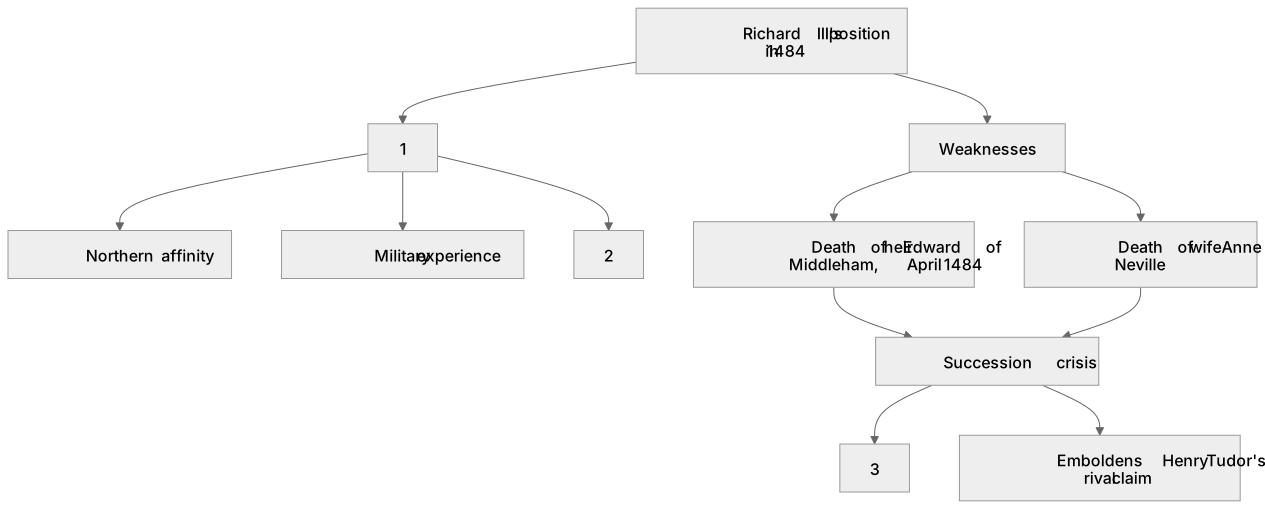
Label the diagram
Some boxes have lost their names. Pick the right name for each number.
1Box 1
2Box 2
3Box 3
There is more to this lesson
The full lesson goes on to check your understanding and help you earn the marks. Create a free account to carry on, with your progress saved.
A week of Premium from your first lesson · Then the free plan continues · No card, no charge
Test your understanding of 2B The Wars of the Roses, 1450–1499 – The downfall of the Yorkist Monarchy, 1483–1486 (A-level only): The strengths and weaknesses of Richard III’s position in 1484: the death of his wife and heir; the problem of the succession
Active recall beats re-reading. Take an instant quiz now to test what you’ve learned and lock it into long-term memory.
A week of Premium from your first lesson · Then the free plan continues · No card, no charge