AQA · A-Level · History
Course version: 7042 · Version from Sept 2017
The impact of the Wars of the Roses on English society by 1499: trade and…
Full specification wording
2B The Wars of the Roses, 1450–1499 – The end of the Yorkist Dynasty, 1486–1499 (A-level only): The impact of the Wars of the Roses on English society by 1499: trade and the economy; central authority and the regions
By 1499, the Wars of the Roses had left a complex legacy on English society, though the disruption was less catastrophic than Tudor propaganda suggested.
Checked against the AQA 7042 specification (opens in a new tab) on .
- Point 4 of 4
- 4 key terms
Study notes
From the checked teaching notes for this specification point.
The idea
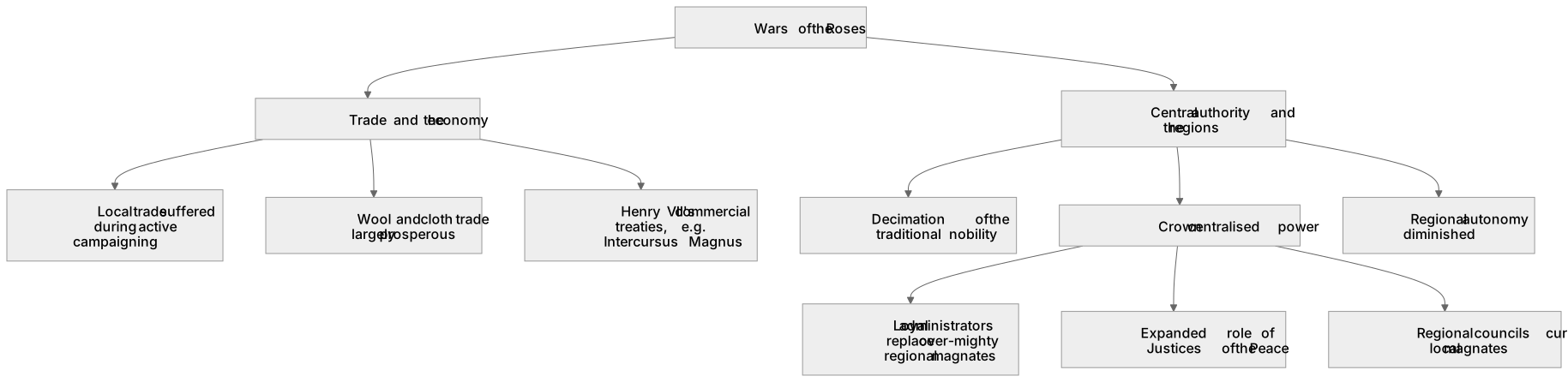
By 1499, the Wars of the Roses had left a complex legacy on English society, though the disruption was less catastrophic than Tudor propaganda suggested. Trade and the economy demonstrated remarkable resilience; while specific areas suffered temporary devastation during campaigns, the broader agricultural and cloth-exporting sectors continued to grow, aided by Henry VII's commercial treaties like the Intercursus Magnus. However, the conflict profoundly impacted central authority and the regions. The decimation of the traditional nobility allowed the Crown to centralise power, replacing over-mighty regional magnates with loyal administrators and expanding the role of Justices of the Peace. Consequently, regional autonomy diminished as royal authority was systematically reasserted across the localities.
What earns the marks
- Evaluate the extent of economic disruption, noting that while local trade suffered during active campaigning, national industries like the wool and cloth trade remained largely prosperous.
- Analyse the shift in central authority, explaining how the attrition of the nobility during the wars enabled Henry VII to centralise government and rely on lesser landowners.
- Assess the changing relationship between the Crown and the regions, highlighting the use of regional councils to curb the power of local magnates.
- Discuss the social impact of the wars by 1499, contrasting the severe consequences for the aristocracy with the relative continuity experienced by the peasantry and merchant classes.
Common mistakes and how to put them right
Overstating the economic devastation of the wars.
Put it right by noting that campaigns were brief and localised, allowing the general economy and trade to function normally.
Assuming the nobility was entirely wiped out.
Put it right: While many prominent families were extinguished, the peerage survived, though their regional military power was significantly curtailed.
Treating England as uniformly affected.
Put it right: Recognise that regions like the North and the Welsh Marches experienced different levels of disruption and subsequent centralisation compared to the South East.
Exam tips
- Challenge the traditional Tudor myth of total anarchy by providing evidence of economic continuity and the survival of local administration during the conflict.
- Use specific examples of Henry VII's policies, such as bonds and recognisances, to demonstrate how central authority was re-established over regional lords by 1499.
- When discussing trade, reference the importance of the cloth industry and international treaties to show that economic recovery and growth were active priorities.
Try the lesson
The start of the 2B The Wars of the Roses, 1450–1499 – The end of the Yorkist Dynasty, 1486–1499 (A-level only): The impact of the Wars of the Roses on English society by 1499: trade and the economy; central authority and the regions lesson, made from checked teaching notes for this specification point.
Have a go first
How did the conclusion of the Wars of the Roses by 1499 affect the relationship between central authority and the English regions?
Listen
By 1499, the Wars of the Roses had left a complex legacy on English society, though the disruption was less catastrophic than Tudor propaganda suggested. Trade and the economy demonstrated remarkable resilience; while specific areas suffered temporary devastation during campaigns, the broader agricultural and cloth-exporting sectors continued to grow, aided by Henry VII's commercial treaties like the Intercursus Magnus. However, the conflict profoundly impacted central authority and the regions. The decimation of the traditional nobility allowed the Crown to centralise power, replacing over-mighty regional magnates with loyal administrators and expanding the role of Justices of the Peace. Consequently, regional autonomy diminished as royal authority was systematically reasserted across the localities. A strong answer earns marks for these points. Evaluate the extent of economic disruption, noting that while local trade suffered during active campaigning, national industries like the wool and cloth trade remained largely prosperous. Analyse the shift in central authority, explaining how the attrition of the nobility during the wars enabled Henry VII to centralise government and rely on lesser landowners. Assess the changing relationship between the Crown and the regions, highlighting the use of regional councils to curb the power of local magnates. Discuss the social impact of the wars by 1499, contrasting the severe consequences for the aristocracy with the relative continuity experienced by the peasantry and merchant classes. A common slip: Overstating the economic devastation of the wars. Instead, noting that campaigns were brief and localised, allowing the general economy and trade to function normally. Exam tip: Challenge the traditional Tudor myth of total anarchy by providing evidence of economic continuity and the survival of local administration during the conflict.
See it
Key words
Say what each word means before you turn the card.
Economic continuity and change
Try answering aloud or in your head before turning the card.
Centralisation of power
Try answering aloud or in your head before turning the card.
Regional governance
Try answering aloud or in your head before turning the card.
Social hierarchy
Try answering aloud or in your head before turning the card.
See every definition
- Economic continuity and change
- Trade and the economy demonstrated remarkable resilience, with the broader agricultural and cloth-exporting sectors continuing to grow, while specific areas suffered temporary devastation during campaigns.
- Centralisation of power
- The decimation of the traditional nobility allowed the Crown to centralise power, replacing over-mighty regional magnates with loyal administrators and expanding the role of Justices of the Peace.
- Regional governance
- Regional autonomy diminished as royal authority was systematically reasserted across the localities, with regional councils used to curb the power of local magnates.
- Social hierarchy
- The wars brought severe consequences for the aristocracy, contrasting with the relative continuity experienced by the peasantry and merchant classes.
Label the diagram
Some boxes have lost their names. Pick the right name for each number.
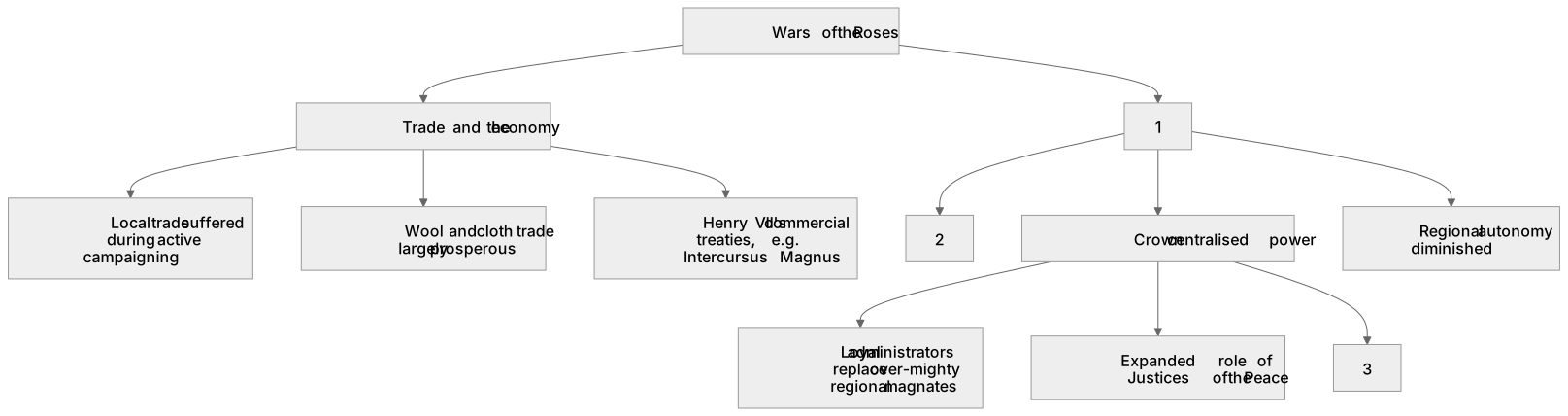
1Box 1
2Box 2
3Box 3
There is more to this lesson
The full lesson goes on to check your understanding and help you earn the marks. Create a free account to carry on, with your progress saved.
A week of Premium from your first lesson · Then the free plan continues · No card, no charge
Test your understanding of 2B The Wars of the Roses, 1450–1499 – The end of the Yorkist Dynasty, 1486–1499 (A-level only): The impact of the Wars of the Roses on English society by 1499: trade and the economy; central authority and the regions
Active recall beats re-reading. Take an instant quiz now to test what you’ve learned and lock it into long-term memory.
A week of Premium from your first lesson · Then the free plan continues · No card, no charge