AQA · A-Level · History
Course version: 7042 · Version from Sept 2017
The end of the Yorkist challenge: defeat of Warbeck and his Scottish and…
Full specification wording
2B The Wars of the Roses, 1450–1499 – The end of the Yorkist Dynasty, 1486–1499 (A-level only): The end of the Yorkist challenge: defeat of Warbeck and his Scottish and Cornish allies; the execution of Warbeck and Warwick
The final eradication of the Yorkist threat by Henry VII culminated in the defeat and execution of Perkin Warbeck and Edward, Earl of Warwick.
Checked against the AQA 7042 specification (opens in a new tab) on .
- Point 3 of 4
- 4 key terms
Study notes
From the checked teaching notes for this specification point.
The idea
The final eradication of the Yorkist threat by Henry VII culminated in the defeat and execution of Perkin Warbeck and Edward, Earl of Warwick. Warbeck, claiming to be Richard, Duke of York, sustained a prolonged challenge by securing foreign backing, notably from James IV of Scotland, who provided troops for an abortive invasion in 1496. Warbeck later capitalised on domestic unrest by aligning with the Cornish rebels in 1497, but his forces were crushed at Taunton. Henry initially showed leniency, but Warbeck's repeated escape attempts led to his imprisonment in the Tower alongside Warwick, the last legitimate male Yorkist claimant. Their alleged plot to escape provided Henry with the pretext to execute both in 1499, decisively ending the Yorkist dynastic challenge and securing the Tudor succession.
What earns the marks
- Explain the significance of Scottish support under James IV, including the failed 1496 invasion and the subsequent Truce of Ayton which deprived Warbeck of his northern ally.
- Analyse Warbeck's opportunistic alliance with the Cornish rebels in 1497, noting how the rebellion's suppression at Blackheath and Taunton demonstrated Henry VII's military control.
- Evaluate the political necessity of executing the Earl of Warwick in 1499, as his royal blood made him a permanent figurehead for Yorkist conspiracies.
- Assess how the combined executions of Warbeck and Warwick reassured foreign powers, particularly Spain, paving the way for the marriage of Prince Arthur and Catherine of Aragon.
Common mistakes and how to put them right
Confusing Perkin Warbeck with Lambert Simnel.
Put it right: Warbeck claimed to be Richard, Duke of York, whereas Simnel impersonated the Earl of Warwick.
Assuming the Cornish Rebellion was primarily a pro-Yorkist uprising.
Put it right: It was initially triggered by taxation for a Scottish war, which Warbeck only later exploited.
Believing Warwick was an active, willing conspirator.
Put it right: He had been imprisoned since childhood and was likely entrapped by Henry VII to justify his execution.
Exam tips
- Link the defeat of Warbeck's Scottish and Cornish allies to Henry VII's broader strategy of using diplomacy and financial penalties to isolate pretenders.
- When evaluating the end of the Yorkist challenge, contrast the prolonged nuisance of Warbeck with the genuine dynastic threat posed by the Earl of Warwick.
- Use the events of 1499 to discuss the consolidation of Tudor power, noting how the executions were a prerequisite for securing international alliances.
Try the lesson
The start of the 2B The Wars of the Roses, 1450–1499 – The end of the Yorkist Dynasty, 1486–1499 (A-level only): The end of the Yorkist challenge: defeat of Warbeck and his Scottish and Cornish allies; the execution of Warbeck and Warwick lesson, made from checked teaching notes for this specification point.
Have a go first
Which event in 1499 definitively ended the immediate Yorkist dynastic challenge to Henry VII?
Listen
The final eradication of the Yorkist threat by Henry VII culminated in the defeat and execution of Perkin Warbeck and Edward, Earl of Warwick. Warbeck, claiming to be Richard, Duke of York, sustained a prolonged challenge by securing foreign backing, notably from James IV of Scotland, who provided troops for an abortive invasion in 1496. Warbeck later capitalised on domestic unrest by aligning with the Cornish rebels in 1497, but his forces were crushed at Taunton. Henry initially showed leniency, but Warbeck's repeated escape attempts led to his imprisonment in the Tower alongside Warwick, the last legitimate male Yorkist claimant. Their alleged plot to escape provided Henry with the pretext to execute both in 1499, decisively ending the Yorkist dynastic challenge and securing the Tudor succession. A strong answer earns marks for these points. Explain the significance of Scottish support under James IV, including the failed 1496 invasion and the subsequent Truce of Ayton which deprived Warbeck of his northern ally. Analyse Warbeck's opportunistic alliance with the Cornish rebels in 1497, noting how the rebellion's suppression at Blackheath and Taunton demonstrated Henry VII's military control. Evaluate the political necessity of executing the Earl of Warwick in 1499, as his royal blood made him a permanent figurehead for Yorkist conspiracies. Assess how the combined executions of Warbeck and Warwick reassured foreign powers, particularly Spain, paving the way for the marriage of Prince Arthur and Catherine of Aragon. Exam tip: Link the defeat of Warbeck's Scottish and Cornish allies to Henry VII's broader strategy of using diplomacy and financial penalties to isolate pretenders.
See it
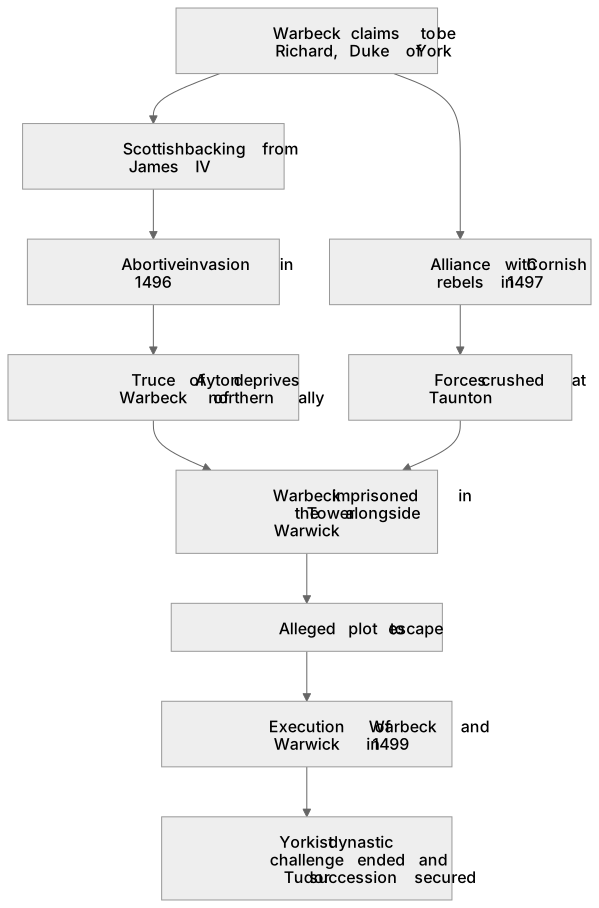
Put the events in order
Put these events in the order they happened, earliest first.
- 1. Scottish-backed invasion by Warbeck fails
- 2. Warbeck and Warwick executed
- 3. Warbeck allies with Cornish rebels, crushed at Taunton
Key words
Say what each word means before you turn the card.
Rebellions and uprisings
Try answering aloud or in your head before turning the card.
Consolidation of power
Try answering aloud or in your head before turning the card.
Dynastic security
Try answering aloud or in your head before turning the card.
Foreign diplomacy
Try answering aloud or in your head before turning the card.
See every definition
- Rebellions and uprisings
- Warbeck capitalised on domestic unrest by aligning with the Cornish rebels in 1497, but his forces were crushed at Taunton.
- Consolidation of power
- The executions of Warbeck and Warwick decisively ended the Yorkist dynastic challenge and secured the Tudor succession.
- Dynastic security
- Executing Warwick, the last legitimate male Yorkist claimant, removed a permanent figurehead for Yorkist conspiracies.
- Foreign diplomacy
- Depriving Warbeck of his northern ally through the Truce of Ayton formed part of a strategy of using diplomacy to isolate pretenders.
Label the diagram
Some boxes have lost their names. Pick the right name for each number.
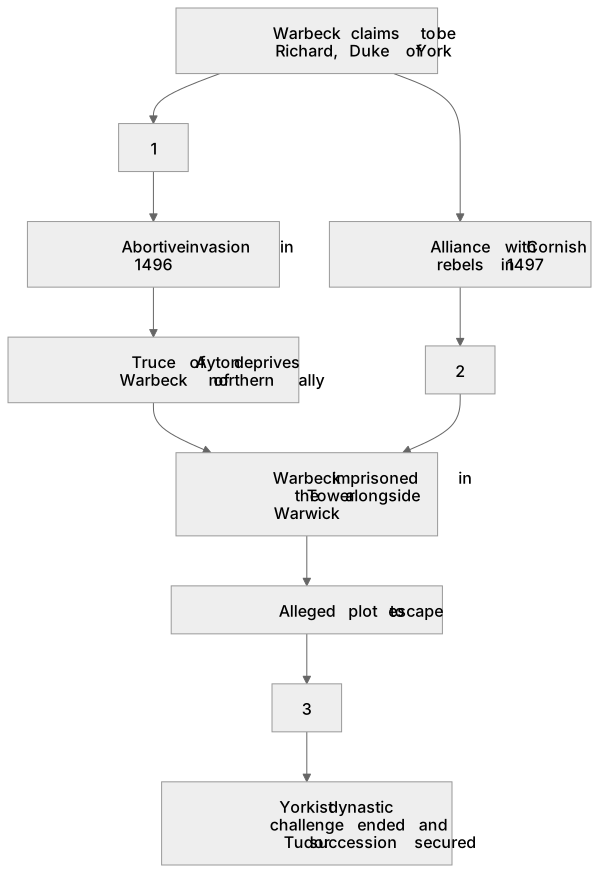
1Box 1
2Box 2
3Box 3
There is more to this lesson
The full lesson goes on to check your understanding and help you earn the marks. Create a free account to carry on, with your progress saved.
A week of Premium from your first lesson · Then the free plan continues · No card, no charge
Test your understanding of 2B The Wars of the Roses, 1450–1499 – The end of the Yorkist Dynasty, 1486–1499 (A-level only): The end of the Yorkist challenge: defeat of Warbeck and his Scottish and Cornish allies; the execution of Warbeck and Warwick
Active recall beats re-reading. Take an instant quiz now to test what you’ve learned and lock it into long-term memory.
A week of Premium from your first lesson · Then the free plan continues · No card, no charge