AQA · A-Level · History
Course version: 7042 · Version from Sept 2017
English society and politics in 1450: the weakness of Henry VI’s rule;…
Full specification wording
2B The Wars of the Roses, 1450–1499 – The origins of conflict, 1450–1459: English society and politics in 1450: the weakness of Henry VI’s rule; baronial factions; Cade’s rebellion; the loss of Normandy
In 1450, English society and politics were destabilised by the profound weakness of Henry VI’s rule.
Checked against the AQA 7042 specification (opens in a new tab) on .
- Point 1 of 4
- 4 key terms
Study notes
From the checked teaching notes for this specification point.
The idea
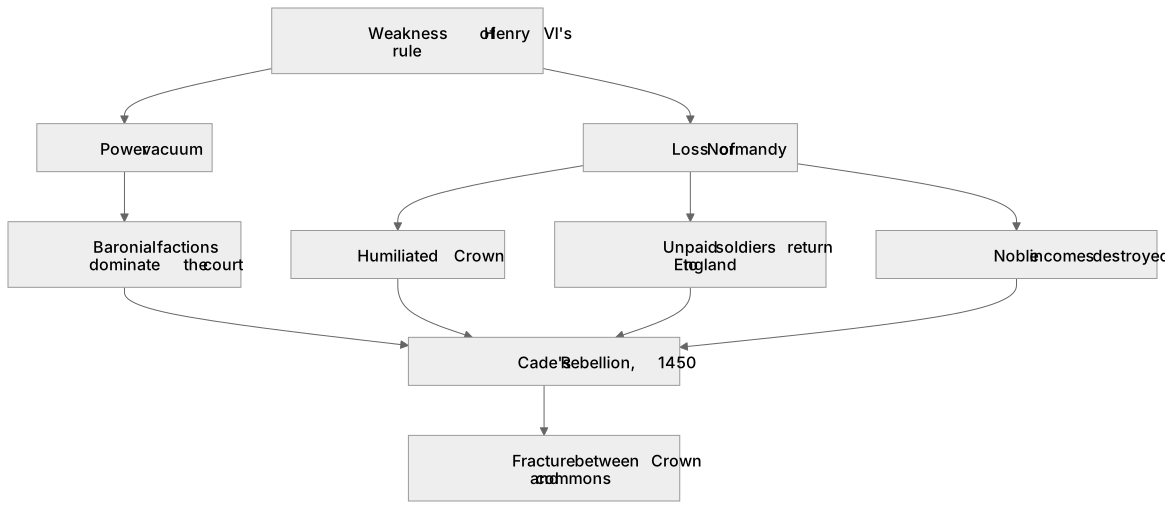
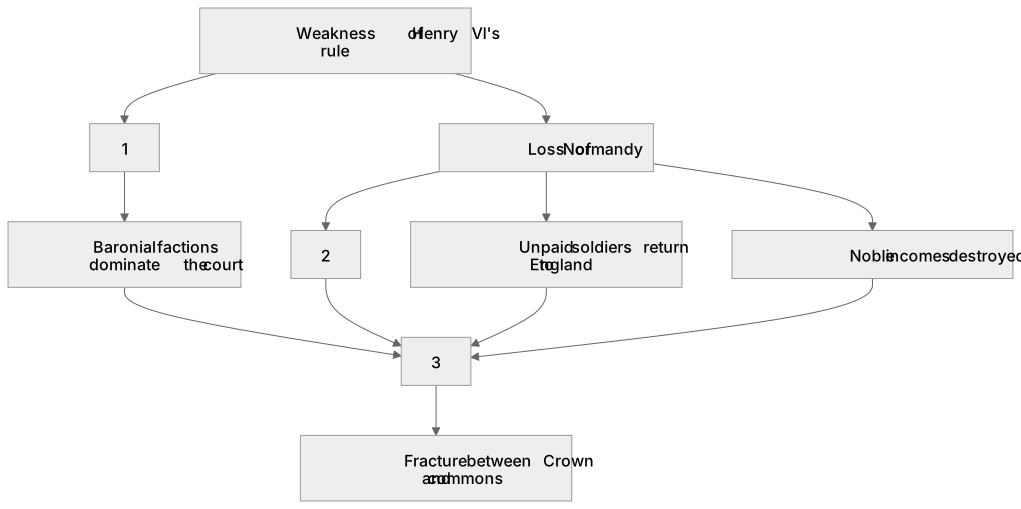
In 1450, English society and politics were destabilised by the profound weakness of Henry VI’s rule. His inability to govern effectively created a power vacuum, allowing intense baronial factions to dominate the court, notably the rivalry between the Beauforts and Richard of York. This domestic crisis was exacerbated by the disastrous loss of Normandy, which humiliated the Crown, flooded England with unpaid soldiers, and destroyed noble incomes. These compounding failures culminated in Cade’s Rebellion (1450), a major popular uprising in Kent protesting against corrupt royal advisors, heavy taxation, and the mismanagement of the French campaigns, highlighting the deep fracture between the Crown and the commons.
What earns the marks
- Assess the extent to which Henry VI's personal inadequacies, such as his extreme passivity and reliance on favourites like Suffolk, undermined royal authority.
- Evaluate how the loss of Normandy in 1450 acted as a catalyst for domestic unrest, focusing on the economic impact and the return of defeated, unpaid garrisons.
- Analyse the composition and demands of Cade's Rebellion, noting that it included gentry and artisans protesting against corruption rather than just a peasant revolt.
- Explain the role of baronial factions, particularly how the over-mighty nobility exploited the king's weakness to pursue private feuds and control patronage.
Common mistakes and how to put them right
Confusing Cade's Rebellion with the Peasants' Revolt of 1381.
Put it right: Specify that Cade's Rebellion occurred in 1450 and involved significant numbers of the middling sort and gentry, focusing on political corruption rather than serfdom.
Assuming Henry VI was a tyrant whose oppressive rule caused the conflict.
Put it right: Emphasise that Henry VI's primary flaw was his extreme passivity, piety, and inability to control his nobles, leading to a vacuum of power.
Treating the loss of Normandy as purely a foreign policy issue.
Put it right: Link the loss of Normandy directly to domestic politics, showing how it bankrupted the Crown and discredited Henry's court favourites.
Exam tips
- When discussing the origins of the Wars of the Roses, explicitly link the loss of French territories to the rise of domestic factionalism.
- Use the manifesto of Cade's rebels to demonstrate contemporary grievances against the Duke of Suffolk and the king's 'evil councillors'.
- Avoid narrative descriptions of the battles in France; focus instead on the political and economic fallout of the defeat within England.
Try the lesson
The start of the 2B The Wars of the Roses, 1450–1499 – The origins of conflict, 1450–1459: English society and politics in 1450: the weakness of Henry VI’s rule; baronial factions; Cade’s rebellion; the loss of Normandy lesson, made from checked teaching notes for this specification point.
Have a go first
What was a primary grievance of the rebels during Cade's Rebellion in 1450?
Listen
In 1450, English society and politics were destabilised by the profound weakness of Henry VI’s rule. His inability to govern effectively created a power vacuum, allowing intense baronial factions to dominate the court, notably the rivalry between the Beauforts and Richard of York. This domestic crisis was exacerbated by the disastrous loss of Normandy, which humiliated the Crown, flooded England with unpaid soldiers, and destroyed noble incomes. These compounding failures culminated in Cade’s Rebellion (1450), a major popular uprising in Kent protesting against corrupt royal advisors, heavy taxation, and the mismanagement of the French campaigns, highlighting the deep fracture between the Crown and the commons. A strong answer earns marks for these points. Assess the extent to which Henry VI's personal inadequacies, such as his extreme passivity and reliance on favourites like Suffolk, undermined royal authority. Evaluate how the loss of Normandy in 1450 acted as a catalyst for domestic unrest, focusing on the economic impact and the return of defeated, unpaid garrisons. Analyse the composition and demands of Cade's Rebellion, noting that it included gentry and artisans protesting against corruption rather than just a peasant revolt. Explain the role of baronial factions, particularly how the over-mighty nobility exploited the king's weakness to pursue private feuds and control patronage. A common slip: Confusing Cade's Rebellion with the Peasants' Revolt of 1381. Instead, Specify that Cade's Rebellion occurred in 1450 and involved significant numbers of the middling sort and gentry, focusing on political corruption rather than serfdom. Exam tip: When discussing the origins of the Wars of the Roses, explicitly link the loss of French territories to the rise of domestic factionalism.
See it
Key words
Say what each word means before you turn the card.
Royal authority and the monarchy
Try answering aloud or in your head before turning the card.
Conflict and rebellion
Try answering aloud or in your head before turning the card.
Foreign policy and its domestic impact
Try answering aloud or in your head before turning the card.
Social hierarchy and the nobility
Try answering aloud or in your head before turning the card.
See every definition
- Royal authority and the monarchy
- Undermined by Henry VI's extreme passivity and reliance on favourites, which created a vacuum of power.
- Conflict and rebellion
- Cade's Rebellion was a major popular uprising in Kent protesting against corrupt royal advisors, heavy taxation and the mismanagement of the French campaigns.
- Foreign policy and its domestic impact
- The disastrous loss of Normandy humiliated the Crown, flooded England with unpaid soldiers and destroyed noble incomes.
- Social hierarchy and the nobility
- Intense baronial factions dominated the court, with the over-mighty nobility exploiting the king's weakness to pursue private feuds and control patronage.
Label the diagram
Some boxes have lost their names. Pick the right name for each number.
1Box 1
2Box 2
3Box 3
There is more to this lesson
The full lesson goes on to check your understanding and help you earn the marks. Create a free account to carry on, with your progress saved.
A week of Premium from your first lesson · Then the free plan continues · No card, no charge
Test your understanding of 2B The Wars of the Roses, 1450–1499 – The origins of conflict, 1450–1459: English society and politics in 1450: the weakness of Henry VI’s rule; baronial factions; Cade’s rebellion; the loss of Normandy
Active recall beats re-reading. Take an instant quiz now to test what you’ve learned and lock it into long-term memory.
A week of Premium from your first lesson · Then the free plan continues · No card, no charge