AQA · A-Level · History
Course version: 7042 · Version from Sept 2017
The impact on English politics of the emerging power and influence of…
Full specification wording
2B The Wars of the Roses, 1450–1499 – The origins of conflict, 1450–1459: The impact on English politics of the emerging power and influence of Richard of York
The emerging power and influence of Richard, Duke of York, profoundly impacted English politics by challenging the established court faction.
Checked against the AQA 7042 specification (opens in a new tab) on .
- Point 2 of 4
- 4 key terms
Study notes
From the checked teaching notes for this specification point.
The idea
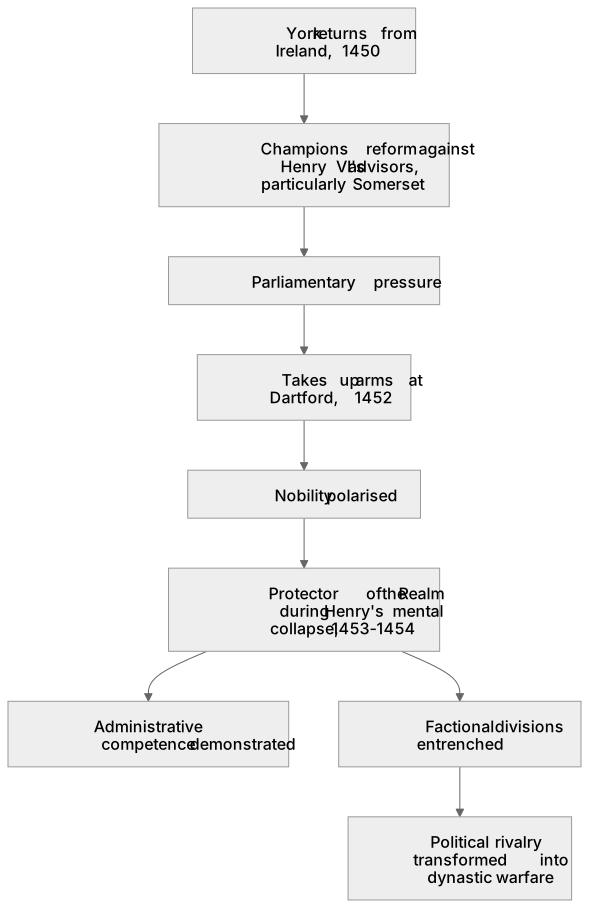
The emerging power and influence of Richard, Duke of York, profoundly impacted English politics by challenging the established court faction. As the wealthiest magnate, York’s return from Ireland in 1450 positioned him as the champion of reform against the corrupt advisors of Henry VI, particularly Somerset. York’s attempts to assert his influence, initially through parliamentary pressure and later by taking up arms at Dartford in 1452, polarised the nobility. His appointment as Protector of the Realm during Henry’s mental collapse (1453-1454) demonstrated his administrative competence but entrenched factional divisions. Ultimately, York’s growing ambition and the court's resistance transformed political rivalry into dynastic warfare.
What earns the marks
- Analyse York's dual role as a genuine reformer seeking better government and an ambitious magnate pursuing personal power and dynastic claims.
- Evaluate the significance of York's rivalry with the Duke of Somerset in polarising the English nobility and destabilising the government.
- Assess the impact of York's First Protectorate (1454) in demonstrating his capability to govern while simultaneously alienating Queen Margaret of Anjou.
- Examine how York's use of armed force, such as at Dartford in 1452 and St Albans in 1455, escalated political disputes into military conflict.
Common mistakes and how to put them right
Claiming Richard of York aimed to usurp the throne from the very beginning in 1450.
Put it right: Clarify that York initially sought to reform the government and secure his position as chief councillor, only claiming the throne much later in 1460.
Viewing the nobility as universally supporting York against a universally unpopular king.
Put it right: Recognise that York struggled to gain widespread noble support initially, as many peers remained loyal to the anointed king and feared York's use of armed force.
Ignoring York's time in Ireland.
Put it right: Acknowledge that York's exile to Ireland was a deliberate move by the court to marginalise him, making his uninvited return in 1450 a significant political shock.
Exam tips
- Contrast York's stated aims in his public bills and manifestos with his actual actions to evaluate his true motivations.
- Discuss the role of Margaret of Anjou as a political force who actively opposed York's influence to protect her son's inheritance.
- Use the events of the Dartford uprising (1452) to illustrate York's early failure to mobilise the nobility against the king.
Try the lesson
The start of the 2B The Wars of the Roses, 1450–1499 – The origins of conflict, 1450–1459: The impact on English politics of the emerging power and influence of Richard of York lesson, made from checked teaching notes for this specification point.
Have a go first
What was Richard of York's primary stated aim when he returned from Ireland to England in 1450?
Listen
The emerging power and influence of Richard, Duke of York, profoundly impacted English politics by challenging the established court faction. As the wealthiest magnate, York’s return from Ireland in 1450 positioned him as the champion of reform against the corrupt advisors of Henry VI, particularly Somerset. York’s attempts to assert his influence, initially through parliamentary pressure and later by taking up arms at Dartford in 1452, polarised the nobility. His appointment as Protector of the Realm during Henry’s mental collapse (1453-1454) demonstrated his administrative competence but entrenched factional divisions. Ultimately, York’s growing ambition and the court's resistance transformed political rivalry into dynastic warfare. A strong answer earns marks for these points. Analyse York's dual role as a genuine reformer seeking better government and an ambitious magnate pursuing personal power and dynastic claims. Evaluate the significance of York's rivalry with the Duke of Somerset in polarising the English nobility and destabilising the government. Assess the impact of York's First Protectorate (1454) in demonstrating his capability to govern while simultaneously alienating Queen Margaret of Anjou. Examine how York's use of armed force, such as at Dartford in 1452 and St Albans in 1455, escalated political disputes into military conflict. A common slip: Claiming Richard of York aimed to usurp the throne from the very beginning in 1450. Instead, Clarify that York initially sought to reform the government and secure his position as chief councillor, only claiming the throne much later in 1460. Exam tip: Contrast York's stated aims in his public bills and manifestos with his actual actions to evaluate his true motivations.
See it
Put the events in order
Put these events in the order they happened, earliest first.
- 1. York takes up arms at Dartford
- 2. Richard of York returns uninvited from Ireland
- 3. York claims the throne
- 4. York serves as Protector of the Realm
- 5. York uses armed force at St Albans
Key words
Say what each word means before you turn the card.
Power and ambition
Try answering aloud or in your head before turning the card.
Factionalism and rivalry
Try answering aloud or in your head before turning the card.
The role of the nobility
Try answering aloud or in your head before turning the card.
Legitimacy and succession
Try answering aloud or in your head before turning the card.
See every definition
- Power and ambition
- York's growing ambition, alongside the court's resistance, transformed political rivalry into dynastic warfare.
- Factionalism and rivalry
- York's appointment as Protector entrenched factional divisions, while his rivalry with Somerset polarised the English nobility and destabilised the government.
- The role of the nobility
- York's attempts to assert his influence polarised the nobility, and his use of armed force escalated political disputes into military conflict.
- Legitimacy and succession
- York initially sought to reform the government and secure his position as chief councillor, only claiming the throne much later in 1460.
Label the diagram
Some boxes have lost their names. Pick the right name for each number.
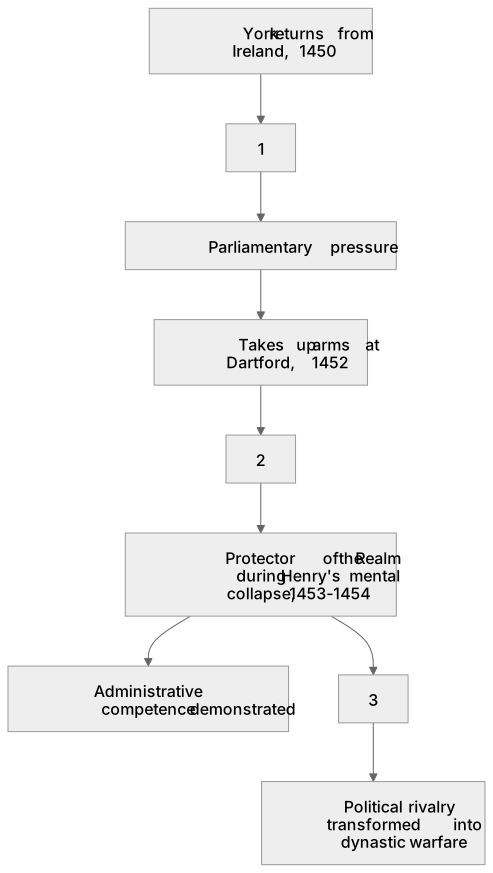
1Box 1
2Box 2
3Box 3
There is more to this lesson
The full lesson goes on to check your understanding and help you earn the marks. Create a free account to carry on, with your progress saved.
A week of Premium from your first lesson · Then the free plan continues · No card, no charge
Test your understanding of 2B The Wars of the Roses, 1450–1499 – The origins of conflict, 1450–1459: The impact on English politics of the emerging power and influence of Richard of York
Active recall beats re-reading. Take an instant quiz now to test what you’ve learned and lock it into long-term memory.
A week of Premium from your first lesson · Then the free plan continues · No card, no charge