AQA · A-Level · History
Course version: 7042 · Version from Sept 2017
The reign of Edward IV, 1471–1483 (A-level only): Change and continuity in…
Full specification wording
2B The Wars of the Roses, 1450–1499 – 'The Sun in Splendour': the reign of Edward IV, 1471–1483 (A-level only): Change and continuity in English society during a decade of peace: trade and the economy, social mobility, the regions
During the 'decade of peace' in the 1470s, English society experienced significant continuity alongside gradual change.
Checked against the AQA 7042 specification (opens in a new tab) on .
- Point 3 of 4
- 4 key terms
Study notes
From the checked teaching notes for this specification point.
The idea
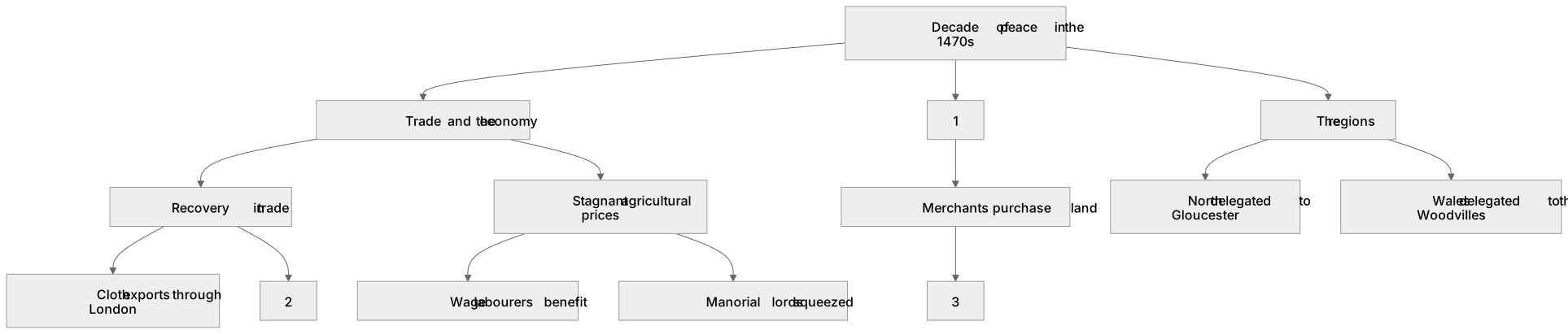
During the 'decade of peace' in the 1470s, English society experienced significant continuity alongside gradual change. The economy saw a marked recovery in trade, particularly cloth exports through London, bolstered by commercial treaties like the 1474 agreement with the Hanseatic League and the 1475 Treaty of Picquigny. Meanwhile, agricultural prices remained stagnant, benefiting wage labourers but squeezing manorial lords. Social mobility persisted as wealthy merchants used their economic power to purchase land and integrate into the gentry. Regionally, Edward IV established distinct power bases, delegating the North to Gloucester and Wales to the Woodvilles, reflecting the interplay between regional identities and royal control.
What earns the marks
- Assess the extent of economic recovery in the 1470s, noting the growth of the cloth trade, commercial treaties, and the dominance of London merchants.
- Evaluate the impact of stagnant agricultural prices on different social groups, such as the rising prosperity of wage labourers versus the declining incomes of traditional landlords.
- Analyse the mechanisms of social mobility, specifically how the acquisition of land allowed merchants and lawyers to enter the ranks of the gentry.
- Contrast the regional experiences of the decade, highlighting how Edward IV managed different areas through delegated authority to powerful magnates.
Common mistakes and how to put them right
Incorrectly identifying the 'decade of peace' as the 1460s.
Put it right: Ensure all examples and analysis focus on the 1470s and early 1480s, following Edward IV's restoration in 1471.
Treating the English economy as uniformly prosperous or depressed.
Put it right: Differentiate between the booming urban cloth trade, aided by royal treaties, and the stagnant rural agrarian economy.
Overstating the rigidity of the social hierarchy.
Put it right: Acknowledge that social mobility was possible and frequently achieved through marriage, legal careers, and mercantile wealth.
Exam tips
- Use specific examples of economic policy, such as the 1474 Hanseatic League treaty, to illustrate the recovery of trade during the decade of peace.
- When discussing the regions, explicitly link the economic and administrative management of areas like the North and Wales to Edward's reliance on regional magnates.
- Evaluate 'change and continuity' by weighing the emergence of a wealthy merchant class against the enduring power of the traditional nobility in the localities.
Try the lesson
The start of the 2B The Wars of the Roses, 1450–1499 – 'The Sun in Splendour': the reign of Edward IV, 1471–1483 (A-level only): Change and continuity in English society during a decade of peace: trade and the economy, social mobility, the regions lesson, made from checked teaching notes for this specification point.
Have a go first
Which industry remained the most significant driver of the English export economy during the relatively peaceful years of Edward IV's reign?
Listen
During the 'decade of peace' in the 1470s, English society experienced significant continuity alongside gradual change. The economy saw a marked recovery in trade, particularly cloth exports through London, bolstered by commercial treaties like the 1474 agreement with the Hanseatic League and the 1475 Treaty of Picquigny. Meanwhile, agricultural prices remained stagnant, benefiting wage labourers but squeezing manorial lords. Social mobility persisted as wealthy merchants used their economic power to purchase land and integrate into the gentry. Regionally, Edward IV established distinct power bases, delegating the North to Gloucester and Wales to the Woodvilles, reflecting the interplay between regional identities and royal control. A strong answer earns marks for these points. Assess the extent of economic recovery in the 1470s, noting the growth of the cloth trade, commercial treaties, and the dominance of London merchants. Evaluate the impact of stagnant agricultural prices on different social groups, such as the rising prosperity of wage labourers versus the declining incomes of traditional landlords. Analyse the mechanisms of social mobility, specifically how the acquisition of land allowed merchants and lawyers to enter the ranks of the gentry. Contrast the regional experiences of the decade, highlighting how Edward IV managed different areas through delegated authority to powerful magnates. A common slip: Incorrectly identifying the 'decade of peace' as the 1460s. Instead, Ensure all examples and analysis focus on the 1470s and early 1480s, following Edward IV's restoration in 1471. Exam tip: Use specific examples of economic policy, such as the 1474 Hanseatic League treaty, to illustrate the recovery of trade during the decade of peace.
See it

Key words
Say what each word means before you turn the card.
Change and continuity
Try answering aloud or in your head before turning the card.
Economic development
Try answering aloud or in your head before turning the card.
Social hierarchy
Try answering aloud or in your head before turning the card.
Regionalism
Try answering aloud or in your head before turning the card.
See every definition
- Change and continuity
- The significant continuity alongside gradual change that English society experienced during the decade of peace in the 1470s.
- Economic development
- A marked recovery in trade, particularly cloth exports through London, bolstered by commercial treaties, while agricultural prices remained stagnant.
- Social hierarchy
- A structure in which social mobility persisted as wealthy merchants used their economic power to purchase land and integrate into the gentry.
- Regionalism
- The interplay between regional identities and royal control, reflected in Edward IV establishing distinct power bases by delegating the North to Gloucester and Wales to the Woodvilles.
Label the diagram
Some boxes have lost their names. Pick the right name for each number.
1Box 1
2Box 2
3Box 3
There is more to this lesson
The full lesson goes on to check your understanding and help you earn the marks. Create a free account to carry on, with your progress saved.
A week of Premium from your first lesson · Then the free plan continues · No card, no charge
Test your understanding of 2B The Wars of the Roses, 1450–1499 – 'The Sun in Splendour': the reign of Edward IV, 1471–1483 (A-level only): Change and continuity in English society during a decade of peace: trade and the economy, social mobility, the regions
Active recall beats re-reading. Take an instant quiz now to test what you’ve learned and lock it into long-term memory.
A week of Premium from your first lesson · Then the free plan continues · No card, no charge